

1 Ducat – Kingdom of Bohemia
Context
Year: 1714
Country: Bohemia
Issuer: Kingdom of Bohemia
Ruler: Charles VI
Currency:
(1520—1754)
Demonetized: Yes
Material
References
KM: #Click to copy to clipboard671
Numista: #316009
Value
Bullion value: $558.87
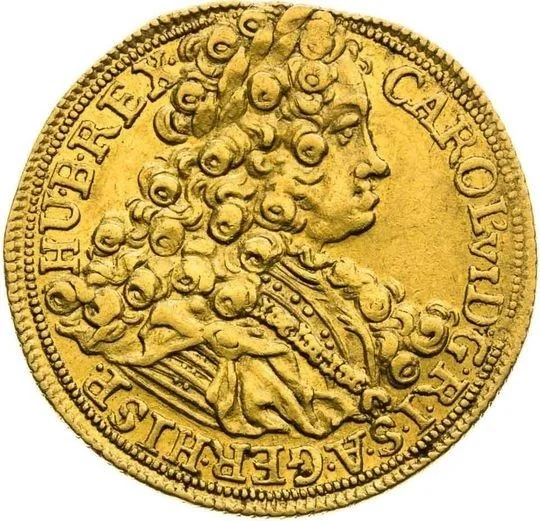
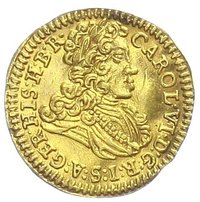
Obverse
Description:
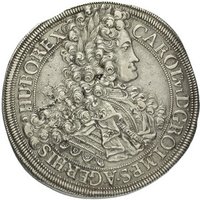
Karl VI, laureate bust right.
Inscription:
CAROL VI D G R I S A GER HISP HU B REX
Script: Latin
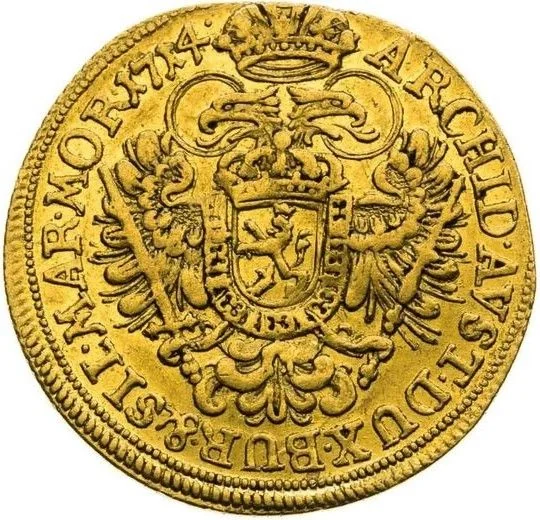
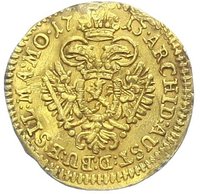
Reverse
Description:
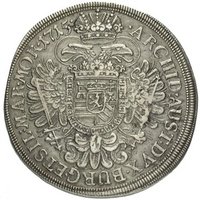
Double-headed crowned eagle.
Inscription:
ARCHID AVST DUX BUR & SIL MAR MOR 1714
Script: Latin
Edge
Mints
| Name | Mark |
|---|---|
| Prague | — |
Mintings
| Year | Mint Mark | Mintage | Quality | Collection |
|---|---|---|---|---|
| 1714 | — | — |
Historical background
In 1714, the Kingdom of Bohemia, a core hereditary land of the Habsburg Monarchy, operated within a complex and strained monetary system. The primary currency was the silver Konventionstaler, a legacy of the 1692 imperial convention that standardized coinage across much of the Holy Roman Empire. However, the reality was one of monetary duality and confusion. Alongside these "convention coins," a parallel system of lower-quality Landmünze (regional coinage) circulated for daily transactions, its value often fluctuating against the standard. This situation was further complicated by the widespread circulation of older, debased coins and foreign currency, particularly from neighboring German states, creating a chaotic marketplace where exchange rates were local and uncertain.
The root of this instability lay in the financial exhaustion from decades of war, most recently the War of the Spanish Succession (1701-1714). To fund these conflicts, the Habsburg state, including Bohemia, had repeatedly resorted to debasement—reducing the precious metal content in coins while maintaining their face value. This practice, while providing short-term revenue, led to inflation, a loss of public trust in the currency, and Gresham's Law in action, where "bad money drives out good." People hoarded the older, full-weight coins, worsening the scarcity of reliable specie. The Bohemian estates and the Vienna court were acutely aware of the economic drag this caused, hindering trade and tax collection.
Consequently, the year 1714 fell within a period of tentative stabilization and reform efforts. With the war ending, the Habsburg authorities, under Emperor Charles VI, began to prioritize monetary order. The goal was to reassert the standard of the Konventionstaler and gradually reduce the chaotic variety of circulating mediums. While a comprehensive resolution would take more time—culminating later in the more robust Conventionsfuß of 1753—the post-1714 period marked the beginning of a concerted, if challenging, drive to unify and strengthen the currency system across the Habsburg domains, with Bohemia's economy central to this project.
The root of this instability lay in the financial exhaustion from decades of war, most recently the War of the Spanish Succession (1701-1714). To fund these conflicts, the Habsburg state, including Bohemia, had repeatedly resorted to debasement—reducing the precious metal content in coins while maintaining their face value. This practice, while providing short-term revenue, led to inflation, a loss of public trust in the currency, and Gresham's Law in action, where "bad money drives out good." People hoarded the older, full-weight coins, worsening the scarcity of reliable specie. The Bohemian estates and the Vienna court were acutely aware of the economic drag this caused, hindering trade and tax collection.
Consequently, the year 1714 fell within a period of tentative stabilization and reform efforts. With the war ending, the Habsburg authorities, under Emperor Charles VI, began to prioritize monetary order. The goal was to reassert the standard of the Konventionstaler and gradually reduce the chaotic variety of circulating mediums. While a comprehensive resolution would take more time—culminating later in the more robust Conventionsfuß of 1753—the post-1714 period marked the beginning of a concerted, if challenging, drive to unify and strengthen the currency system across the Habsburg domains, with Bohemia's economy central to this project.
✨ Legendary