

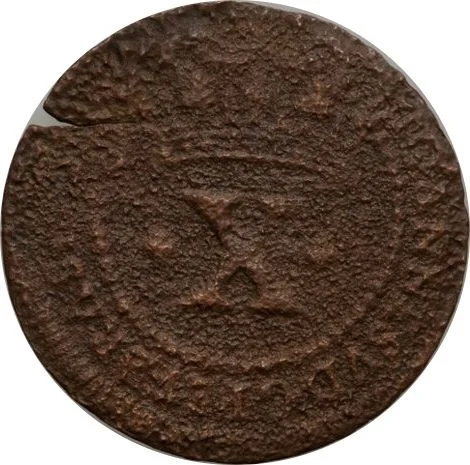
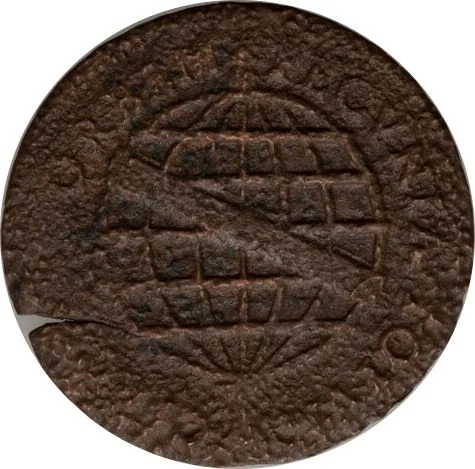

Obverse
Description:
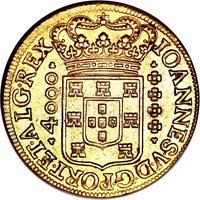
Crowned pearl circle encircles center value X.
Inscription:
IOANNES.V.D.G.P.ET.BRASIL.REX
Script: Latin
Reverse
Edge
Plain
Categories
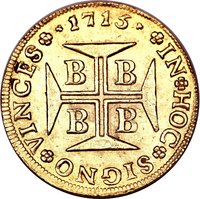
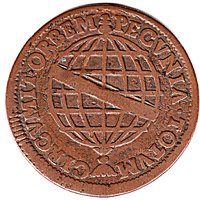
| Symbol> Armillary sphere |
| Symbol> Crown |
Mints
| Name | Mark |
|---|---|
| Imprensa Nacional - Casa da Moeda | — |
Mintings
| Year | Mint Mark | Mintage | Quality | Collection |
|---|---|---|---|---|
| 1714 | — | — |
Historical background
In 1714, Brazil's currency situation was a complex and unstable system, largely a legacy of its colonial status under Portugal. The primary circulating medium was a chaotic mix of physical commodities, notably sugar and tobacco, which were officially designated as legal tender for local transactions and tax payments. Alongside these, there was a severe shortage of official Portuguese coinage (the real), leading to widespread use of irregularly cut and often debased Spanish-American silver coins, known as macacos or patacas, which circulated at values determined by local weight and purity rather than face value.
This monetary disorder was exacerbated by Portugal's mercantilist policies, which drained gold and silver to the metropolis. Although significant gold discoveries in Minas Gerais were beginning to transform the economy, by 1714 the gold boom was still in its early stages and had not yet been monetized into a stable circulating currency. The Crown's response to the chaos was primarily reactive; earlier attempts to establish a mint in Bahia had failed, and it would not be until 1694 that the Casa da Moeda do Brasil began operations in Salvador, later moving to Rio de Janeiro in 1698 due to the gold strikes. However, its output in these early years was insufficient to meet the colony's needs.
Consequently, the Brazilian economy in 1714 functioned with a fragile and inefficient monetary base, hindering commerce and creating opportunities for fraud. Regional differences in the value of the patchwork of currencies further complicated internal trade. The situation underscored the growing disconnect between a booming colonial economy and an archaic financial system, a tension that would only begin to be addressed with the increasing formal minting of gold coins later in the 1710s and 1720s as the gold rush accelerated.
This monetary disorder was exacerbated by Portugal's mercantilist policies, which drained gold and silver to the metropolis. Although significant gold discoveries in Minas Gerais were beginning to transform the economy, by 1714 the gold boom was still in its early stages and had not yet been monetized into a stable circulating currency. The Crown's response to the chaos was primarily reactive; earlier attempts to establish a mint in Bahia had failed, and it would not be until 1694 that the Casa da Moeda do Brasil began operations in Salvador, later moving to Rio de Janeiro in 1698 due to the gold strikes. However, its output in these early years was insufficient to meet the colony's needs.
Consequently, the Brazilian economy in 1714 functioned with a fragile and inefficient monetary base, hindering commerce and creating opportunities for fraud. Regional differences in the value of the patchwork of currencies further complicated internal trade. The situation underscored the growing disconnect between a booming colonial economy and an archaic financial system, a tension that would only begin to be addressed with the increasing formal minting of gold coins later in the 1710s and 1720s as the gold rush accelerated.

✨ Legendary