

1 thaler – Austrian Empire
Add to wishlist
Austria
Context
Year: 1753
Country: Austria
Issuer: Austrian Empire
Ruler: Maria Theresa
Currency:
(1520—1754)
Demonetized: Yes
Material
References
KM: #
Numista: #315552
Value
Bullion value: $62.94
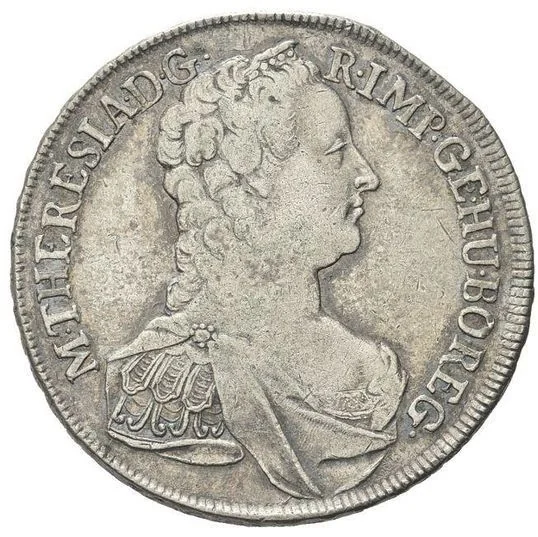
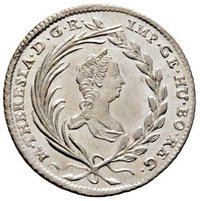
Obverse
Description:
Armored profile right
Inscription:
M • THERESIA • D: G • R • IMP • GE • HU • BO • REG •
Script: Latin
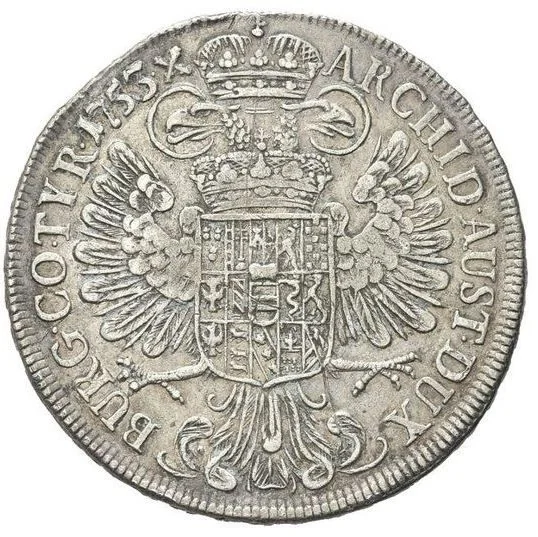
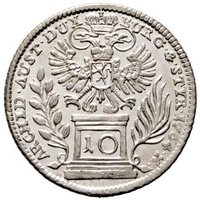
Reverse
Description:
Imperial double eagle, crowned, bearing a crowned shield on its breast.
Inscription:
ARCHID • AUST • DUX • BURG • CO • TYR • 1753
Script: Latin
Edge
Mints
| Name | Mark |
|---|---|
| Münze Österreich | — |
Mintings
| Year | Mint Mark | Mintage | Quality | Collection |
|---|---|---|---|---|
| 1753 | — | — |
Historical background
In 1753, the Habsburg Monarchy, under Empress Maria Theresa, enacted a pivotal monetary reform to address a century of severe currency instability. The period leading up to this was defined by the financial exhaustion of continuous warfare, particularly the War of Austrian Succession (1740-1748). To fund these conflicts, the state had repeatedly debased its coinage, notably the small-denomination Kreuzer, by reducing its silver content. This led to a proliferation of disparate and unreliable coins across the empire's many lands, causing rampant inflation, crippling uncertainty in trade, and a deep loss of public trust in the currency.
The solution was the imperial patent of September 1753, which established a new, standardized monetary system based on the Conventionsfuß (Convention Standard). This standard fixed the minting of 20 Gulden (florins) from one Cologne mark of fine silver, creating a stable and universally accepted benchmark. The reform introduced two key, high-quality silver coins: the Conventionsthaler (also called the Maria Theresa Thaler) and the Conventionsgulden. Crucially, these coins were to be produced with uniform weight and fineness across all imperial mints, ensuring their acceptance throughout the diverse territories of the empire and beyond.
The 1753 reform was a landmark success in state-building and economic modernization. It restored monetary order, facilitated domestic and international commerce, and strengthened the central authority of the Habsburg state by providing a reliable fiscal foundation. The iconic Maria Theresa Thaler, with its fixed design, went on to become one of the most famous and widely circulated trade coins in world history, a testament to the durability and credibility established by this critical reform.
The solution was the imperial patent of September 1753, which established a new, standardized monetary system based on the Conventionsfuß (Convention Standard). This standard fixed the minting of 20 Gulden (florins) from one Cologne mark of fine silver, creating a stable and universally accepted benchmark. The reform introduced two key, high-quality silver coins: the Conventionsthaler (also called the Maria Theresa Thaler) and the Conventionsgulden. Crucially, these coins were to be produced with uniform weight and fineness across all imperial mints, ensuring their acceptance throughout the diverse territories of the empire and beyond.
The 1753 reform was a landmark success in state-building and economic modernization. It restored monetary order, facilitated domestic and international commerce, and strengthened the central authority of the Habsburg state by providing a reliable fiscal foundation. The iconic Maria Theresa Thaler, with its fixed design, went on to become one of the most famous and widely circulated trade coins in world history, a testament to the durability and credibility established by this critical reform.
✨ Legendary