


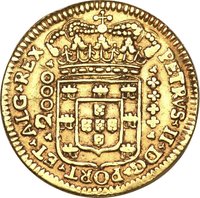
Obverse
Description:
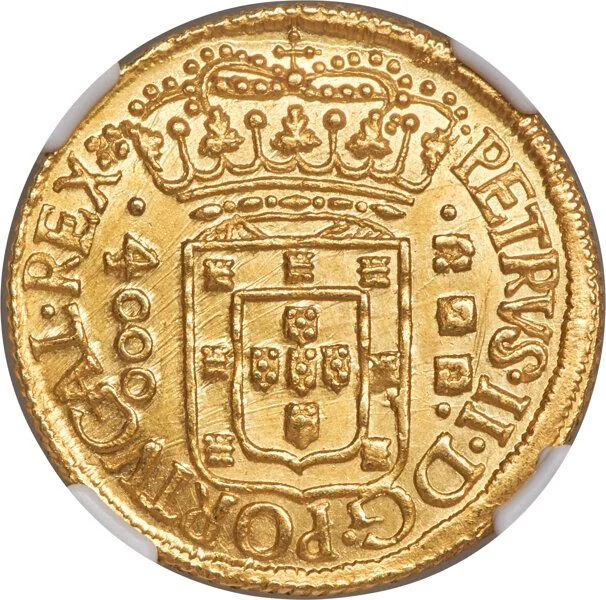
Portuguese arms, 4000 value, three flowers between dots.
Inscription:
PETRVS. II. D. G. PORTVGAL. REX.
4000
4000
Script: Latin
Engraver: Amaro de Barros
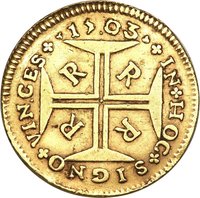
Reverse
Description:
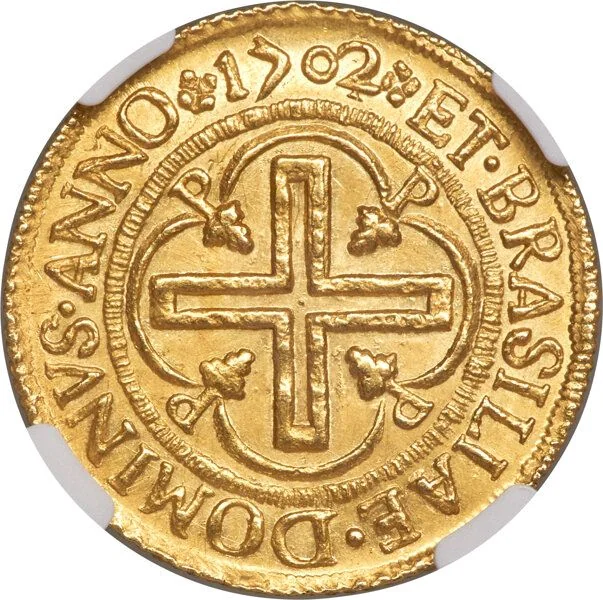
Saint George's cross with flanking ornaments, four diagonal P's, and a date.
Inscription:
ET. BRASILIAE. DOMINVS. ANNO (year)
PPPP
PPPP
Script: Latin
Engraver: Amaro de Barros
Edge
Reeded.
Categories
| Symbol> Cross |
| Symbols> Coat of Arms |
Mints
| Name | Mark |
|---|---|
| Casa da Moeda de Pernambuco | — |
Mintings
| Year | Mint Mark | Mintage | Quality | Collection |
|---|---|---|---|---|
| 1702 | PPPP | 2,027 |
Historical background
In 1702, Brazil was a Portuguese colony in the midst of a transformative economic boom driven by the discovery of gold in the interior region of Minas Gerais at the end of the 1690s. This event triggered a massive internal migration and a shift in the colony's economic center of gravity away from the sugar-producing northeast. However, the official currency system was ill-equipped for this new reality. Portugal maintained a mercantilist policy, meaning Brazil's primary function was to supply raw wealth (like gold and sugar) to the mother country, not to develop a sophisticated internal economy. Consequently, there was a chronic shortage of official minted coinage in circulation within the colony itself.
The daily economy in Brazil therefore operated on a complex and cumbersome system of multiple concurrent currencies. The most important was the réis (plural réis), a Portuguese unit of account, but actual physical coins were scarce. Trade relied heavily on commodity money, most notably sugar, tobacco, and blocks of hard, compressed snuff tobacco called fumo de rolo, which were legally recognized as currency for local transactions and even tax payments. Additionally, a wide variety of foreign coins, especially Spanish pesos (often called "pieces of eight") from Peru and Mexico, circulated widely due to Portugal's political union with Spain from 1580 to 1640 and ongoing contraband trade. This created a chaotic monetary environment where exchange rates between commodities, foreign coins, and the official réis account were unstable and locally negotiated.
Recognizing the disorder and the urgent need to facilitate the collection of the royal fifth (o quinto) on the newfound gold, the Portuguese Crown took decisive action. In 1694, it had already established the first mint in Brazil, the Casa da Moeda, in Salvador, Bahia, but it was relocated to Rio de Janeiro in 1699 to be closer to the gold fields. By 1702, this mint was beginning to produce the first official gold coins struck in the Americas: the moedas de ouro. The initial series included coins of 1,000, 2,000, and 4,000 réis, directly converting mined gold into regulated currency. This marked the beginning of a slow and challenging process to impose monetary order and solidify royal control over the wealth that would define 18th-century Brazil.
The daily economy in Brazil therefore operated on a complex and cumbersome system of multiple concurrent currencies. The most important was the réis (plural réis), a Portuguese unit of account, but actual physical coins were scarce. Trade relied heavily on commodity money, most notably sugar, tobacco, and blocks of hard, compressed snuff tobacco called fumo de rolo, which were legally recognized as currency for local transactions and even tax payments. Additionally, a wide variety of foreign coins, especially Spanish pesos (often called "pieces of eight") from Peru and Mexico, circulated widely due to Portugal's political union with Spain from 1580 to 1640 and ongoing contraband trade. This created a chaotic monetary environment where exchange rates between commodities, foreign coins, and the official réis account were unstable and locally negotiated.
Recognizing the disorder and the urgent need to facilitate the collection of the royal fifth (o quinto) on the newfound gold, the Portuguese Crown took decisive action. In 1694, it had already established the first mint in Brazil, the Casa da Moeda, in Salvador, Bahia, but it was relocated to Rio de Janeiro in 1699 to be closer to the gold fields. By 1702, this mint was beginning to produce the first official gold coins struck in the Americas: the moedas de ouro. The initial series included coins of 1,000, 2,000, and 4,000 réis, directly converting mined gold into regulated currency. This marked the beginning of a slow and challenging process to impose monetary order and solidify royal control over the wealth that would define 18th-century Brazil.

✨ Legendary