

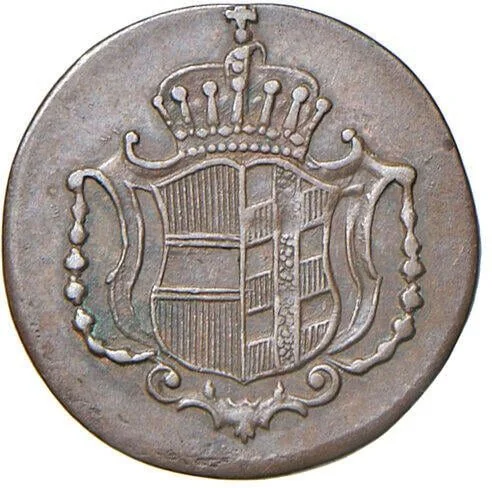
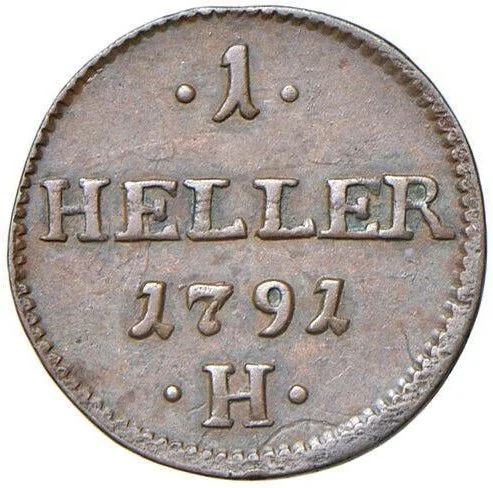
1 heller – Further Austria
Add to wishlist
Austria
Context
Years: 1783–1792
Country: Austria
Issuer: Further Austria
Ruler: Joseph II
Currency:
Demonetized: Yes
Material
References
KM: #
Numista: #31531
Mints
| Name | Mark |
|---|---|
| Günzburg | — |
Mintings
| Year | Mint Mark | Mintage | Quality | Collection |
|---|---|---|---|---|
| 1783 | — | — | ||
| 1784 | — | — | ||
| 1785 | — | — | ||
| 1787 | — | — | ||
| 1788 | — | — | ||
| 1789 | — | — | ||
| 1790 | — | — | ||
| 1791 | — | — | ||
| 1792 | — | — |
Historical background
In 1783, the currency situation in Further Austria (Vorderösterreich) was characterized by fragmentation and complexity, a direct result of the territory's scattered geography and political structure. These Habsburg possessions, stretching across the Swabian region, the Black Forest, and parts of present-day Switzerland, were not a unified economic zone. Consequently, a multitude of circulating mediums existed alongside the official Habsburg currency. The Maria Theresa thaler was a recognized standard, but in daily trade, a plethora of regional and local coins from neighboring German states, as well as accountings in gulden and kreuzer, created a confusing monetary landscape for merchants and peasants alike.
This fragmentation was actively being challenged by the centralizing reforms of Emperor Joseph II, who co-ruled with his mother, Maria Theresa, until 1780. The Habsburg state sought to impose greater monetary uniformity across all its lands, including its western outliers. Efforts were underway to suppress the circulation of foreign coins and to standardize values based on the Vienna mint standard. However, in 1783, these policies were still in a state of implementation and resistance, meaning the old, heterogeneous system stubbornly persisted in market transactions, causing frequent disputes over exchange rates and valuations.
The situation was further complicated by the use of both specie (coin) and various forms of credit. While larger transactions and state finances were increasingly conducted in standardized silver, small-scale local trade often relied on a mix of lower-value subsidiary coins and even barter. Thus, the monetary background of Further Austria in 1783 was one of transition and tension, caught between the entrenched legacy of regional particularism and the relentless, but still incomplete, drive of Habsburg absolutism to create a unified economic space.
This fragmentation was actively being challenged by the centralizing reforms of Emperor Joseph II, who co-ruled with his mother, Maria Theresa, until 1780. The Habsburg state sought to impose greater monetary uniformity across all its lands, including its western outliers. Efforts were underway to suppress the circulation of foreign coins and to standardize values based on the Vienna mint standard. However, in 1783, these policies were still in a state of implementation and resistance, meaning the old, heterogeneous system stubbornly persisted in market transactions, causing frequent disputes over exchange rates and valuations.
The situation was further complicated by the use of both specie (coin) and various forms of credit. While larger transactions and state finances were increasingly conducted in standardized silver, small-scale local trade often relied on a mix of lower-value subsidiary coins and even barter. Thus, the monetary background of Further Austria in 1783 was one of transition and tension, caught between the entrenched legacy of regional particularism and the relentless, but still incomplete, drive of Habsburg absolutism to create a unified economic space.
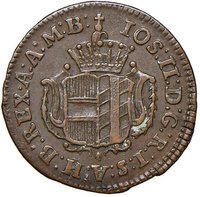
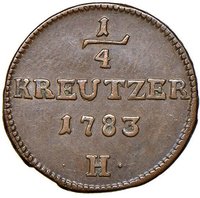
⭐ Somewhat Rare