

50 pence – United Kingdom
Add to wishlist
Circulating commemorative coins
Commemoration: The legacy of Sir Isaac Newton
United Kingdom
Context
Years: 2017–2018
Issuer: United Kingdom
Ruler: Elizabeth II
Currency:
(since 1971)
Total mintage: 1,918,489
Material
Diameter: 27.3 mm
Weight: 8 g
Shape: Equilateral curve heptagon
Composition: Copper-nickel
Technique: Milled
Alignment: Medal alignment
flip
References
KM: #
Numista: #100957
Value
Exchange value: 0.50 GBP
Inflation-adjusted value: 0.70 GBP
Obverse
Description:
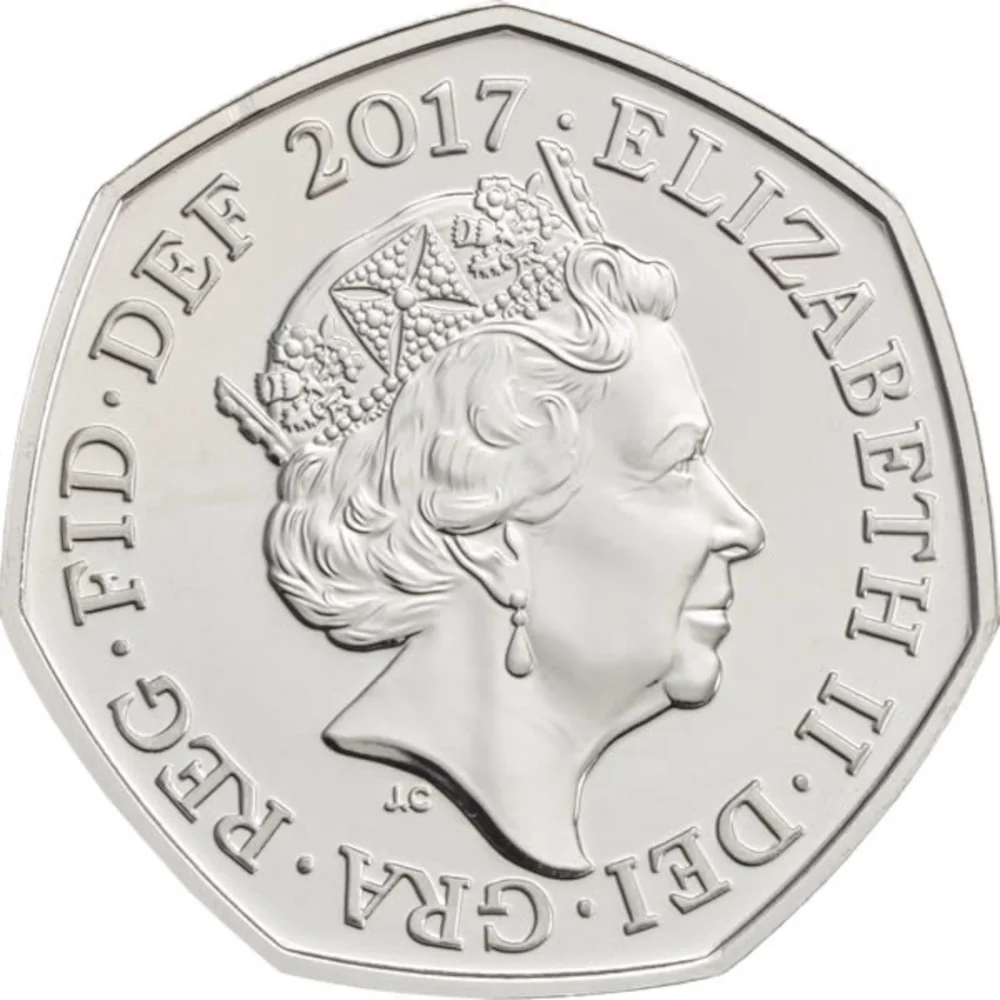
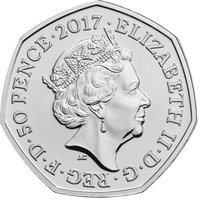
Queen Elizabeth V crowned right, wearing George IV State Diadem.
Inscription:
ELIZABETH II·DEI·GRA·REG·FID·DEF·2017·
J.C
J.C
Translation:
Elizabeth II by the Grace of God Queen Defender of the Faith 2017 J.C
Script: Latin
Language: Latin
Designer: Jody Clark
Reverse
Description:
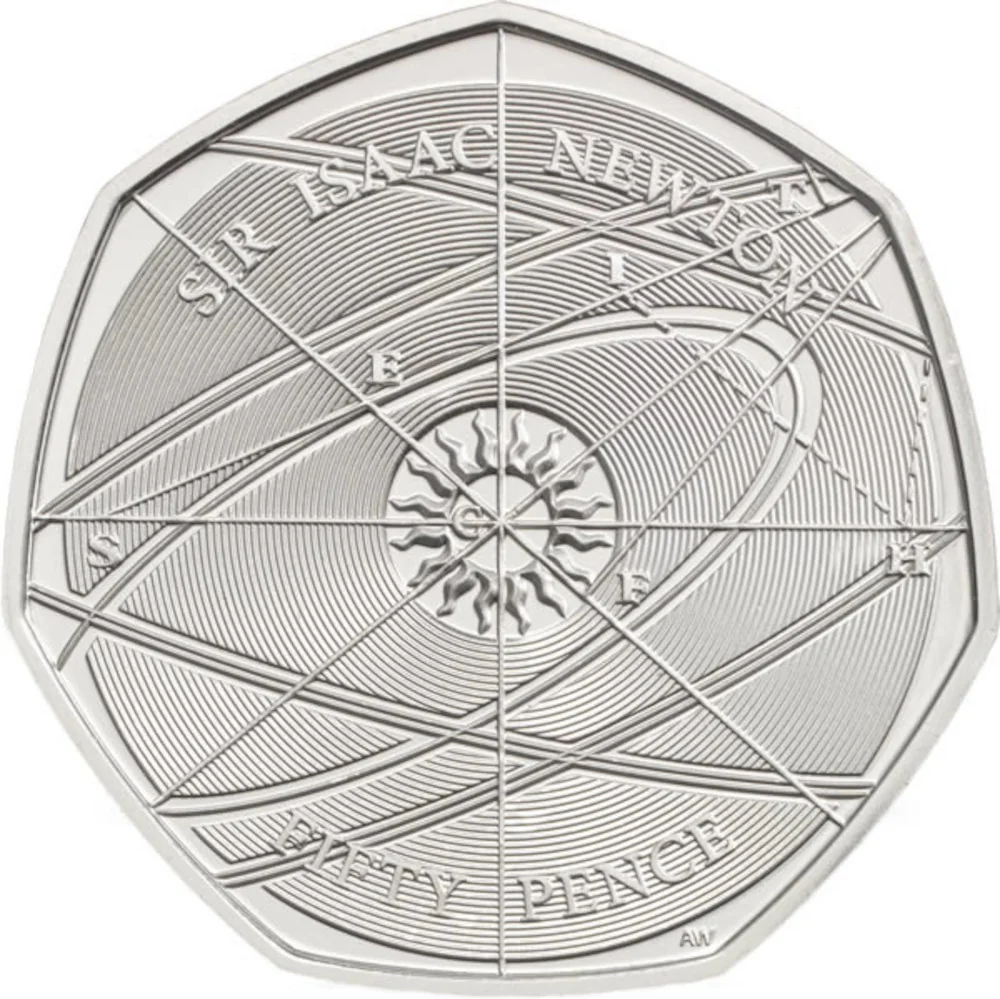
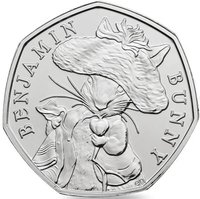
Design inspired by Newton's Principia, Proposition 11.
Inscription:
SIR ISAAC NEWTON
FIFTY PENCE
AW
FIFTY PENCE
AW
Script: Latin
Designer: Aaron West
Edge
Plain
Categories
| Science |
Mints
| Name | Mark |
|---|---|
| Royal Mint | — |
Mintings
| Year | Mint Mark | Mintage | Quality | Collection |
|---|---|---|---|---|
| 2017 | — | 1,801,500 | ||
| 2017 | — | 14,555 | Proof | |
| 2017 | — | 81,608 | BU | |
| 2018 | — | 20,826 |
Historical background
In 2017, the United Kingdom's currency, the pound sterling (GBP), was fundamentally shaped by the unfolding political and economic consequences of the 2016 referendum vote to leave the European Union. The year began with sterling trading near historic lows, having experienced a sharp devaluation immediately after the Brexit vote. This "Brexit discount" persisted throughout 2017, reflecting sustained market uncertainty about the future UK-EU relationship and concerns over potential economic disruption. The currency's value acted as a key barometer for investor sentiment, fluctuating in response to political developments, notably the triggering of Article 50 in March and the subsequent tumultuous Brexit negotiations.
Economically, the weaker pound created a dual-edged impact. On one hand, it provided a significant boost to UK exporters and the manufacturing sector by making British goods cheaper on international markets. It also contributed to a rise in inflation, which peaked at 3.1% in November, as the increased cost of imported goods and commodities squeezed household incomes. The Bank of England responded to this inflationary pressure by raising interest rates in November for the first time in a decade, a move from 0.25% to 0.5% that was aimed at anchoring inflation expectations but also underscored the challenging trade-offs facing policymakers in a post-referendum economy.
Politically, sterling remained highly sensitive to headlines from the Brexit talks. The currency experienced volatility around key events, such as Prime Minister Theresa May's Lancaster House speech and the disappointing outcome of the June snap election, which resulted in a hung parliament. Progress towards a potential transitional deal in the final months of the year provided some modest support for the pound, but it failed to recover to its pre-referendum levels. Thus, 2017 closed with sterling still subdued, emblematic of a nation and an economy in a state of protracted negotiation and unresolved future direction.
Economically, the weaker pound created a dual-edged impact. On one hand, it provided a significant boost to UK exporters and the manufacturing sector by making British goods cheaper on international markets. It also contributed to a rise in inflation, which peaked at 3.1% in November, as the increased cost of imported goods and commodities squeezed household incomes. The Bank of England responded to this inflationary pressure by raising interest rates in November for the first time in a decade, a move from 0.25% to 0.5% that was aimed at anchoring inflation expectations but also underscored the challenging trade-offs facing policymakers in a post-referendum economy.
Politically, sterling remained highly sensitive to headlines from the Brexit talks. The currency experienced volatility around key events, such as Prime Minister Theresa May's Lancaster House speech and the disappointing outcome of the June snap election, which resulted in a hung parliament. Progress towards a potential transitional deal in the final months of the year provided some modest support for the pound, but it failed to recover to its pre-referendum levels. Thus, 2017 closed with sterling still subdued, emblematic of a nation and an economy in a state of protracted negotiation and unresolved future direction.
🌱 Common