

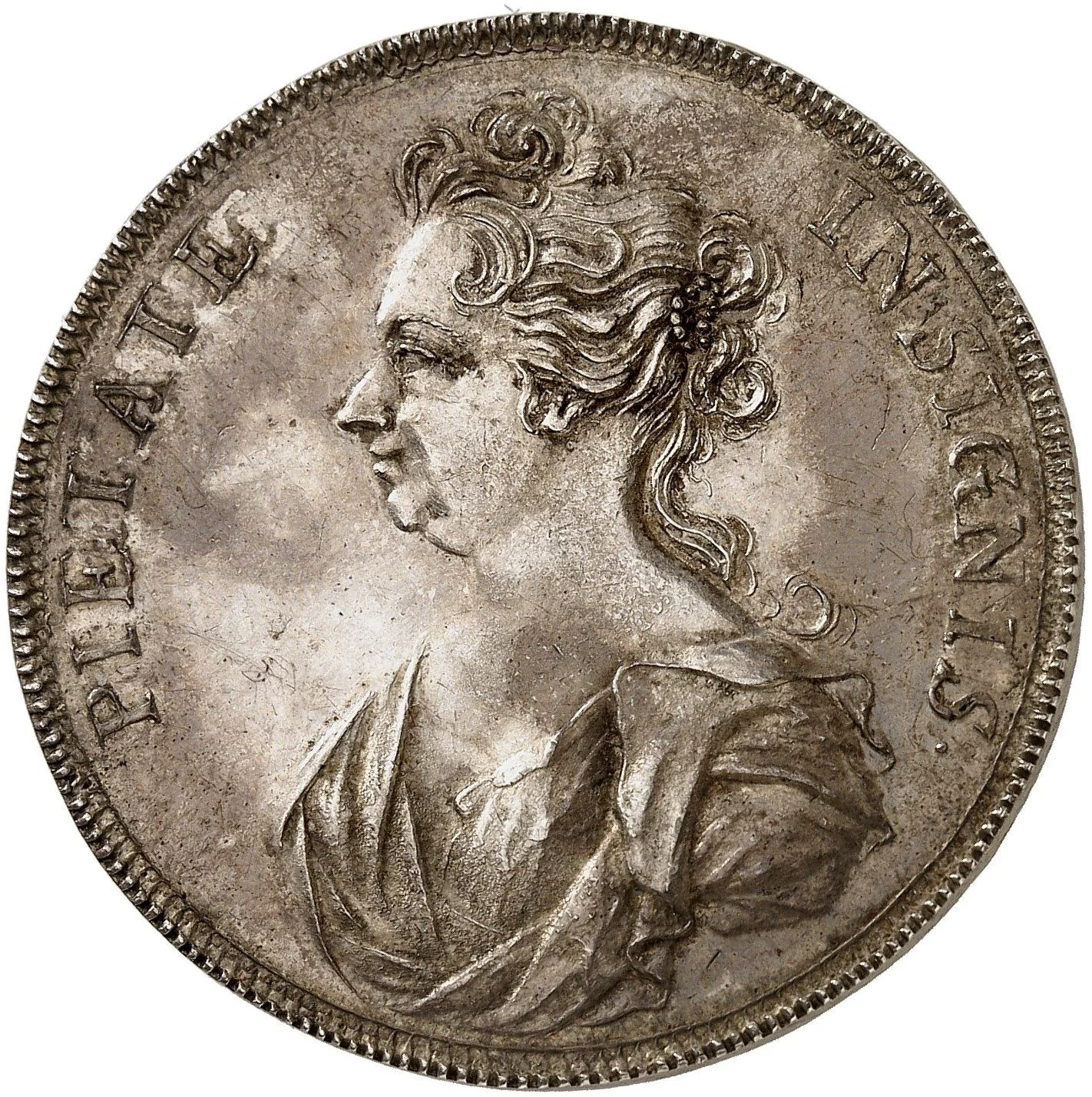
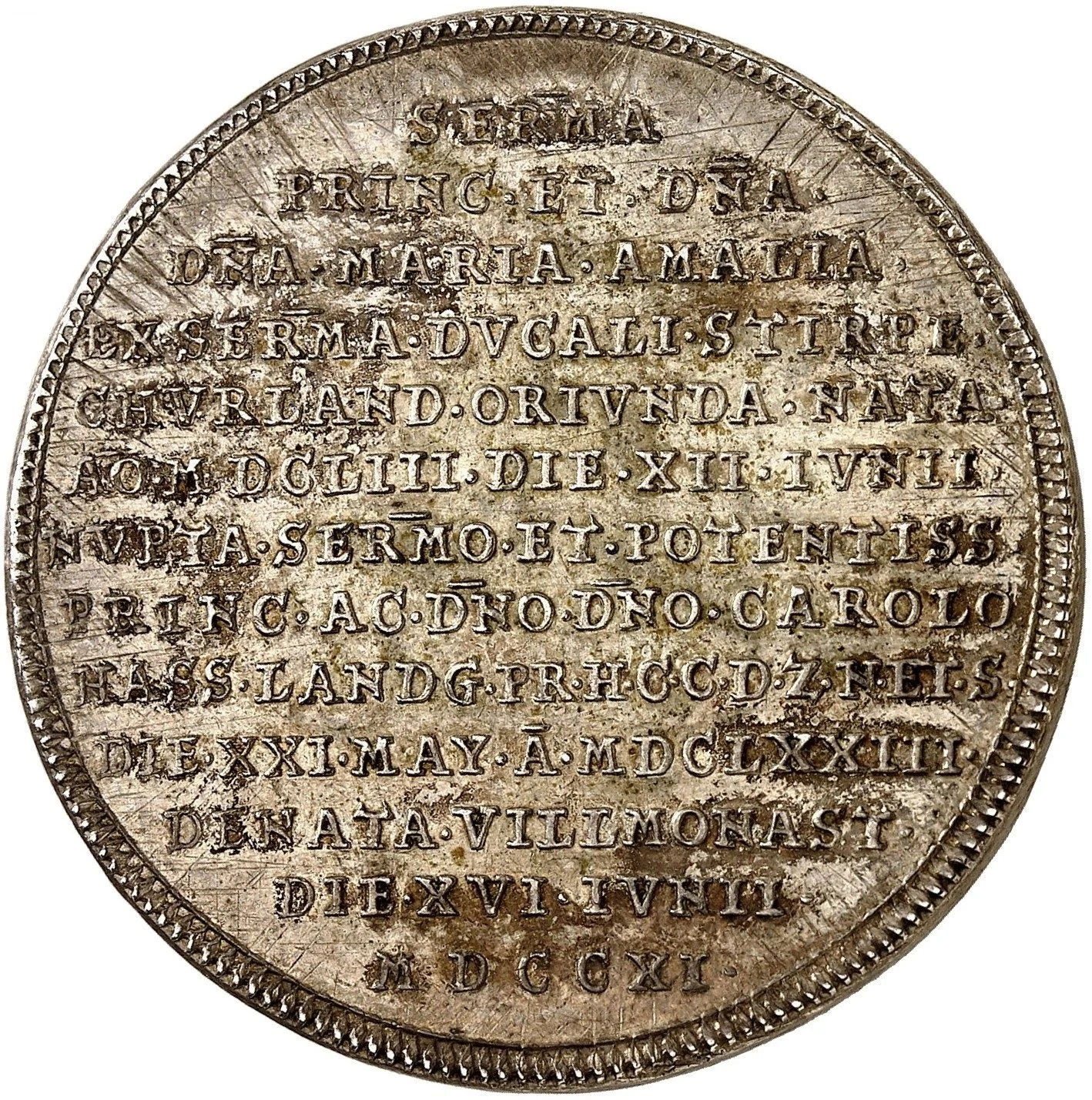
1 Thaler – Landgraviate of Hesse-Cassel
Circulating commemorative coins
Commemoration: Death of Maria Amalia
Obverse
Reverse
Description:
13-line inscription dated with Roman numerals.
Inscription:
SERMA
PRINC. ET. DNA.
DNA. MARIA. AMALIA.
EX. SERMA. DVCALI. STIRPE.
CHVRLAND. ORIVNDA. NATA.
AO. MDCLIII. DIE. XIII. IVNII.
NVPTA. SERMO. ET. POTENTISS.
PRINC. AC. DNO. DNO. CAROLO
HASS. LANDG. PR. H. C. C. D. Z. N. ET. S.
DIE. XXI. MAY. A. MDCLXXIII.
DENATA. VILLMONAST.
DIE. XVI. IVNII.
MDCCXI.
PRINC. ET. DNA.
DNA. MARIA. AMALIA.
EX. SERMA. DVCALI. STIRPE.
CHVRLAND. ORIVNDA. NATA.
AO. MDCLIII. DIE. XIII. IVNII.
NVPTA. SERMO. ET. POTENTISS.
PRINC. AC. DNO. DNO. CAROLO
HASS. LANDG. PR. H. C. C. D. Z. N. ET. S.
DIE. XXI. MAY. A. MDCLXXIII.
DENATA. VILLMONAST.
DIE. XVI. IVNII.
MDCCXI.
Script: Latin
Edge
Mints
| Name | Mark |
|---|---|
| Kassel | — |
Mintings
| Year | Mint Mark | Mintage | Quality | Collection |
|---|---|---|---|---|
| 1711 | — | — |
Historical background
In 1711, the currency situation in the Landgraviate of Hesse-Cassel was complex and challenging, characterized by monetary fragmentation and persistent devaluation. The landgraviate did not have a uniform coinage; instead, it operated within the wider framework of the Holy Roman Empire's monetary systems, notably the Reichsthaler (Imperial Thaler) as a unit of account. However, a plethora of actual circulating coins—foreign and domestic, of varying silver content—created chronic confusion. This "billon" coinage, with low intrinsic value, was frequently debased by the state to generate seigniorage revenue, a common but inflationary practice that eroded public trust and complicated commerce.
The financial pressures of the early 18th century heavily influenced this monetary instability. Landgrave Charles, who ruled from 1670 to 1730, had maintained a large and modern standing army, which was a significant drain on the treasury. While famously profitable through the rental of Hessian troops to foreign powers (most notably to Great Britain during the War of the Spanish Succession), the immediate need for liquidity often prompted short-sighted currency manipulation. The year 1711 fell during the prolonged War of the Spanish Succession (1701-1714), a conflict in which Hesse-Cassel was a major participant, intensifying the demand for funds and thus the temptation to debase coinage to pay for military expenditures.
Consequently, merchants and the populace faced daily difficulties with exchange rates and the uncertain value of coins. Trade was hindered by the need for constant assay and negotiation, while prices were unstable. This environment prompted increased use of banking and credit instruments among merchants to bypass the unreliable physical currency. The situation demanded, though it would not see major reform until later in the century, a move toward more standardized and centrally controlled coinage to stabilize the economy and facilitate the landgraviate's sophisticated military-financial state.
The financial pressures of the early 18th century heavily influenced this monetary instability. Landgrave Charles, who ruled from 1670 to 1730, had maintained a large and modern standing army, which was a significant drain on the treasury. While famously profitable through the rental of Hessian troops to foreign powers (most notably to Great Britain during the War of the Spanish Succession), the immediate need for liquidity often prompted short-sighted currency manipulation. The year 1711 fell during the prolonged War of the Spanish Succession (1701-1714), a conflict in which Hesse-Cassel was a major participant, intensifying the demand for funds and thus the temptation to debase coinage to pay for military expenditures.
Consequently, merchants and the populace faced daily difficulties with exchange rates and the uncertain value of coins. Trade was hindered by the need for constant assay and negotiation, while prices were unstable. This environment prompted increased use of banking and credit instruments among merchants to bypass the unreliable physical currency. The situation demanded, though it would not see major reform until later in the century, a move toward more standardized and centrally controlled coinage to stabilize the economy and facilitate the landgraviate's sophisticated military-financial state.
✨ Legendary