

1 Piastra – Papal States
Circulating commemorative coins
Commemoration: Sede Vacante
Vatican City
Context
Material
References
KM: #Click to copy to clipboard930
Numista: #314526
Value
Bullion value: $81.83
Obverse
Description:
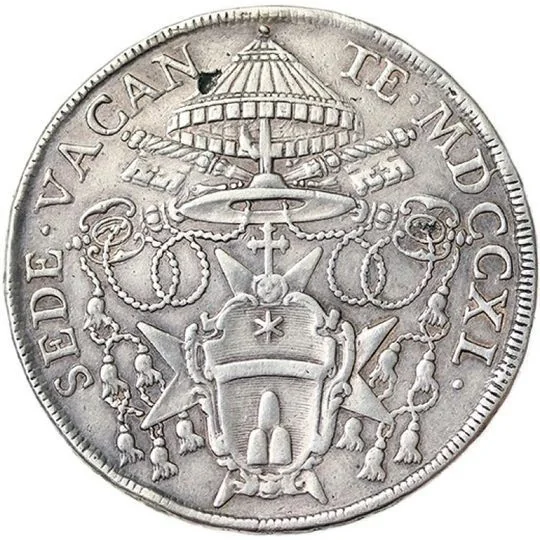
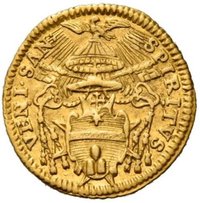
Cardinal Annibale Albani's coat of arms.
Inscription:
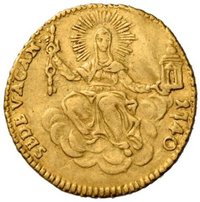
SEDE. VACAN TE. MDCCXL
Script: Latin
Reverse
Edge
Mints
| Name | Mark |
|---|---|
| Rome | — |
Mintings
| Year | Mint Mark | Mintage | Quality | Collection |
|---|---|---|---|---|
| 1740 | — | — |
Historical background
In 1740, the Papal States, a patchwork of central Italian territories under the sovereign rule of the Pope, operated within a complex and archaic monetary system typical of the ancien régime. There was no single, unified Papal currency. Instead, the primary silver coin was the giulio, but Roman commerce was dominated by a bewildering array of circulating coins from other Italian and European states, including the Tuscan piastra, Venetian ducats, and Spanish reales. This created a chaotic environment where exchange rates fluctuated constantly, and money changers (banchieri) held significant power, complicating trade and taxation.
The financial situation was further strained by the legacy of decades of deficit spending. Popes and their relatives, the Cardinal-Nephews, often financed lavish artistic projects, building programs, and court expenditures through borrowing and debasement. A common method was the practice of aggio, where the government would issue coins with an official face value higher than their intrinsic metal content, leading to inflation and a loss of public confidence. By 1740, the Papal treasury was chronically weak, reliant on inefficient taxes and forced loans, leaving little capacity for economic modernization or monetary reform.
Pope Benedict XIV, who ascended to the throne in August of 1740, inherited this precarious system. Recognized for his scholarly and reformist inclinations, his early pontificate would be marked by a serious attempt to address these financial disorders. While major monetary reform would crystallize later in his reign with the introduction of the scudo romano in 1753, the year 1740 stands as a point of crisis and transition, where the pressing need for monetary stability and fiscal responsibility became a key challenge for the new papal administration.
The financial situation was further strained by the legacy of decades of deficit spending. Popes and their relatives, the Cardinal-Nephews, often financed lavish artistic projects, building programs, and court expenditures through borrowing and debasement. A common method was the practice of aggio, where the government would issue coins with an official face value higher than their intrinsic metal content, leading to inflation and a loss of public confidence. By 1740, the Papal treasury was chronically weak, reliant on inefficient taxes and forced loans, leaving little capacity for economic modernization or monetary reform.
Pope Benedict XIV, who ascended to the throne in August of 1740, inherited this precarious system. Recognized for his scholarly and reformist inclinations, his early pontificate would be marked by a serious attempt to address these financial disorders. While major monetary reform would crystallize later in his reign with the introduction of the scudo romano in 1753, the year 1740 stands as a point of crisis and transition, where the pressing need for monetary stability and fiscal responsibility became a key challenge for the new papal administration.
✨ Legendary