

1 gold louis – France
Add to wishlist
France
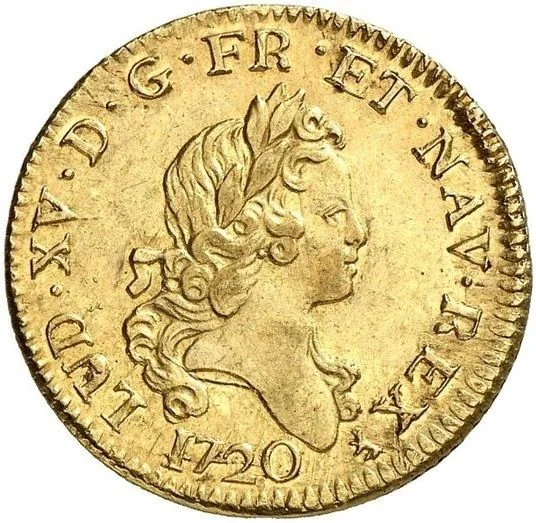
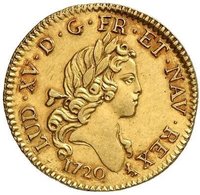
Obverse
Description:
Right-facing bust.
Inscription:
LVD • XV • D • G • FR • ET • NAV • REX
1720
1720
Script: Latin
Engraver: Norbert Roettiers
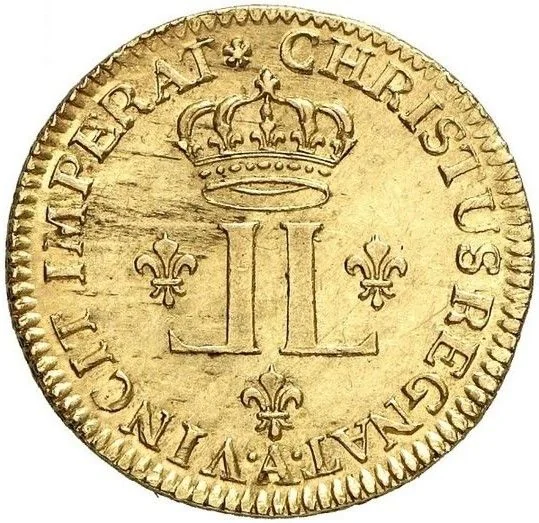
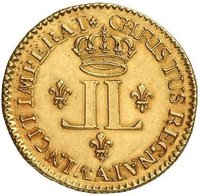
Reverse
Description:
Crowned double L and three fleur-de-lis.
Inscription:
✭ CHRISTUS REGNAT VINCIT IMPERAT
LL
• A •
LL
• A •
Script: Latin
Engraver: Norbert Roettiers
Edge
Mints
| Name | Mark |
|---|---|
| Aix-en-Provence | & |
| Rennes | 9 |
| Monnaie de Paris | A |
| Metz | AA |
| Rouen | B |
| Strasbourg | BB |
| Caen | C |
| Lyon | D |
| Tours | E |
| Poitiers | G |
| La Rochelle | H |
| Limoges | I |
| Bayonne | L |
| Toulouse | M |
| Montpellier | N |
| Reims | S |
| Nantes | T |
| Troyes | V |
| Lille | W |
| Amiens | X |
| Bourges | Y |
Mintings
| Year | Mint Mark | Mintage | Quality | Collection |
|---|---|---|---|---|
| 1720 | A | 176,010 | ||
| 1720 | BB | 667 | ||
| 1720 | D | 29,000 | ||
| 1720 | H | 23,000 | ||
| 1720 | I | 3,620 | ||
| 1720 | L | 803 | ||
| 1720 | T | 500 | ||
| 1720 | V | — | ||
| 1720 | W | 19,000 | ||
| 1721 | & | — | ||
| 1721 | 9 | 45,000 | ||
| 1721 | A | — | ||
| 1721 | AA | 927,239 | ||
| 1721 | B | 20,000 | ||
| 1721 | BB | 55,000 | ||
| 1721 | C | 6,128 | ||
| 1721 | D | — | ||
| 1721 | H | 37,000 | ||
| 1721 | L | — | ||
| 1721 | M | — | ||
| 1721 | N | 31,000 | ||
| 1721 | W | 139,000 | ||
| 1721 | X | 9,621 | ||
| 1722 | A | — | ||
| 1722 | BB | — | ||
| 1722 | E | 4,261 | ||
| 1722 | 9 | 69,000 | ||
| 1722 | G | 4,115 | ||
| 1722 | H | — | ||
| 1722 | L | — | ||
| 1722 | N | 15,000 | ||
| 1722 | Y | 3,346 | ||
| 1723 | W | 51,000 | ||
| 1723 | 9 | — | ||
| 1723 | A | — | ||
| 1723 | S | — |
Historical background
In 1720, France was engulfed in a catastrophic financial crisis precipitated by the audacious schemes of Scottish economist John Law. Appointed Controller General of Finances, Law sought to resolve the kingdom's colossal debt from the wars of Louis XIV by establishing a national bank (the Banque Royale) and a monopoly trading company (the Mississippi Company). His system revolved around replacing hard currency with paper banknotes, theoretically backed by the vast wealth of France's American colonies, and using this paper money to absorb the government's debt.
The situation rapidly spiraled out of control. Speculative frenzy drove shares in the Mississippi Company to dizzying heights, creating a bubble fueled by the continuous printing of banknotes with inadequate metallic backing. When confidence began to waver in early 1720, a rush to convert paper into gold and silver ensued. The government's desperate attempts to prop up the system—including illegalizing the possession of large amounts of coinage and forcibly devaluing paper money—only accelerated the panic and shattered public trust.
The collapse was total. By the end of 1720, the paper currency was worthless, the Banque Royale was shuttered, and John Law had fled the country. The episode left the French economy in ruins, devastated private fortunes, and ingrained a deep, lasting suspicion of paper money and central banking that would influence French financial policy for generations. This trauma contributed to the fiscal weakness of the monarchy, setting a stage for the crises that would culminate in the French Revolution later in the century.
The situation rapidly spiraled out of control. Speculative frenzy drove shares in the Mississippi Company to dizzying heights, creating a bubble fueled by the continuous printing of banknotes with inadequate metallic backing. When confidence began to waver in early 1720, a rush to convert paper into gold and silver ensued. The government's desperate attempts to prop up the system—including illegalizing the possession of large amounts of coinage and forcibly devaluing paper money—only accelerated the panic and shattered public trust.
The collapse was total. By the end of 1720, the paper currency was worthless, the Banque Royale was shuttered, and John Law had fled the country. The episode left the French economy in ruins, devastated private fortunes, and ingrained a deep, lasting suspicion of paper money and central banking that would influence French financial policy for generations. This trauma contributed to the fiscal weakness of the monarchy, setting a stage for the crises that would culminate in the French Revolution later in the century.
✨ Legendary