

½ rial – Oman
Add to wishlist
Non-circulating coins
Commemoration: 10th National Day
Oman
Context
Year: 1980
Islamic (Hijri) Year:: 1400
Issuer: Oman
Ruler: Qaboos bin Said
Currency:
(since 1972)
Total mintage: 600
Material
References
KM: #
Numista: #103934
Value
Exchange value: ½ OMR
Bullion value: $2763.30
Obverse
Description:
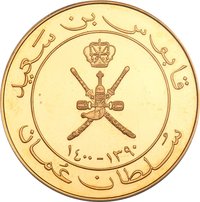
Oman's emblem: a sheathed khanjar over two crossed swords.
Reverse
Edge
Categories
| Event> National day |
Mintings
| Year | Mint Mark | Mintage | Quality | Collection |
|---|---|---|---|---|
| 1980 | — | 600 | Proof |
Historical background
In 1980, Oman's currency situation was defined by its reliance on the Gulf Rupee (XPGR), a currency issued by the Government of India and the Reserve Bank of India specifically for circulation in the Persian Gulf region. This arrangement was a legacy of Oman's historical economic and trade ties with India, dating back to when the Indian rupee served as the de facto common currency across the Gulf. However, by the late 1970s, this system was becoming increasingly untenable. The Gulf Rupee's value was pegged to the Indian rupee, which itself was subject to controls and devaluations, creating instability and misalignment with Oman's growing economic ambitions and its regional peers.
The decisive shift came with the accession of Sultan Qaboos bin Said and the nation's rapid modernization fueled by oil revenues beginning in the 1970s. Seeking monetary sovereignty and stability aligned with its oil-based economy and burgeoning financial sector, Oman introduced its own national currency, the Omani Rial (OMR), in 1972. By 1980, this transition was complete and well-established. The Omani Rial was pegged to the U.S. Dollar at a fixed rate of 1 OMR = 2.895 USD, a peg chosen to provide stability for oil exports, which were priced in dollars, and to attract foreign investment.
Therefore, by 1980, the currency "situation" was one of notable stability and confidence. Oman had successfully shed its colonial-era monetary dependency and established a strong, sovereign currency managed by the newly formed Central Bank of Oman (established in 1974). The high-value rial, backed by substantial hydrocarbon revenues, provided a solid foundation for the country's development plans and integrated Oman more closely with the global financial system, setting it apart from the earlier era of the Gulf Rupee.
The decisive shift came with the accession of Sultan Qaboos bin Said and the nation's rapid modernization fueled by oil revenues beginning in the 1970s. Seeking monetary sovereignty and stability aligned with its oil-based economy and burgeoning financial sector, Oman introduced its own national currency, the Omani Rial (OMR), in 1972. By 1980, this transition was complete and well-established. The Omani Rial was pegged to the U.S. Dollar at a fixed rate of 1 OMR = 2.895 USD, a peg chosen to provide stability for oil exports, which were priced in dollars, and to attract foreign investment.
Therefore, by 1980, the currency "situation" was one of notable stability and confidence. Oman had successfully shed its colonial-era monetary dependency and established a strong, sovereign currency managed by the newly formed Central Bank of Oman (established in 1974). The high-value rial, backed by substantial hydrocarbon revenues, provided a solid foundation for the country's development plans and integrated Oman more closely with the global financial system, setting it apart from the earlier era of the Gulf Rupee.

✨ Legendary