

50 Schilling – Austria
Circulating commemorative coins
Commemoration: European Monetary Union
Austria
Context
Year: 1999
Issuer: Austria 
Period:
(since 1945)
Currency:
(1945—2001)
Demonetization: 28 February 2002
Total mintage: 1,300,000
Material
References
KM: #Click to copy to clipboard3057
Numista: #10093
Value
Exchange value: 50 ATS
Inflation-adjusted value: 94.83 ATS
Obverse
Description:
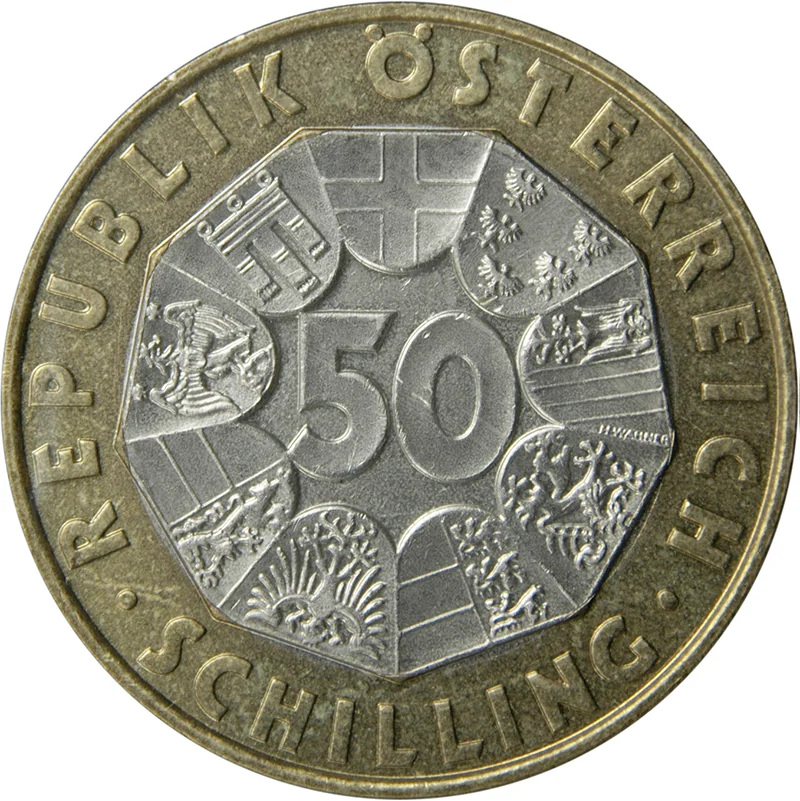
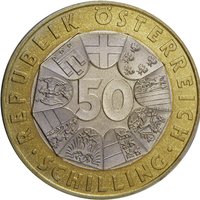
The face value "50" is encircled by the coats of arms of Austria's federal provinces and the text "Republik Österreich".
Inscription:
REPUBLIK ÖSTERREICH
50
· SCHILLING ·
50
· SCHILLING ·
Translation:
REPUBLIC OF AUSTRIA
50
· SCHILLING ·
50
· SCHILLING ·
Script: Latin
Language: German
Engraver: Thomas Pesendorfer
Reverse
Description:
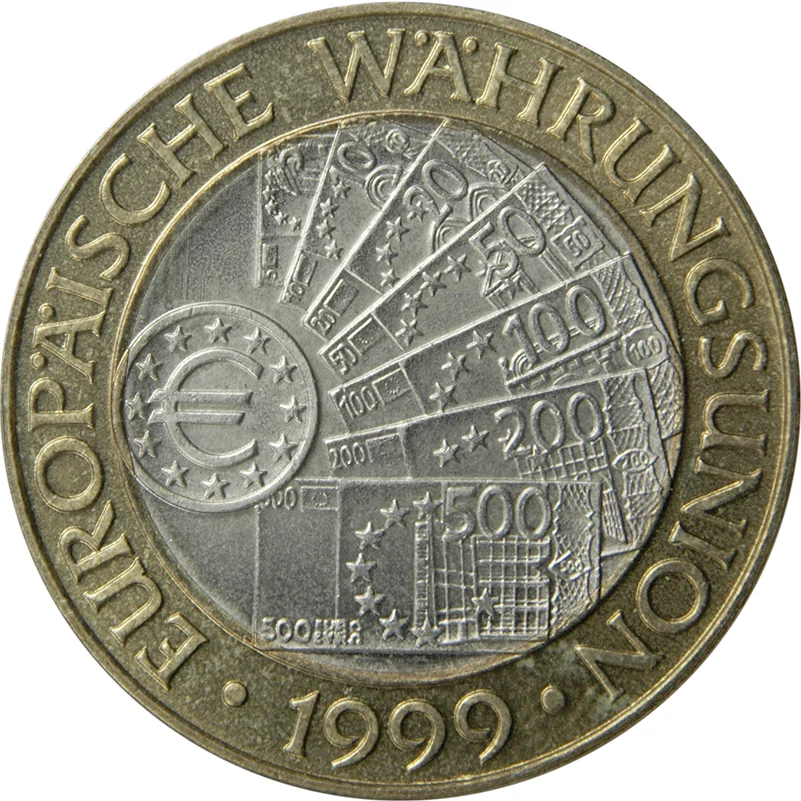
Issued May 5, 1999, this Austrian 50 Schilling coin commemorates the European Monetary Union. Its design fans the new Euro banknotes from the Euro symbol, surrounded by European stars and the inscription "Europäische Währungsunion 1999".
Inscription:
EUROPÄISCHE WÄHRUNGSUNION
· 1999 ·
· 1999 ·
Translation:
EUROPEAN MONETARY UNION
· 1999 ·
· 1999 ·
Script: Latin
Language: German
Edge
Categories
| Currency> Banknote |
| Symbols> Coat of Arms |
Mints
| Name | Mark |
|---|---|
| Münze Österreich | — |
Mintings
| Year | Mint Mark | Mintage | Quality | Collection |
|---|---|---|---|---|
| 1999 | — | 1,200,000 | ||
| 1999 | — | 100,000 | Special Uncirculated |
Historical background
In 1999, Austria was in a pivotal transitional year regarding currency, as it was a founding member of the European Economic and Monetary Union (EMU) but had not yet introduced euro banknotes and coins. On January 1, 1999, the euro was launched as an electronic currency for banking and financial transactions, and the Austrian schilling was irrevocably fixed at an exchange rate of 1 euro = 13.7603 schillings. This meant the schilling ceased to be an independent currency and became a non-decimal subdivision of the euro, with all financial markets, public debt, and government accounting switching to the new unit.
During this three-year transition period, known as "legacy currency" status, the schilling remained the everyday physical currency in circulation. Austrians experienced a "no prohibition, no compulsion" environment, where prices were often displayed in both schilling and euro to foster familiarity, but all legal transactions were conducted in schillings. This period was characterized by significant public information campaigns and logistical preparations by the Austrian National Bank (OeNB) and businesses to ensure a smooth future changeover, including the production and secure distribution of euro cash.
Thus, the currency situation in Austria in 1999 was one of a dual-system limbo: a definitive legal and financial framework had shifted to the euro, while the tangible monetary experience for citizens remained with the familiar schilling. This careful and planned transition aimed to build public confidence and minimize disruption ahead of the final, physical introduction of euro banknotes and coins on January 1, 2002, when the schilling would be completely phased out.
During this three-year transition period, known as "legacy currency" status, the schilling remained the everyday physical currency in circulation. Austrians experienced a "no prohibition, no compulsion" environment, where prices were often displayed in both schilling and euro to foster familiarity, but all legal transactions were conducted in schillings. This period was characterized by significant public information campaigns and logistical preparations by the Austrian National Bank (OeNB) and businesses to ensure a smooth future changeover, including the production and secure distribution of euro cash.
Thus, the currency situation in Austria in 1999 was one of a dual-system limbo: a definitive legal and financial framework had shifted to the euro, while the tangible monetary experience for citizens remained with the familiar schilling. This careful and planned transition aimed to build public confidence and minimize disruption ahead of the final, physical introduction of euro banknotes and coins on January 1, 2002, when the schilling would be completely phased out.
🌱 Fairly Common