

½ Piastra – Papal States
Circulating commemorative coins
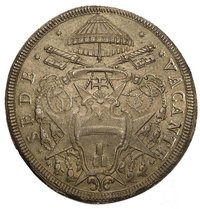
Commemoration: Sede Vacante
Vatican City
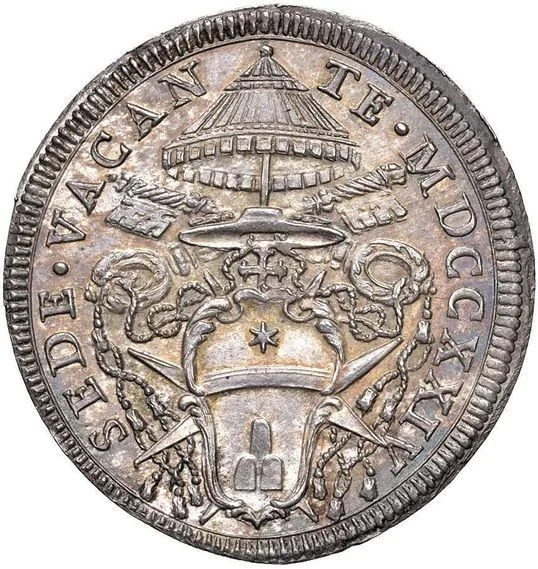
Obverse
Description:
Cardinal Annibale Albanti's coat of arms.
Inscription:
SEDE.VACAN TE.MDCCXXIV
Script: Latin
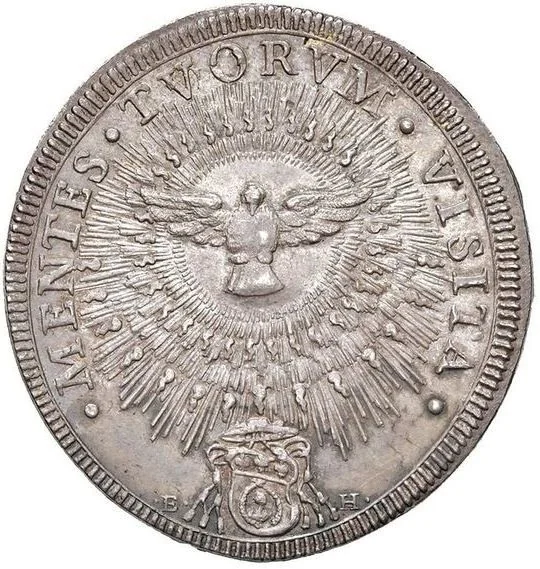
Reverse
Edge
Mints
| Name | Mark |
|---|---|
| Rome | — |
Mintings
| Year | Mint Mark | Mintage | Quality | Collection |
|---|---|---|---|---|
| 1724 | — | — |
Historical background
In 1724, the currency situation within the Papal States was characterized by significant complexity and debasement, a legacy of the severe financial crises of the previous century. The primary unit was the scudo, which existed in both silver (scudo di moneta) and gold (scudo d'oro) forms, but its value and silver content had been eroded through repeated devaluations. This period fell under the pontificate of Innocent XIII (1721-1724) and the beginning of Benedict XIII (1724-1730), a time of relative but fragile stability where the underlying monetary disorders were managed rather than fundamentally reformed. The circulation was a chaotic mix of official papal coinage, older issues from previous popes, and a multitude of foreign coins, particularly from neighbouring Italian states and Spanish silver, all trading at fluctuating values.
The root of the instability lay in the chronic budget deficits of the papal government, which traditionally resorted to reducing the precious metal content in coins to generate seigniorage revenue. This practice, while providing short-term liquidity, fueled inflation, undermined public trust in the currency, and disrupted commerce. Furthermore, the Papal States' numerous minting authorities (in Rome, Bologna, and Avignon) sometimes issued coins with slight variations, adding to the confusion. Exchange rates between copper baiocchi, silver giuli, and the scudo were not fixed, leading to difficulties in everyday transactions and creating opportunities for money-changers (banchi) to profit from the uncertainty.
Consequently, the monetary landscape in 1724 was one of fragile equilibrium. While not in the midst of an acute crisis, the system was inefficient and a burden on the economy. Proposals for monetary unification and stabilization were discussed among officials, but comprehensive reform would not be seriously attempted until later in the century under Pope Pius VI. Thus, in 1724, the Papal States navigated its financial affairs with a debased and heterogeneous currency system that reflected its broader administrative and fiscal challenges.
The root of the instability lay in the chronic budget deficits of the papal government, which traditionally resorted to reducing the precious metal content in coins to generate seigniorage revenue. This practice, while providing short-term liquidity, fueled inflation, undermined public trust in the currency, and disrupted commerce. Furthermore, the Papal States' numerous minting authorities (in Rome, Bologna, and Avignon) sometimes issued coins with slight variations, adding to the confusion. Exchange rates between copper baiocchi, silver giuli, and the scudo were not fixed, leading to difficulties in everyday transactions and creating opportunities for money-changers (banchi) to profit from the uncertainty.
Consequently, the monetary landscape in 1724 was one of fragile equilibrium. While not in the midst of an acute crisis, the system was inefficient and a burden on the economy. Proposals for monetary unification and stabilization were discussed among officials, but comprehensive reform would not be seriously attempted until later in the century under Pope Pius VI. Thus, in 1724, the Papal States navigated its financial affairs with a debased and heterogeneous currency system that reflected its broader administrative and fiscal challenges.
✨ Legendary