

1 Teston – Papal States
Circulating commemorative coins
Commemoration: Vacant Seat 1730
Vatican City
Context

Material
References
KM: #Click to copy to clipboard838
Numista: #310221
Value
Bullion value: $23.94
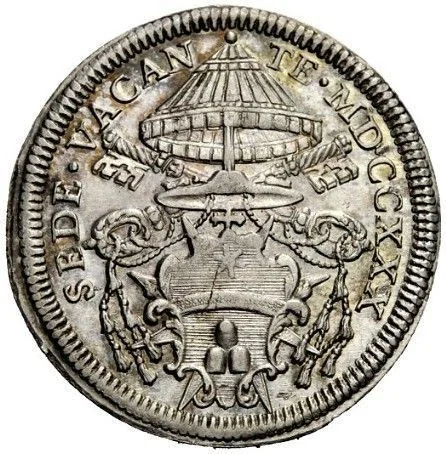
Obverse
Description:
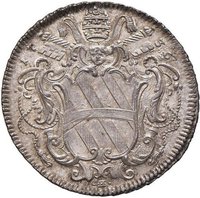
Cardinal Annibale Albani's coat of arms.
Inscription:
SEDE·VACAN TE·MDCCXXX
Script: Latin
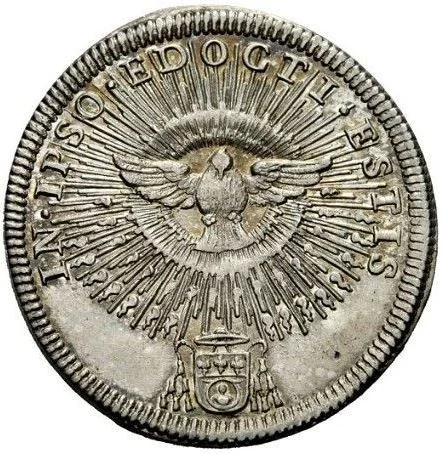
Reverse
Description:
Radiant dove. Mintmaster'ss arm below.
Inscription:
IN·IPSO·EDOGTI·ESTIS·
Script: Latin
Edge
Plain
Mints
| Name | Mark |
|---|---|
| Rome | — |
Mintings
| Year | Mint Mark | Mintage | Quality | Collection |
|---|---|---|---|---|
| 1730 | — | — |
Historical background
By 1730, the currency situation in the Papal States was characterized by significant complexity and debasement, a legacy of persistent fiscal pressures. The state financed its operations and the lavish papal court primarily through taxes, fees, and the sale of offices, but chronic budget shortfalls were often addressed by manipulating the coinage. Popes and their treasurers frequently reduced the precious metal content in coins while maintaining their face value, a practice that generated immediate seigniorage revenue but eroded purchasing power and trust. Consequently, a bewildering variety of coins circulated, including scudi, giuli, baiochi, and quattrini, each with fluctuating real values against the theoretical standard.
The monetary system was officially bimetallic, based on the Roman scudo (gold) and the giulio (silver), but the relationship between coins was unstable. Debasement was most severe in the low-denomination copper and billon (alloy) coins used in everyday transactions, which caused severe hardship for the common people. Furthermore, alongside papal issues, older coins from previous reigns and even foreign currencies circulated freely, creating a chaotic marketplace where exchange rates were negotiated daily. This fragmentation was exacerbated by the fact that other cities within the Papal States, like Bologna, also occasionally minted their own coins, adding another layer of inconsistency.
This unstable environment hindered commerce and reflected the broader administrative challenges of the Papal States. While the government issued official tariffs (listoni) to fix exchange rates between different coins, these were often ignored in practice as market prices for precious metals shifted. The situation in 1730 fell within the pontificate of Pope Benedict XIII (1724-1730), a ruler more concerned with religious piety than financial reform, leaving the structural monetary problems unaddressed. Thus, the currency landscape remained a patchwork of degraded and competing monies, undermining economic stability and placing a disproportionate burden on the lower classes through hidden inflation.
The monetary system was officially bimetallic, based on the Roman scudo (gold) and the giulio (silver), but the relationship between coins was unstable. Debasement was most severe in the low-denomination copper and billon (alloy) coins used in everyday transactions, which caused severe hardship for the common people. Furthermore, alongside papal issues, older coins from previous reigns and even foreign currencies circulated freely, creating a chaotic marketplace where exchange rates were negotiated daily. This fragmentation was exacerbated by the fact that other cities within the Papal States, like Bologna, also occasionally minted their own coins, adding another layer of inconsistency.
This unstable environment hindered commerce and reflected the broader administrative challenges of the Papal States. While the government issued official tariffs (listoni) to fix exchange rates between different coins, these were often ignored in practice as market prices for precious metals shifted. The situation in 1730 fell within the pontificate of Pope Benedict XIII (1724-1730), a ruler more concerned with religious piety than financial reform, leaving the structural monetary problems unaddressed. Thus, the currency landscape remained a patchwork of degraded and competing monies, undermining economic stability and placing a disproportionate burden on the lower classes through hidden inflation.
✨ Legendary