

2 Escudos – Spain
Spain
Material
Diameter: 25 mm
Weight: 6.8 g
Gold weight: 6.24 g
Thickness: 0.7 mm
Shape: Round
Composition: 91.7% Gold
Magnetic: No
Technique: Roller milled
References
KM: #Click to copy to clipboard135
Numista: #111205
Value
Bullion value: $1040.09
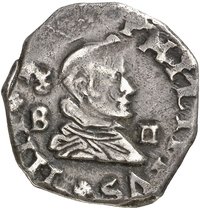
Obverse
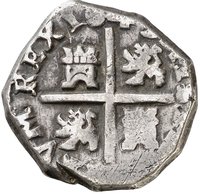
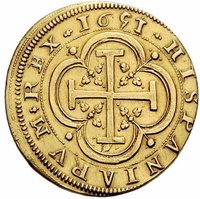
Reverse
Edge
Mints
| Name | Mark |
|---|---|
| Royal Mint of Segovia | — |
Mintings
| Year | Mint Mark | Mintage | Quality | Collection |
|---|---|---|---|---|
| 1651 | I | — |
Historical background
In 1651, Spain was in the midst of a profound monetary crisis, a direct consequence of decades of exhausting warfare and fiscal mismanagement. The Thirty Years' War (1618-1648) and the ongoing conflict with France (the Franco-Spanish War continued until 1659) had drained the royal treasury, leading the Crown to repeatedly debase the primary silver coin, the real. By drastically reducing the silver content in coins like the vellón (copper billon) while mandating they be accepted at their old face value, the government sparked severe inflation and a collapse in public trust. This practice, essentially a form of unilateral debt relief for the state, created a chaotic two-tier system where older, purer coins were hoarded or exported, while the newly minted, inferior coins flooded the market.
The social and economic consequences were devastating. The rampant inflation, known as the "revolución de los precios," eroded wages and savings, causing widespread hardship, particularly for the poor and those on fixed incomes. Trade was severely disrupted as merchants refused the debased currency or raised prices to compensate, leading to shortages and social unrest. The crisis peaked with the government's drastic attempt to resolve it in 1651: a failed plan to reintroduce a pure copper vellón currency, which only deepened the chaos. This monetary instability was compounded by harvest failures, plague, and the political fragility of the reign of Philip IV, whose realm was still reeling from the revolts of Catalonia and Portugal in the 1640s.
Ultimately, the currency situation of 1651 was a symptom of the broader decline of Spanish Habsburg power. The state's reliance on currency manipulation as a short-term fiscal fix undermined the very economy that was needed to sustain its imperial ambitions. It would take years of painful adjustment and reform after the Peace of the Pyrenees in 1659 to begin stabilizing the currency, marking this period as one of the lowest points in Spain's seventeenth-century economic history, where the gap between its global pretensions and its domestic financial reality was starkly exposed.
The social and economic consequences were devastating. The rampant inflation, known as the "revolución de los precios," eroded wages and savings, causing widespread hardship, particularly for the poor and those on fixed incomes. Trade was severely disrupted as merchants refused the debased currency or raised prices to compensate, leading to shortages and social unrest. The crisis peaked with the government's drastic attempt to resolve it in 1651: a failed plan to reintroduce a pure copper vellón currency, which only deepened the chaos. This monetary instability was compounded by harvest failures, plague, and the political fragility of the reign of Philip IV, whose realm was still reeling from the revolts of Catalonia and Portugal in the 1640s.
Ultimately, the currency situation of 1651 was a symptom of the broader decline of Spanish Habsburg power. The state's reliance on currency manipulation as a short-term fiscal fix undermined the very economy that was needed to sustain its imperial ambitions. It would take years of painful adjustment and reform after the Peace of the Pyrenees in 1659 to begin stabilizing the currency, marking this period as one of the lowest points in Spain's seventeenth-century economic history, where the gap between its global pretensions and its domestic financial reality was starkly exposed.
✨ Legendary