

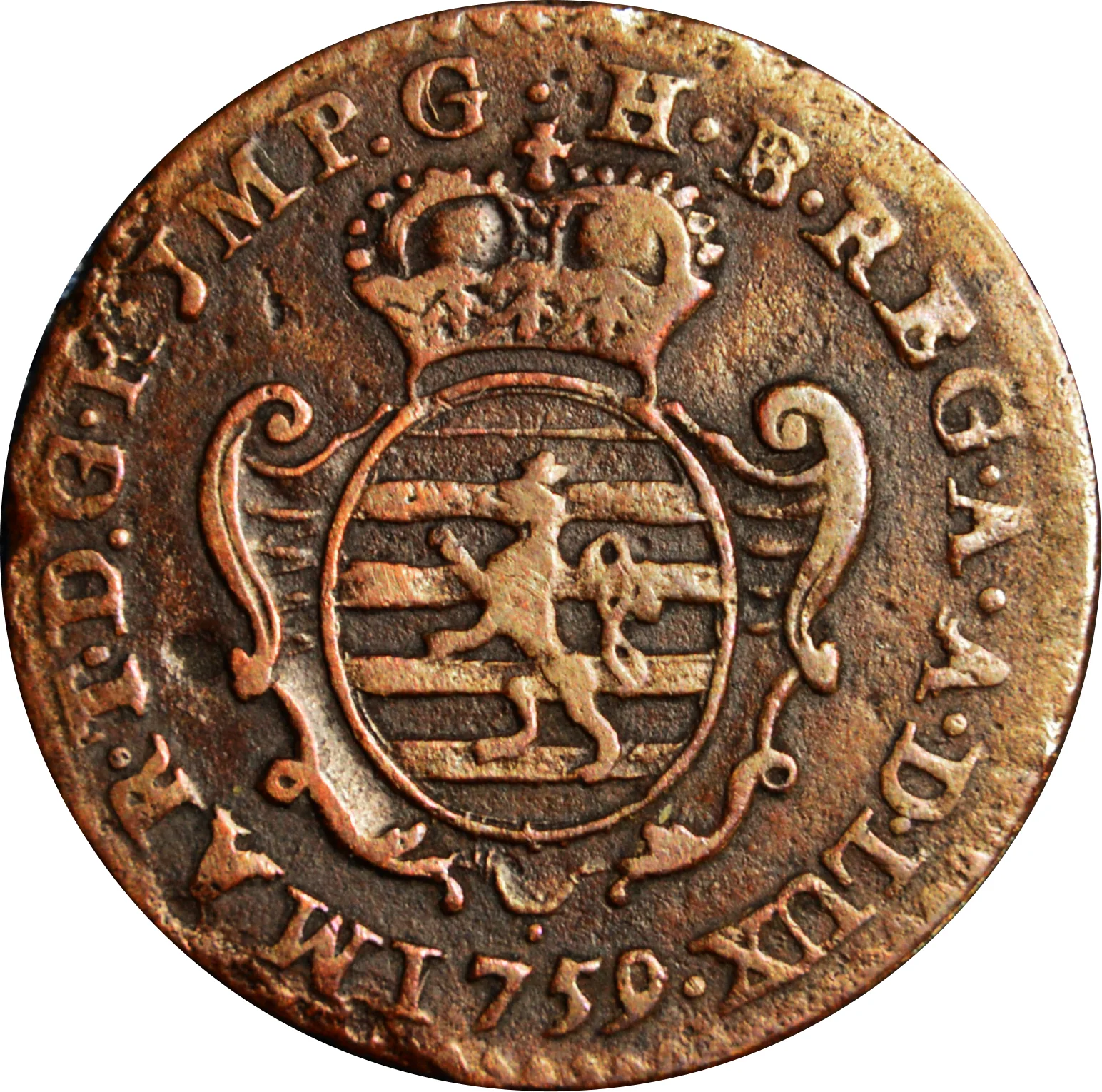
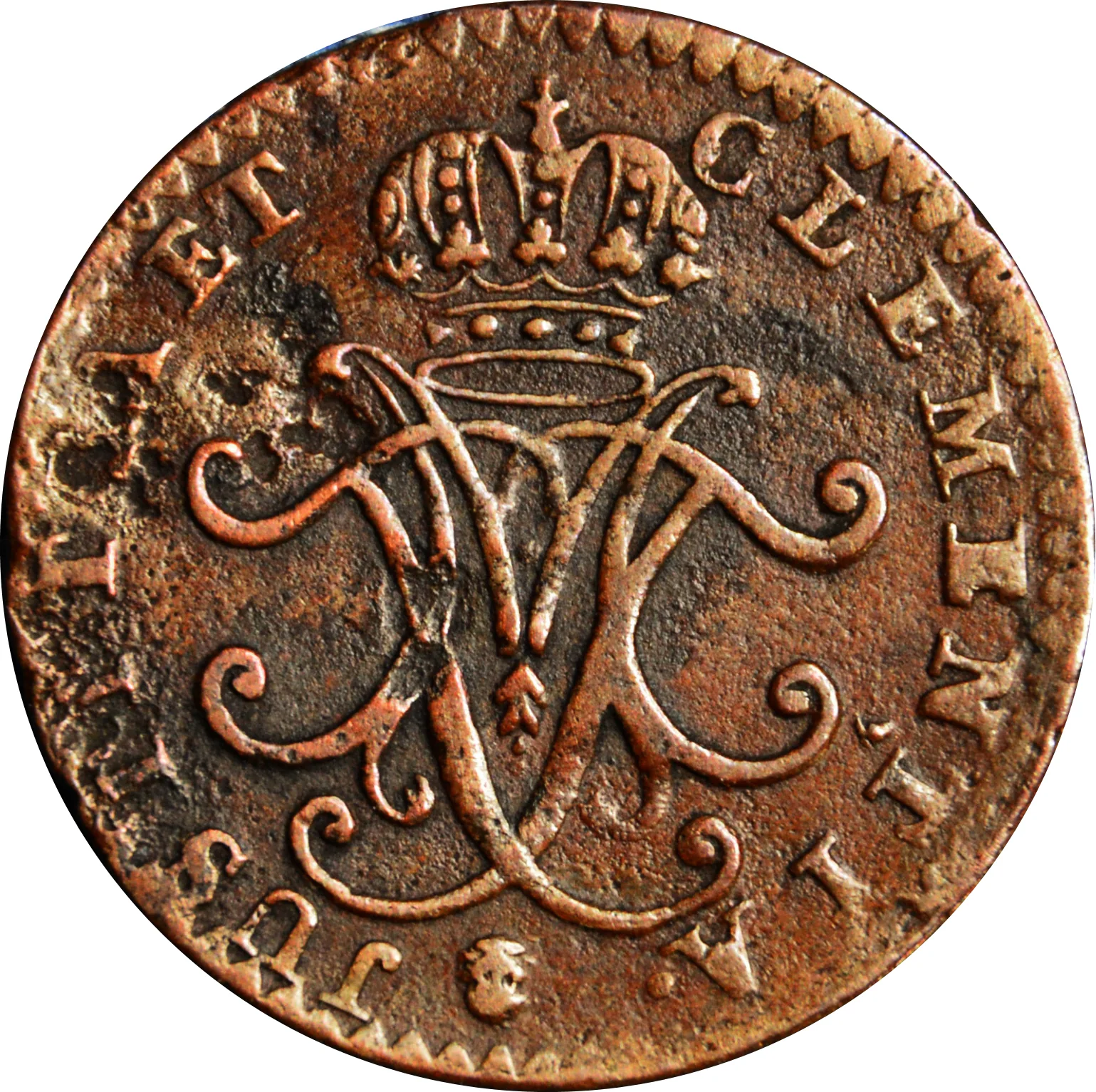
1 Liard – Duchy of Luxembourg
Luxembourg
Context
Years: 1759–1760
Country: Luxembourg 
Issuer: Duchy of Luxembourg
Demonetized: Yes
Total mintage: 1,964,094
Material
References
KM: #Click to copy to clipboard3
Numista: #30723
Obverse
Description:
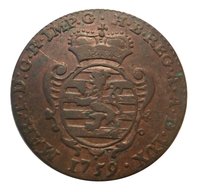
Oval crowned Luxembourgish shield with rock motifs, legend, date, and external dentition.
Inscription:
MAR•T•D:G•R•JMP•G•H•B•REG•A•A•D•LUX•
1759
1759
Script: Latin
Reverse
Description:
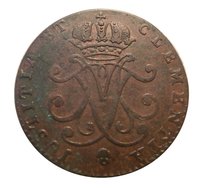
Crowned monogram of Maria Theresa, encircled by legend and outer girdle, with the Brussels mint mark (angel's head) below.
Inscription:
JUSTICIA ET CLEMENTIA •
Script: Latin
Edge
Plain
Mints
| Name | Mark |
|---|---|
| Royal Mint of Belgium | — |
Mintings
| Year | Mint Mark | Mintage | Quality | Collection |
|---|---|---|---|---|
| 1759 | — | 1,531,168 | ||
| 1760 | — | 432,926 |
Historical background
In 1759, the Duchy of Luxembourg, then part of the Austrian Netherlands under Habsburg rule, faced a complex and challenging currency situation typical of the 18th-century European mosaic of monetary systems. The territory did not have a unified, sovereign currency. Instead, its economy operated on a system of "ghost money" (monnaie de compte), where accounts were kept in a stable notional unit—the florin or guilder—while actual physical payment was made in a bewildering array of circulating coins. These included Austrian thalers, Dutch guilders, French écus and livres, Spanish pistoles, and various German state coins, all valued by their precious metal content and subject to official tariff lists.
The core problem was chronic instability and debasement. The intrinsic value of these foreign coins fluctuated with the monetary policies of their issuing states, which were often engaged in wars (like the ongoing Seven Years' War) and resorted to reducing the silver content in their coinage to finance military expenses. This led to Gresham's Law in practice: "bad" debased coins drove "good" full-weight coins out of circulation, as people hoarded the latter or melted them down for bullion. Consequently, Luxembourg suffered from a shortage of sound currency, hindering trade and creating uncertainty in everyday transactions.
Authorities in Brussels and local officials attempted to manage the chaos by periodically issuing ordinances that fixed exchange rates for the myriad of coins. However, these decrees often failed to keep pace with market realities, leading to widespread confusion, counterfeiting, and economic friction. The situation underscored Luxembourg's lack of monetary sovereignty and its vulnerability to the fiscal policies of larger neighboring powers, leaving its local economy fragmented and inefficient on the eve of the industrial and political revolutions that would soon reshape Europe.
The core problem was chronic instability and debasement. The intrinsic value of these foreign coins fluctuated with the monetary policies of their issuing states, which were often engaged in wars (like the ongoing Seven Years' War) and resorted to reducing the silver content in their coinage to finance military expenses. This led to Gresham's Law in practice: "bad" debased coins drove "good" full-weight coins out of circulation, as people hoarded the latter or melted them down for bullion. Consequently, Luxembourg suffered from a shortage of sound currency, hindering trade and creating uncertainty in everyday transactions.
Authorities in Brussels and local officials attempted to manage the chaos by periodically issuing ordinances that fixed exchange rates for the myriad of coins. However, these decrees often failed to keep pace with market realities, leading to widespread confusion, counterfeiting, and economic friction. The situation underscored Luxembourg's lack of monetary sovereignty and its vulnerability to the fiscal policies of larger neighboring powers, leaving its local economy fragmented and inefficient on the eve of the industrial and political revolutions that would soon reshape Europe.
⭐ Somewhat Rare