

20 Francs – French Somaliland
Somalia
Context
Year: 1965
Country: Somalia 
Issuer: French Somaliland
Period:
(1958—1967)
Currency:
(1949—1967)
Demonetized: Yes
Total mintage: 200,000
Material
References
KM: #Click to copy to clipboard12
Numista: #11680
Obverse
Description:
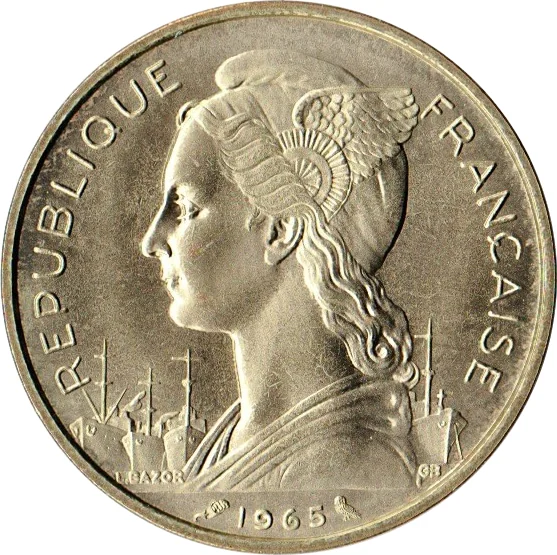
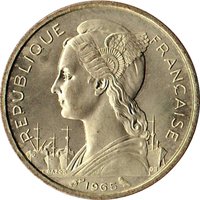
Marianne faces left in a winged Phrygian cap, with four ships in the background. The date and a privy mark are below.
Inscription:
REPUBLIQUE FRANÇAISE
1965
1965
Translation:
FRENCH REPUBLIC
1965
1965
Script: Latin
Language: French
Engraver: Lucien Georges Bazor
Reverse
Description:
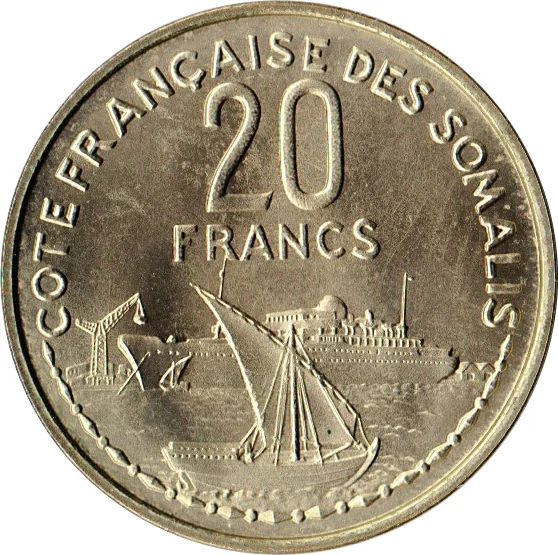
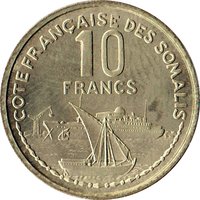
Two dhows, an ocean liner.
Inscription:
COTE FRANÇAISE DES SOMALIS
20
FRANCS
20
FRANCS
Translation:
French Coast of the Somalis
20
Francs
20
Francs
Script: Latin
Language: French
Engraver: Lucien Georges Bazor
Edge
Plain
Categories
| Transportation> Watercraft |
| Symbol> Allegory |
| Symbol> Phrygian cap |
Mints
| Name | Mark |
|---|---|
| Monnaie de Paris | — |
Mintings
| Year | Mint Mark | Mintage | Quality | Collection |
|---|---|---|---|---|
| 1965 | — | 200,000 |
Historical background
In 1965, the currency situation in French Somaliland (present-day Djibouti) was defined by its unique position as a French overseas territory with a strategic port economy. The official currency was the Djiboutian franc (DF), which was not an independent currency but a local issuance pegged at an absolute fixed parity to the French franc (FRF). This peg, established in 1949, was a firm 1 DF = 1.7 FRF, a rate that provided remarkable stability and was a cornerstone of the territory's financial system. The currency was issued by a private institution, the Caisse de la Défense Nationale de Djibouti, under the authority of the French Treasury, which guaranteed its convertibility.
This monetary arrangement was crucial for the territory's economy, which was almost entirely centered on the port of Djibouti and the railway to Addis Ababa, serving as a vital trade gateway for landlocked Ethiopia. The fixed, convertible franc provided the stability required for international commerce and banking, making the territory a financial hub in the region. Importantly, it also facilitated the significant influx of French military spending, which was a major component of the local economy due to the presence of large French military bases.
The stability of the Djiboutian franc stood in stark contrast to the currencies of neighboring countries in the mid-1960s. While Somalia, Ethiopia, and Yemen experienced varying degrees of inflation and volatility, the DF's firm peg to the French franc insulated the territory from regional monetary pressures. This system underscored French economic control and tied the territory's financial fate directly to that of metropolitan France, a relationship that would persist beyond independence in 1977 until the Djiboutian franc's eventual peg to the US dollar in the early 1970s.
This monetary arrangement was crucial for the territory's economy, which was almost entirely centered on the port of Djibouti and the railway to Addis Ababa, serving as a vital trade gateway for landlocked Ethiopia. The fixed, convertible franc provided the stability required for international commerce and banking, making the territory a financial hub in the region. Importantly, it also facilitated the significant influx of French military spending, which was a major component of the local economy due to the presence of large French military bases.
The stability of the Djiboutian franc stood in stark contrast to the currencies of neighboring countries in the mid-1960s. While Somalia, Ethiopia, and Yemen experienced varying degrees of inflation and volatility, the DF's firm peg to the French franc insulated the territory from regional monetary pressures. This system underscored French economic control and tied the territory's financial fate directly to that of metropolitan France, a relationship that would persist beyond independence in 1977 until the Djiboutian franc's eventual peg to the US dollar in the early 1970s.
🌱 Common