

2 sols – French West Indies
Add to wishlist
France
Context
Year: 1763
Country: France
Issuer: French West Indies
Period:
(1792—1804)
Ruler: Louis XVI
Demonetized: Yes
Total mintage: 6,000,000
Material
References
KM: #
Numista: #296562
Obverse
Description:
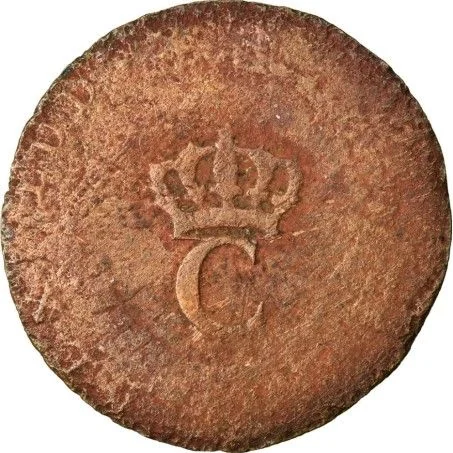
A crowned C with remnants of the Louis XV 2 sols circular inscription.
Inscription:
• LUD • XV • D • G • FR • ET • NAV • REX
C
C
Script: Latin
Reverse
Description:
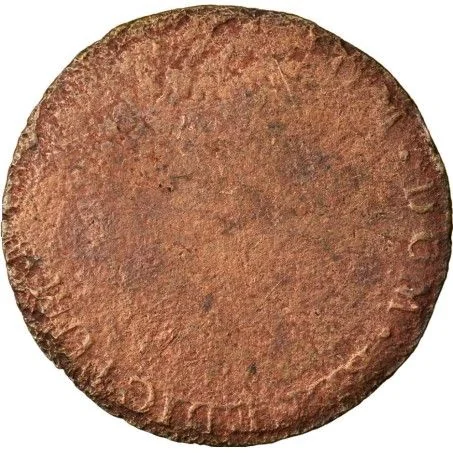
Faint traces of the coin's circular lettering.
Inscription:
• SIT • NOM • DOM • B • BENEDICTUM 1740
Script: Latin
Edge
Plain
Mintings
| Year | Mint Mark | Mintage | Quality | Collection |
|---|---|---|---|---|
| 1763 | — | 6,000,000 |
Historical background
In 1763, the currency situation in the French West Indies, particularly in the key colonies of Martinique, Guadeloupe, and Saint-Domingue, was characterized by severe scarcity and chaotic multiplicity. The Seven Years' War (1756-1763) had just ended, and France ceded valuable territories like Canada and Louisiana to Britain. While the sugar islands were returned to France by the Treaty of Paris, the war had disrupted Atlantic trade, leading to a critical shortage of official French coinage (livres tournois) in the colonies. This scarcity crippled everyday commerce and the plantation economy, which relied on currency to pay for imported goods, contracted services, and a portion of enslaved laborers' incentives.
The vacuum was filled by a confusing patchwork of foreign and improvised currencies. Spanish pieces of eight (reales) and Portuguese gold coins, brought by inter-island trade, circulated widely but at fluctuating values set by local authorities. More significantly, the colonies heavily relied on monnoye de papier—paper notes issued by local authorities and even private merchants. These notes were essentially debt instruments, promises to pay in specie, but their value was highly unstable and tied to the credibility of the issuer. The most notorious form of money was the primitive "money of account" based on the value of staple commodities, like sugar in Saint-Domingue or coffee in Martinique, further complicating transactions.
This unstable monetary environment was a direct concern for the French Crown, as it hindered tax collection and economic control. In response, the royal administration attempted to impose order by officially devaluing the livre tournois against Spanish silver in the colonies in 1763, a measure aimed at attracting foreign coin but which often caused inflation and confusion. Ultimately, the post-1763 period highlighted the fundamental tension between the colonies' booming export economy and their dependence on metropolitan France for a stable circulating medium, a problem that would persist and contribute to future economic grievances.
The vacuum was filled by a confusing patchwork of foreign and improvised currencies. Spanish pieces of eight (reales) and Portuguese gold coins, brought by inter-island trade, circulated widely but at fluctuating values set by local authorities. More significantly, the colonies heavily relied on monnoye de papier—paper notes issued by local authorities and even private merchants. These notes were essentially debt instruments, promises to pay in specie, but their value was highly unstable and tied to the credibility of the issuer. The most notorious form of money was the primitive "money of account" based on the value of staple commodities, like sugar in Saint-Domingue or coffee in Martinique, further complicating transactions.
This unstable monetary environment was a direct concern for the French Crown, as it hindered tax collection and economic control. In response, the royal administration attempted to impose order by officially devaluing the livre tournois against Spanish silver in the colonies in 1763, a measure aimed at attracting foreign coin but which often caused inflation and confusion. Ultimately, the post-1763 period highlighted the fundamental tension between the colonies' booming export economy and their dependence on metropolitan France for a stable circulating medium, a problem that would persist and contribute to future economic grievances.
✨ Legendary