

1 Piastra – Papal States
Circulating commemorative coins
Commemoration: Restoration of the Basilica of Santa Maria in Trastevere
Vatican City
Context
Year: 1702
Country: Vatican City 
Issuer: Papal States
Ruler: Clement XI
Currency:
(1534—1835)
Demonetized: Yes
Material
References
KM: #Click to copy to clipboard664
Numista: #29396
Value
Bullion value: $83.27
Obverse
Description:
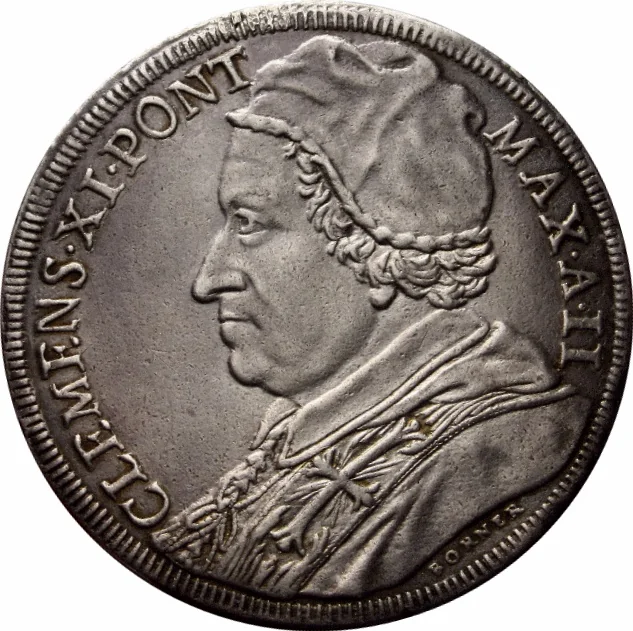
Pope Clement XI in camauro, facing left. Engraver's name below.
Inscription:
CLEMENS • XI • PONT MAX • A • II
BORNER
BORNER
Script: Latin
Engraver: Peter Paul Borner
Reverse
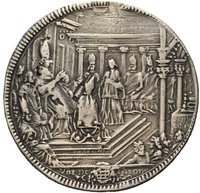
Description:
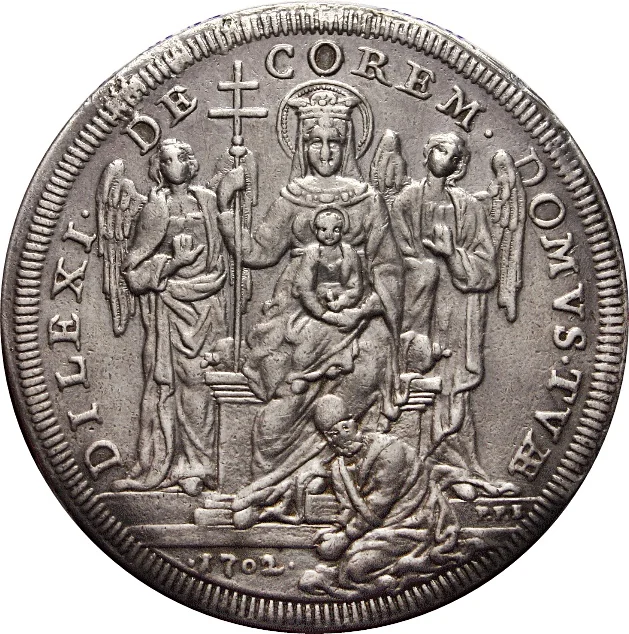
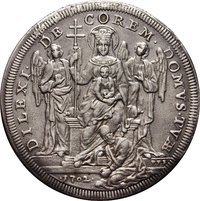
Our Lady of St. Mary in Trastevere enthroned with child, flanked by angels, with Pope Innocent II kneeling before her. Date in exergue. Engraver's initials on throne base.
Inscription:
DILEXI • DE COREM • DOMVS • TVÆ
P.P.B
• 1702 •
P.P.B
• 1702 •
Script: Latin
Engraver: Peter Paul Borner
Edge
Plain
Categories
| Building> Religious building |
Mints
| Name | Mark |
|---|---|
| Rome | — |
Mintings
| Year | Mint Mark | Mintage | Quality | Collection |
|---|---|---|---|---|
| 1702 | — | — |
Historical background
In 1702, the Papal States under Pope Clement XI faced a complex and deteriorating currency situation, a legacy of prolonged fiscal strain. The state’s finances were heavily burdened by the costs of administration, lavish patronage, and military expenditures, including involvement in the War of the Spanish Succession. To meet these obligations, the papal mint had for decades engaged in systematic debasement, reducing the silver content in coins like the grosso and the giulio. This practice created a system where newer, inferior coins circulated alongside older, purer ones, leading to widespread confusion, loss of public trust, and Gresham’s Law in action (“bad money drives out good”).
The monetary chaos was exacerbated by a severe shortage of small-denomination coins for everyday trade, which crippled the local economy. Furthermore, the Papal States were flooded with foreign currencies, particularly high-quality silver from Spain and the Dutch Republic, which were hoarded or exported, leaving the inferior papal coinage as the primary circulating medium. This situation caused significant inflation, harmed merchants and the poor, and undermined the economic stability of the territories. Attempts at reform were piecemeal and largely ineffective, as the Holy See’s immediate need for revenue consistently outweighed long-term monetary stability.
Consequently, the currency crisis of 1702 was not an isolated event but a symptom of deeper structural weaknesses. The inability to control the coinage reflected the broader administrative and political challenges facing the Papal States, caught between its spiritual authority and its temporal governance. The monetary instability would persist for much of the 18th century, requiring more concerted, but ultimately still problematic, reforms under later popes like Benedict XIV.
The monetary chaos was exacerbated by a severe shortage of small-denomination coins for everyday trade, which crippled the local economy. Furthermore, the Papal States were flooded with foreign currencies, particularly high-quality silver from Spain and the Dutch Republic, which were hoarded or exported, leaving the inferior papal coinage as the primary circulating medium. This situation caused significant inflation, harmed merchants and the poor, and undermined the economic stability of the territories. Attempts at reform were piecemeal and largely ineffective, as the Holy See’s immediate need for revenue consistently outweighed long-term monetary stability.
Consequently, the currency crisis of 1702 was not an isolated event but a symptom of deeper structural weaknesses. The inability to control the coinage reflected the broader administrative and political challenges facing the Papal States, caught between its spiritual authority and its temporal governance. The monetary instability would persist for much of the 18th century, requiring more concerted, but ultimately still problematic, reforms under later popes like Benedict XIV.
✨ Legendary