

1 Scudo – Cispadane Republic
Italy
Context
Years: 1796–1797
Country: Italy 
Issuer: Cispadane Republic
Period:
(1796—1797)
Currency:
Subdivision: 1 Scudo = 10 Giuli/Paoli
Demonetized: Yes
Material
References
KM: #Click to copy to clipboard339
Numista: #29324
Value
Bullion value: $69.78
Obverse
Description:
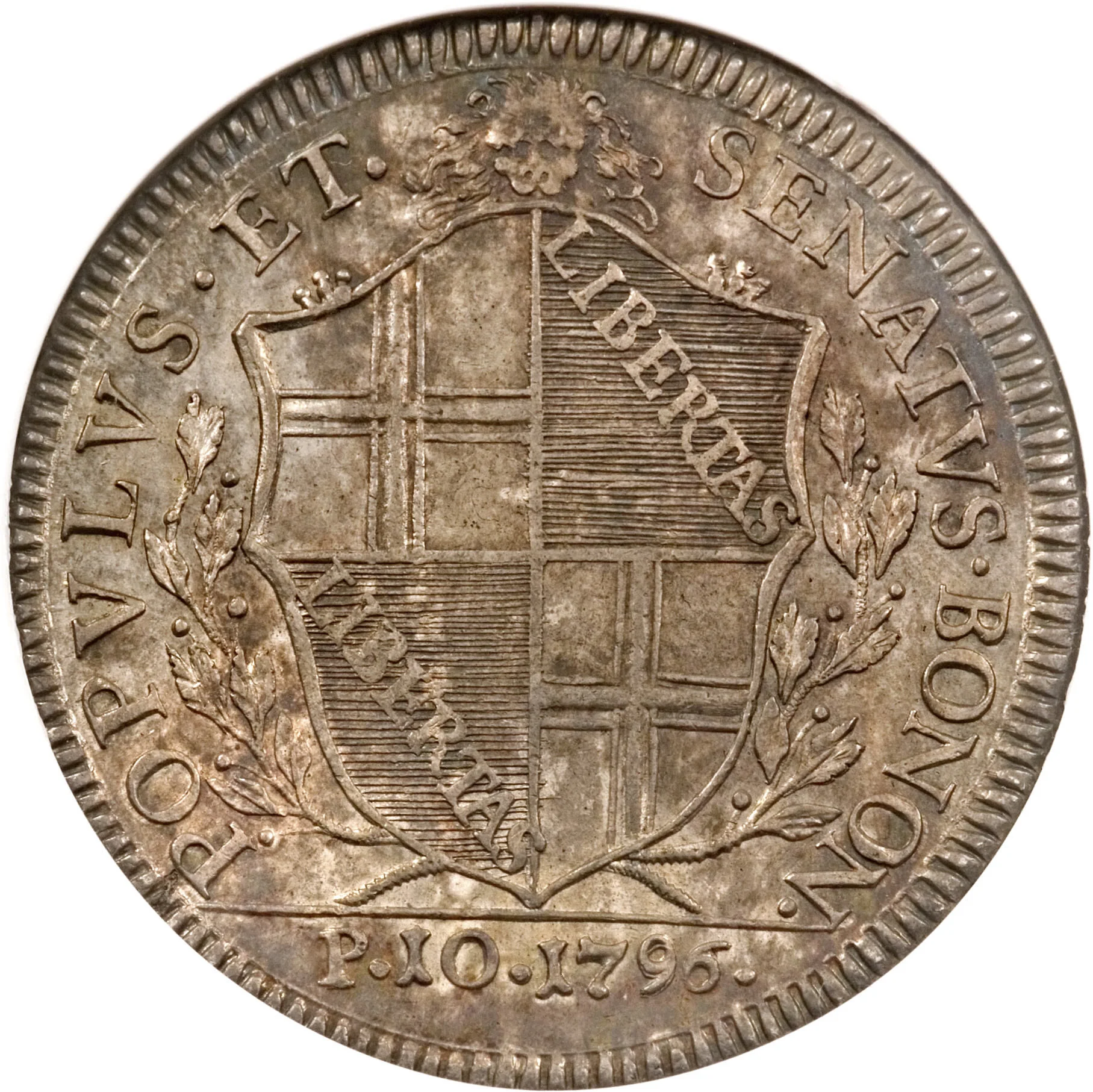
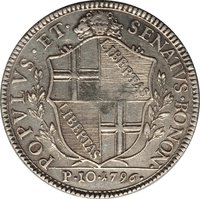
Shielded arms within a wreath, topped by a lion's head and a date below.
Inscription:
POPVLVS • ET • SENATVS • BONON •
dans les armes : LIBERTAS
P.10 . 1796.
dans les armes : LIBERTAS
P.10 . 1796.
Script: Latin
Reverse
Description:
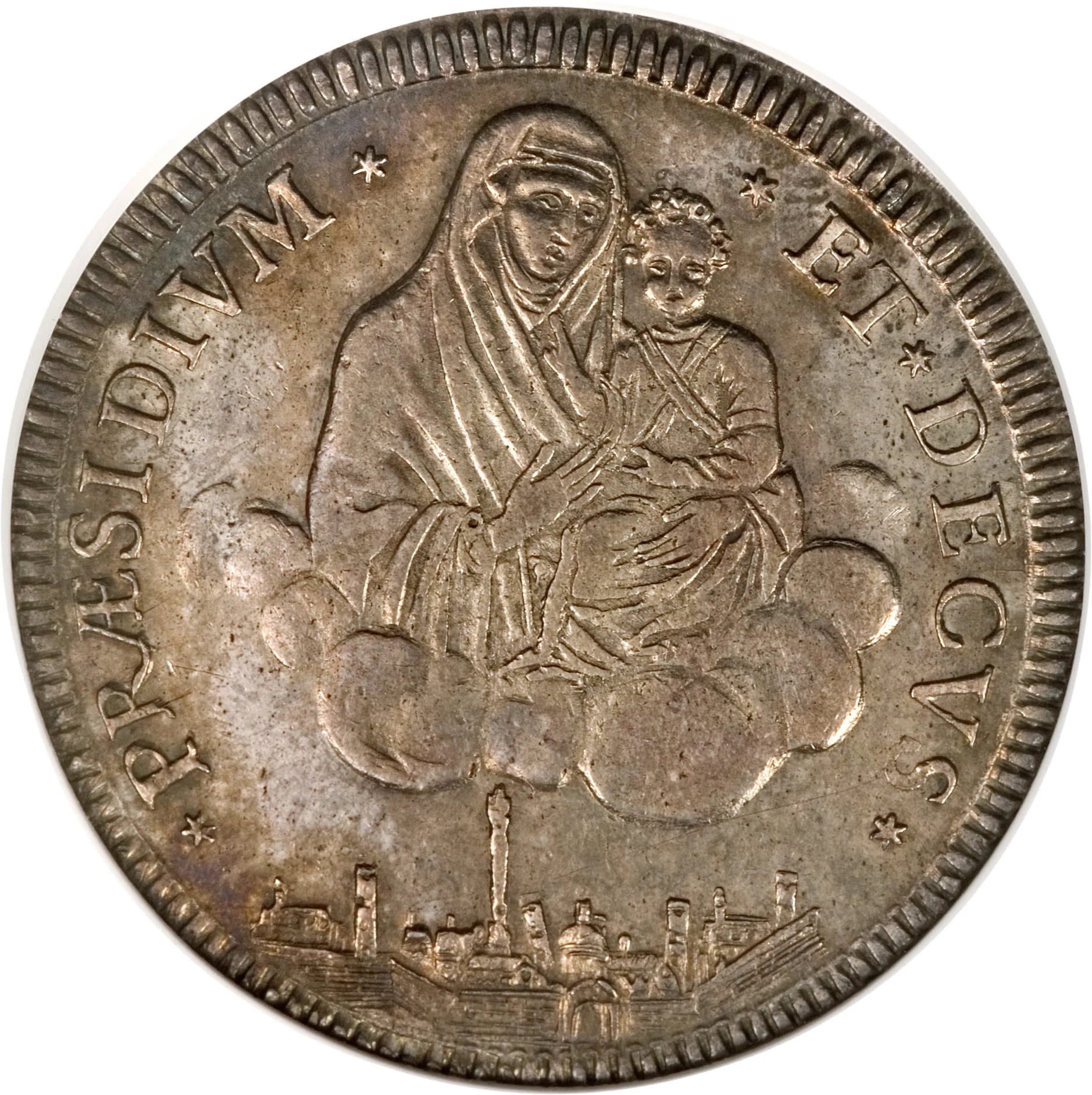
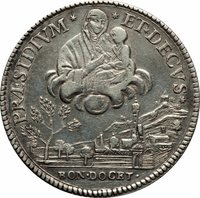
Madonna and Child on a cloud above Bologna.
Inscription:
PRAESIDIVM • • ET • DECVS •
Script: Latin
Edge
Floral pattern in relief
Mints
| Name | Mark |
|---|---|
| Bologna | — |
Mintings
| Year | Mint Mark | Mintage | Quality | Collection |
|---|---|---|---|---|
| 1796 | — | — | ||
| 1797 | — | — |
Historical background
The Cispadane Republic, established in late 1796 in northern Italy under French revolutionary patronage, faced immediate and severe monetary instability. Its territory, carved from former Papal and Austrian holdings, inherited a chaotic mix of circulating currencies, including Papal scudi, Austrian thalers, and various local Italian coinages. This fragmentation crippled trade and state administration, prompting the republic's government, heavily influenced by Napoleon Bonaparte, to declare a new national currency as a fundamental act of sovereignty and modernization. The decree aimed to replace the old feudal and foreign monies with a unified, decimal-based system mirroring the French franc, symbolizing a break from the Ancien Régime.
The chosen system was the lira, subdivided into 20 soldi or 100 centesimi, directly aligning it with the French monetary model. However, the republic's brief existence—it would merge into the larger Cisalpine Republic by July 1797—meant these plans were largely aspirational. The government lacked the time, resources, and minting capacity to produce sufficient quantities of the new coinage. Consequently, while the lira was established as the official unit of account for government finances and legal purposes, the everyday economy continued to rely on a cumbersome circulation of old, heterogeneous coins, with their values fluctuating against the notional new standard.
Thus, the currency situation in 1796 was one of ambitious legal reform starkly contrasted by practical failure. The Cispadane Republic successfully legislated a modern, decimal currency system as a ideological and political statement, laying a foundational blueprint for future Italian monetary unification. In reality, however, it failed to implement this system, leaving a legacy of monetary theory rather than tangible change. The persistent circulation of outdated coins underscored the gap between revolutionary decree and on-the-ground economic reality in a fragile, short-lived state.
The chosen system was the lira, subdivided into 20 soldi or 100 centesimi, directly aligning it with the French monetary model. However, the republic's brief existence—it would merge into the larger Cisalpine Republic by July 1797—meant these plans were largely aspirational. The government lacked the time, resources, and minting capacity to produce sufficient quantities of the new coinage. Consequently, while the lira was established as the official unit of account for government finances and legal purposes, the everyday economy continued to rely on a cumbersome circulation of old, heterogeneous coins, with their values fluctuating against the notional new standard.
Thus, the currency situation in 1796 was one of ambitious legal reform starkly contrasted by practical failure. The Cispadane Republic successfully legislated a modern, decimal currency system as a ideological and political statement, laying a foundational blueprint for future Italian monetary unification. In reality, however, it failed to implement this system, leaving a legacy of monetary theory rather than tangible change. The persistent circulation of outdated coins underscored the gap between revolutionary decree and on-the-ground economic reality in a fragile, short-lived state.
💎 Extremely Rare