

3 Thalers – Brunswick-Lüneburg-Celle
Germany
Context
Year: 1665
Country: Germany 
Issuer: Brunswick-Lüneburg-Celle
Ruler: Christian Louis
Currency:
Demonetized: Yes
References
KM: #Click to copy to clipboard256.2
Numista: #292346
Value
Bullion value: $247.92
Obverse
Description:
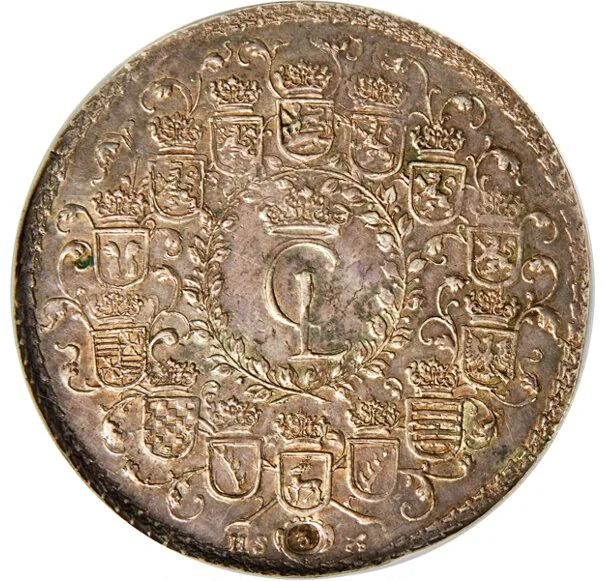
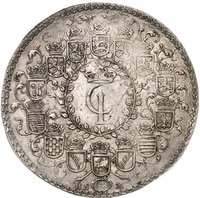
CL monogram with crown, encircled by 14 small shields. Legend includes date and "3" punch mark.
Inscription:
CL
HS
3
HS
3
Script: Latin
Reverse
Edge
Mints
| Name | Mark |
|---|---|
| Zellerfeld | — |
Mintings
| Year | Mint Mark | Mintage | Quality | Collection |
|---|---|---|---|---|
| 1665 | — | — |
Historical background
In 1665, the Duchy of Brunswick-Lüneburg, specifically the Principality of Celle under Duke George William, was entangled in the complex and fragmented monetary landscape of the Holy Roman Empire. The region lacked a unified currency, operating instead within a system where multiple authorities—the Emperor, the Imperial Circles, and individual territorial princes—all claimed minting rights. This resulted in a proliferation of coins of varying standards, with the Reichsthaler serving as a common accounting unit but with its physical counterpart, the Speciesthaler, competing with numerous local and regional issues like the Lüneburg Thaler. The situation was further complicated by the circulation of foreign coins from trade and the persistent problem of debased coinage from neighboring states.
Duke George William faced significant economic pressure to manage this system effectively. The need to finance his court and administration, coupled with the costs of maintaining a modern army—a notable priority in Celle—created a constant temptation to generate revenue through seigniorage (the profit from minting). However, reckless debasement risked damaging the principality’s commercial credibility. Celle’s economy, with its important trade routes and annual fairs, relied on a relatively stable and trustworthy currency to facilitate commerce and tax collection. The Duke therefore had to navigate a careful path between fiscal necessity and monetary stability.
Consequently, the currency situation in 1665 was one of fragile equilibrium, characterized by ongoing negotiation and occasional conflict. George William participated in the monetary ordinances of the Upper Saxon Circle, which aimed to harmonize standards and combat the influx of inferior money. Yet, these agreements were often difficult to enforce. The year falls within a period of active monetary policy in Celle, as the duchy worked to assert control over its coinage, striving to ensure that its issued Thalers and smaller denominations maintained a good Kipper und Wipper period earlier in the century. The stability of Celle's currency was thus a direct reflection of the Duke’s political will and his need to balance domestic fiscal demands with the imperative of participating in a wider, interdependent economic region.
Duke George William faced significant economic pressure to manage this system effectively. The need to finance his court and administration, coupled with the costs of maintaining a modern army—a notable priority in Celle—created a constant temptation to generate revenue through seigniorage (the profit from minting). However, reckless debasement risked damaging the principality’s commercial credibility. Celle’s economy, with its important trade routes and annual fairs, relied on a relatively stable and trustworthy currency to facilitate commerce and tax collection. The Duke therefore had to navigate a careful path between fiscal necessity and monetary stability.
Consequently, the currency situation in 1665 was one of fragile equilibrium, characterized by ongoing negotiation and occasional conflict. George William participated in the monetary ordinances of the Upper Saxon Circle, which aimed to harmonize standards and combat the influx of inferior money. Yet, these agreements were often difficult to enforce. The year falls within a period of active monetary policy in Celle, as the duchy worked to assert control over its coinage, striving to ensure that its issued Thalers and smaller denominations maintained a good Kipper und Wipper period earlier in the century. The stability of Celle's currency was thus a direct reflection of the Duke’s political will and his need to balance domestic fiscal demands with the imperative of participating in a wider, interdependent economic region.
✨ Legendary