

Obverse
Description:
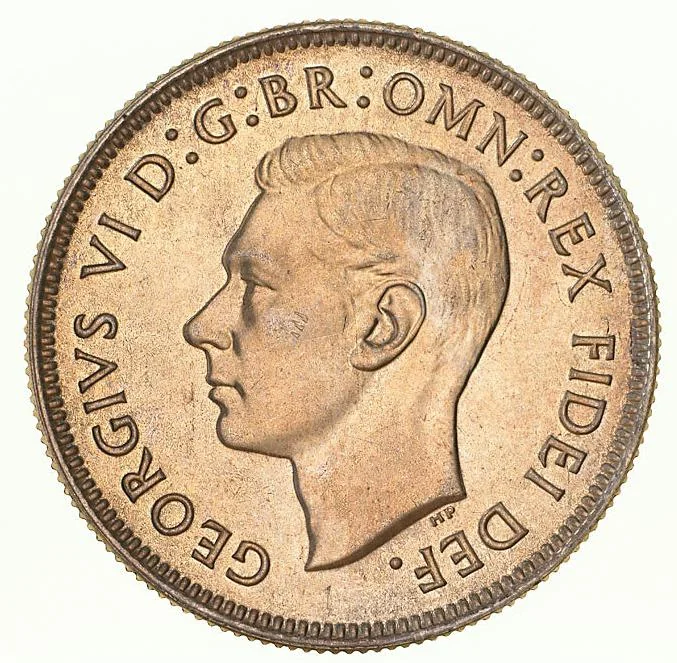
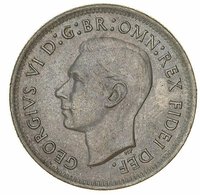
King George VI, left-facing portrait.
Inscription:
GEORGIVS VI D:G:BR:OMN:REX FIDEI DEF.
HP
HP
Translation:
George VI by the Grace of God King of all the Britains Defender of the Faith.
Script: Latin
Language: Latin
Designer: Thomas Humphrey Paget
Reverse
Description:
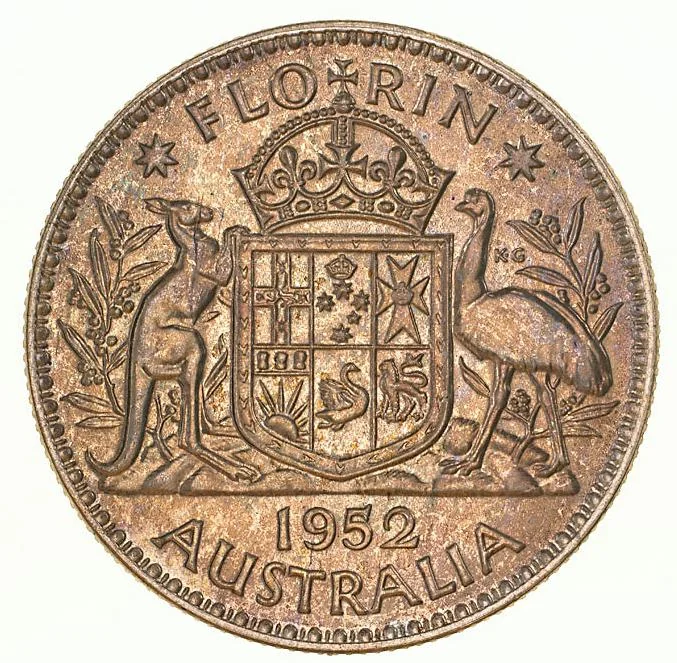
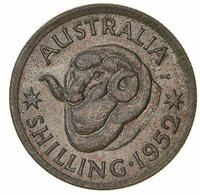
Australian coat of arms
Inscription:
FLO RIN
K·G
1952
AUSTRALIA
K·G
1952
AUSTRALIA
Script: Latin
Designer: George Kruger Gray
Edge
Reeded
Mints
| Name | Mark |
|---|---|
| Royal Mint | — |
Mintings
| Year | Mint Mark | Mintage | Quality | Collection |
|---|---|---|---|---|
| 1951 | — | 10,068,000 | ||
| 1952 | — | 10,044,000 |
Historical background
In 1951, Australia’s currency situation was fundamentally defined by its adherence to the Bretton Woods system, which pegged the Australian pound (£A) to the British pound sterling (£Stg) at parity, and indirectly to the US dollar via a fixed gold price. This meant the value of the Australian currency was not freely floating but was managed by the government and the Commonwealth Bank (the central bank at the time) within a framework of strict exchange controls. These controls, established during World War II, remained in force to conserve scarce US dollar reserves, regulate capital flows, and ensure stability by prioritising essential imports over luxury goods.
The economic context of 1951 was one of intense inflationary pressure and a dramatic shift in Australia's terms of trade. The Korean War boom (1950-51) caused prices for Australia’s key wool exports to skyrocket, creating a massive inflow of sterling revenue. However, this surge in export income flooded the domestic economy with pounds, fueling rampant inflation as consumer demand outstripped the supply of imported and local goods. This created a complex monetary policy challenge: managing the inflationary consequences of a booming export sector while maintaining the fixed exchange rate peg.
Consequently, monetary policy in 1951 was primarily focused on domestic inflation rather than currency valuation itself. The Commonwealth Bank utilised direct tools like credit controls and increased interest rates on government bonds to try to curb spending and credit growth. The fixed exchange rate itself was not in crisis, but the pressures of the boom highlighted the constraints of the system. The situation began to ease in late 1951 as the wool price bubble burst, but the year underscored the difficulties of managing a fixed currency peg in the face of volatile commodity prices and strong domestic economic pressures.
The economic context of 1951 was one of intense inflationary pressure and a dramatic shift in Australia's terms of trade. The Korean War boom (1950-51) caused prices for Australia’s key wool exports to skyrocket, creating a massive inflow of sterling revenue. However, this surge in export income flooded the domestic economy with pounds, fueling rampant inflation as consumer demand outstripped the supply of imported and local goods. This created a complex monetary policy challenge: managing the inflationary consequences of a booming export sector while maintaining the fixed exchange rate peg.
Consequently, monetary policy in 1951 was primarily focused on domestic inflation rather than currency valuation itself. The Commonwealth Bank utilised direct tools like credit controls and increased interest rates on government bonds to try to curb spending and credit growth. The fixed exchange rate itself was not in crisis, but the pressures of the boom highlighted the constraints of the system. The situation began to ease in late 1951 as the wool price bubble burst, but the year underscored the difficulties of managing a fixed currency peg in the face of volatile commodity prices and strong domestic economic pressures.
🌱 Common