

25 centimes – France
Add to wishlist
France
Context
Years: 1914–1917
Issuer: France
Period:
(1870—1940)
Currency:
(1795—1959)
Demonetization: 15 February 1942
Total mintage: 699,873
Material
Diameter: 24 mm
Weight: 5 g
Thickness: 1.5 mm
Shape: Round with a round hole
Composition: Nickel
Magnetic: Yes
Technique: Milled
Alignment: Coin alignment
flip
References
KM: #
Numista: #1162
Obverse
Description:
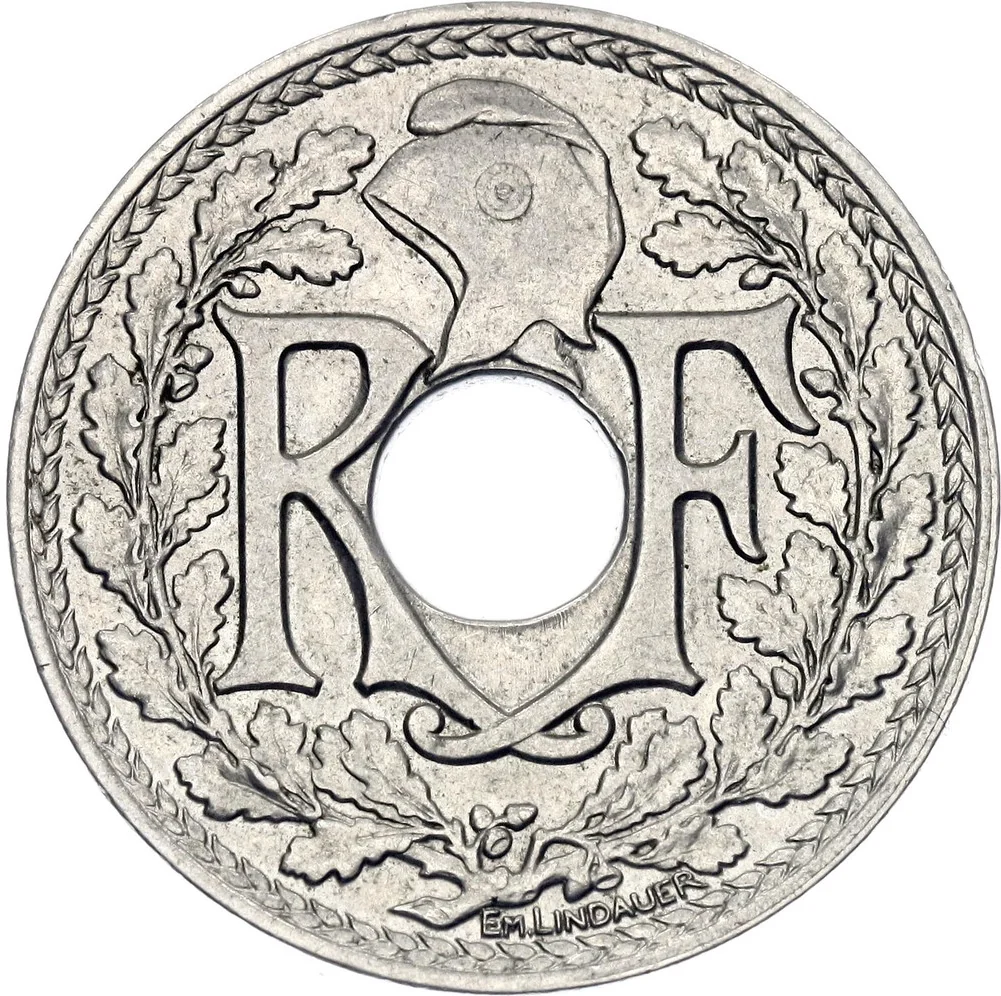
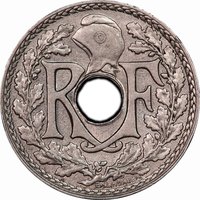
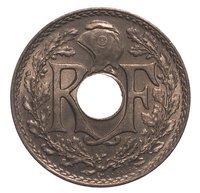
Monogram with central hole, liberty cap above, encircled by oak wreath.
Inscription:
R F
EM LINDAUER
EM LINDAUER
Translation:
R(es) F(ublica) Lindauer
Script: Latin
Language: Latin
Engraver: Edmond-Émile Lindauer
Reverse
Description:
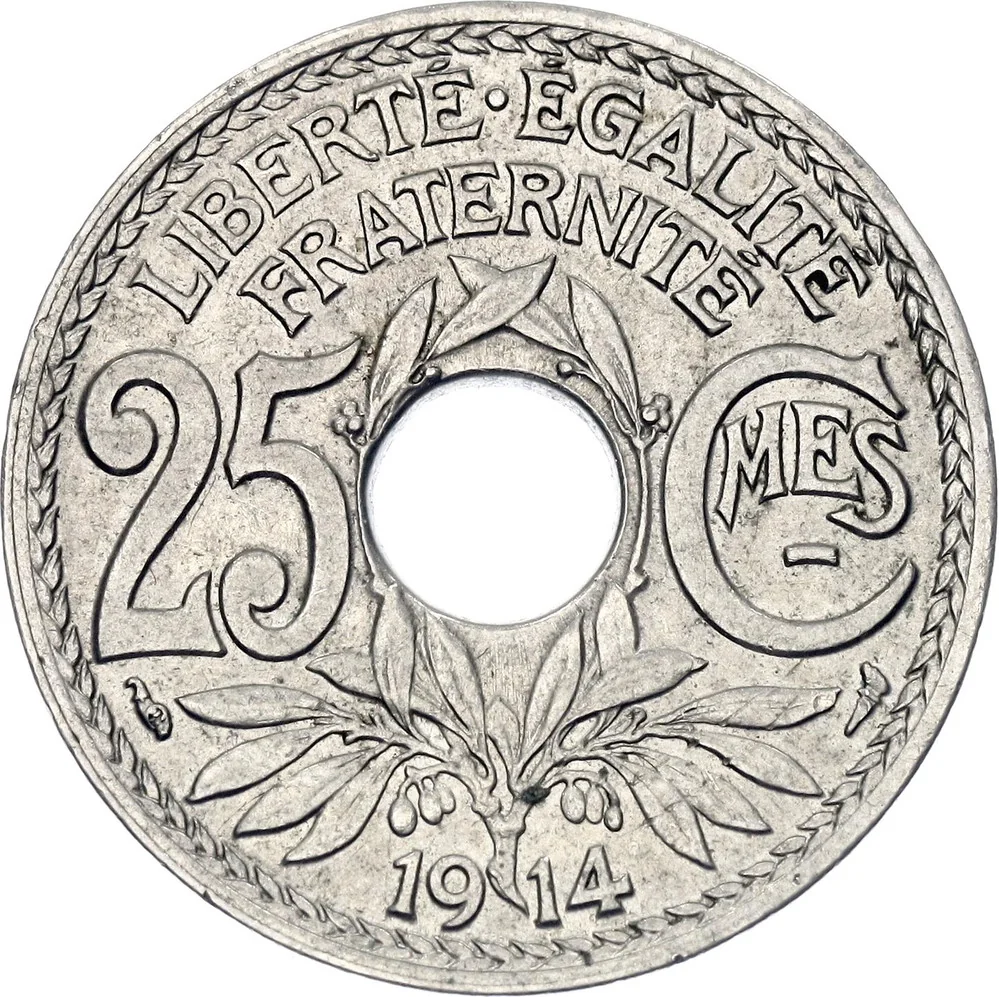
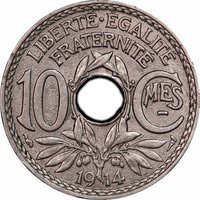
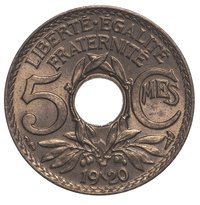
Centre hole splits olive branch. Dash under "MES." Date below.
Inscription:
LIBERTÉ·ÉGALITÉ
FRATERNITE
25 CMES
1917
FRATERNITE
25 CMES
1917
Translation:
LIBERTY EQUALITY
FRATERNITY
25 CENTIMES
1917
FRATERNITY
25 CENTIMES
1917
Script: Latin
Language: French
Engraver: Edmond-Émile Lindauer
Edge
Plain
Mints
| Name | Mark |
|---|---|
| Monnaie de Paris | — |
Mintings
| Year | Mint Mark | Mintage | Quality | Collection |
|---|---|---|---|---|
| 1914 | — | — | ||
| 1915 | — | 535,227 | ||
| 1916 | — | 99,608 | ||
| 1917 | — | 65,038 |
Historical background
In 1914, France operated under the gold standard, a system managed by the Banque de France. The franc, established in the late 18th century, was legally defined as 0.2903225 grams of fine gold, a parity set in 1803 and remarkably stable for over a century. This "germinal franc" symbolized financial solidity and national prestige. The Banque de France held substantial gold reserves to back its banknotes, which were legally convertible into gold coin upon demand, though in practice, large silver coins and banknotes were the common circulating media.
The financial system was robust but not overly centralized, with several private issuing banks still operating alongside the Banque de France in certain regions. However, the economy was characterized by a distinct preference for liquidity and a deep-seated aversion to debt, rooted in traumatic experiences like the collapse of John Law's system in the 1720s and the assignat hyperinflation during the French Revolution. This "currency trauma" made the public and policymakers deeply conservative, prioring monetary stability and hoarding gold coins (napoléons) as private savings.
When war was declared in August 1914, this stable system was immediately suspended to prevent a run on gold and to finance mobilization. The government declared a moratorium on debt payments, made banknotes legal tender and inconvertible into gold, and the Banque de France began providing massive advances to the state. These emergency measures, intended to be temporary, marked the decisive end of the classical gold standard era in France, setting the stage for the wartime inflation and profound monetary challenges that would follow.
The financial system was robust but not overly centralized, with several private issuing banks still operating alongside the Banque de France in certain regions. However, the economy was characterized by a distinct preference for liquidity and a deep-seated aversion to debt, rooted in traumatic experiences like the collapse of John Law's system in the 1720s and the assignat hyperinflation during the French Revolution. This "currency trauma" made the public and policymakers deeply conservative, prioring monetary stability and hoarding gold coins (napoléons) as private savings.
When war was declared in August 1914, this stable system was immediately suspended to prevent a run on gold and to finance mobilization. The government declared a moratorium on debt payments, made banknotes legal tender and inconvertible into gold, and the Banque de France began providing massive advances to the state. These emergency measures, intended to be temporary, marked the decisive end of the classical gold standard era in France, setting the stage for the wartime inflation and profound monetary challenges that would follow.
🌱 Very Common