

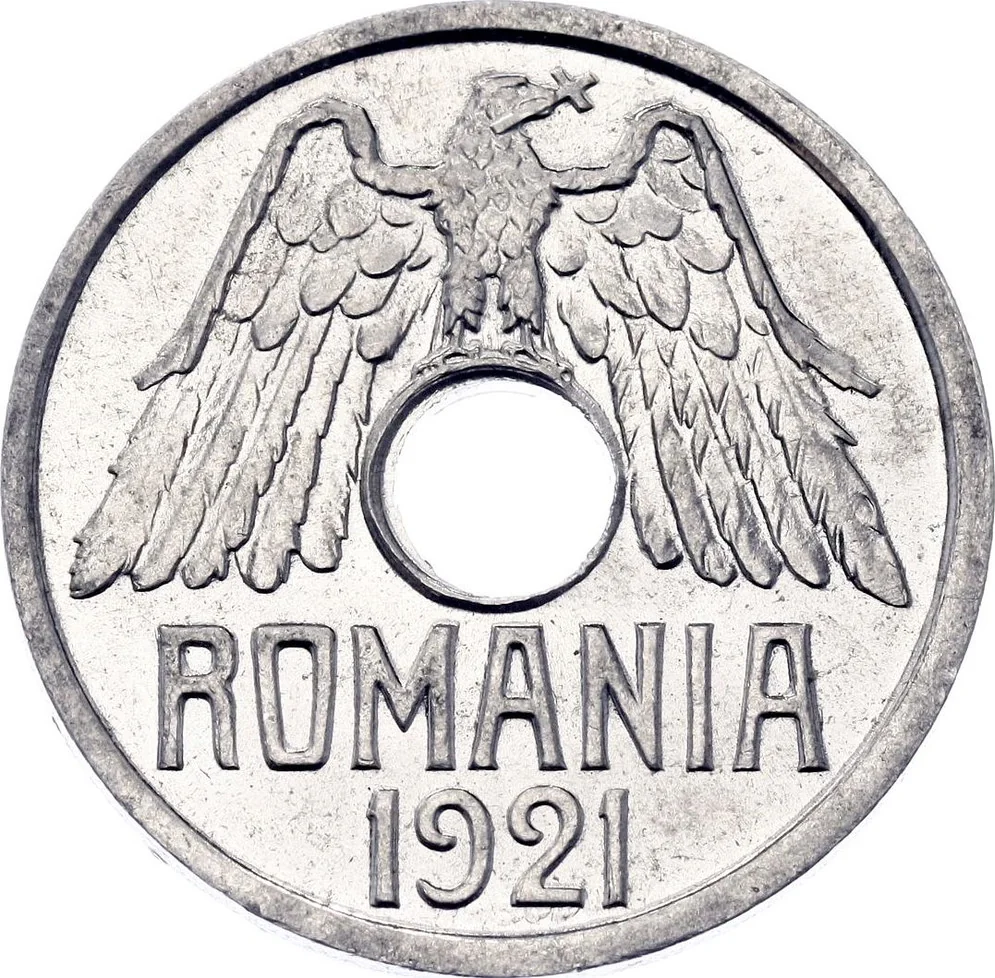
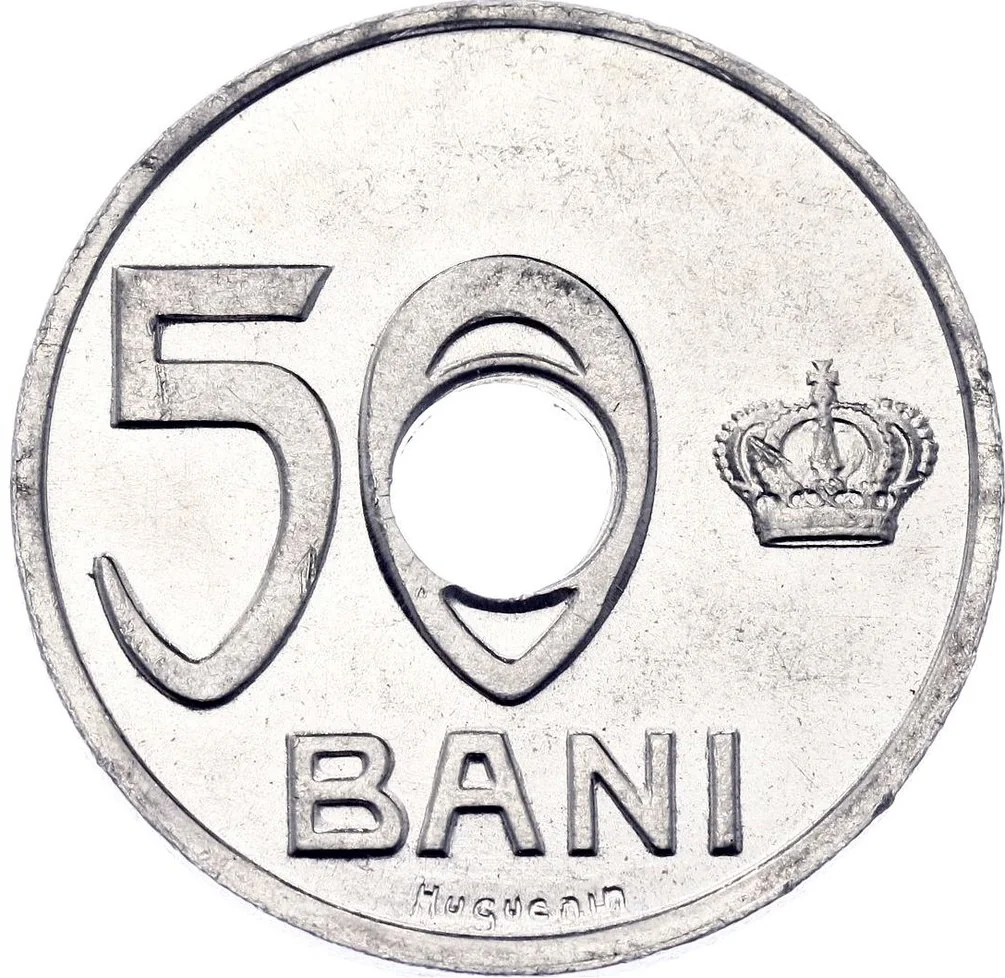
50 Bani – Romania
Romania
Context
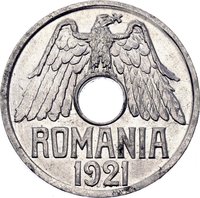
Year: 1921
Issuer: Romania 
Ruler: Ferdinand I
Currency:
(1867—1947)
Demonetized: Yes
Total mintage: 30,000,000
Material
Diameter: 21 mm
Weight: 1.2 g
Shape: Round with a round hole
Composition: Aluminium
Magnetic: No
Technique: Milled
Alignment: Medal alignment
flip
References
KM: #Click to copy to clipboard45
Numista: #11618
Obverse
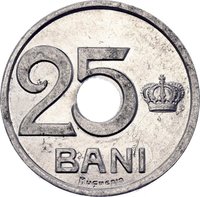
Reverse
Edge
Plain
Mints
| Name | Mark |
|---|---|
| Huguenin | — |
Mintings
| Year | Mint Mark | Mintage | Quality | Collection |
|---|---|---|---|---|
| 1921 | — | 30,000,000 |
Historical background
In 1921, Romania was grappling with severe currency instability and inflation, a direct legacy of the First World War. The national currency, the Romanian leu, had been decoupled from the gold standard in 1914 to finance the war effort, leading to excessive printing of banknotes. By the early 1920s, the money supply had expanded dramatically, while agricultural and industrial production—the country's economic backbone—remained below pre-war levels. This imbalance between available goods and circulating currency fueled rampant inflation, eroding purchasing power and creating significant hardship for the population, particularly those on fixed incomes.
The situation was further complicated by the post-war territorial expansions, which unified regions with different monetary systems. Integrating the currencies of newly acquired regions like Transylvania, Bukovina, and Bessarabia into a single national system presented a massive administrative and economic challenge. The government, led by the Liberal Party under Prime Minister Ion I. C. Brătianu, recognized the urgent need for stabilization but faced political fragmentation and the immense costs of reconstruction and agrarian reform. Consequently, stopgap measures and foreign loans provided only temporary relief without addressing the core monetary disorder.
Therefore, 1921 stands as a critical year of mounting pressure that set the stage for the major monetary reform that would follow. The persistent inflation and economic fragility underscored the necessity for decisive action, culminating in the landmark stabilization law of 1929. This later reform, engineered with the help of a League of Nations loan, finally re-established the gold standard and introduced a new, stable leu, ending the chaotic period of which 1921 was a defining chapter.
The situation was further complicated by the post-war territorial expansions, which unified regions with different monetary systems. Integrating the currencies of newly acquired regions like Transylvania, Bukovina, and Bessarabia into a single national system presented a massive administrative and economic challenge. The government, led by the Liberal Party under Prime Minister Ion I. C. Brătianu, recognized the urgent need for stabilization but faced political fragmentation and the immense costs of reconstruction and agrarian reform. Consequently, stopgap measures and foreign loans provided only temporary relief without addressing the core monetary disorder.
Therefore, 1921 stands as a critical year of mounting pressure that set the stage for the major monetary reform that would follow. The persistent inflation and economic fragility underscored the necessity for decisive action, culminating in the landmark stabilization law of 1929. This later reform, engineered with the help of a League of Nations loan, finally re-established the gold standard and introduced a new, stable leu, ending the chaotic period of which 1921 was a defining chapter.
🌱 Common