

1 Silver Ecu – France
France

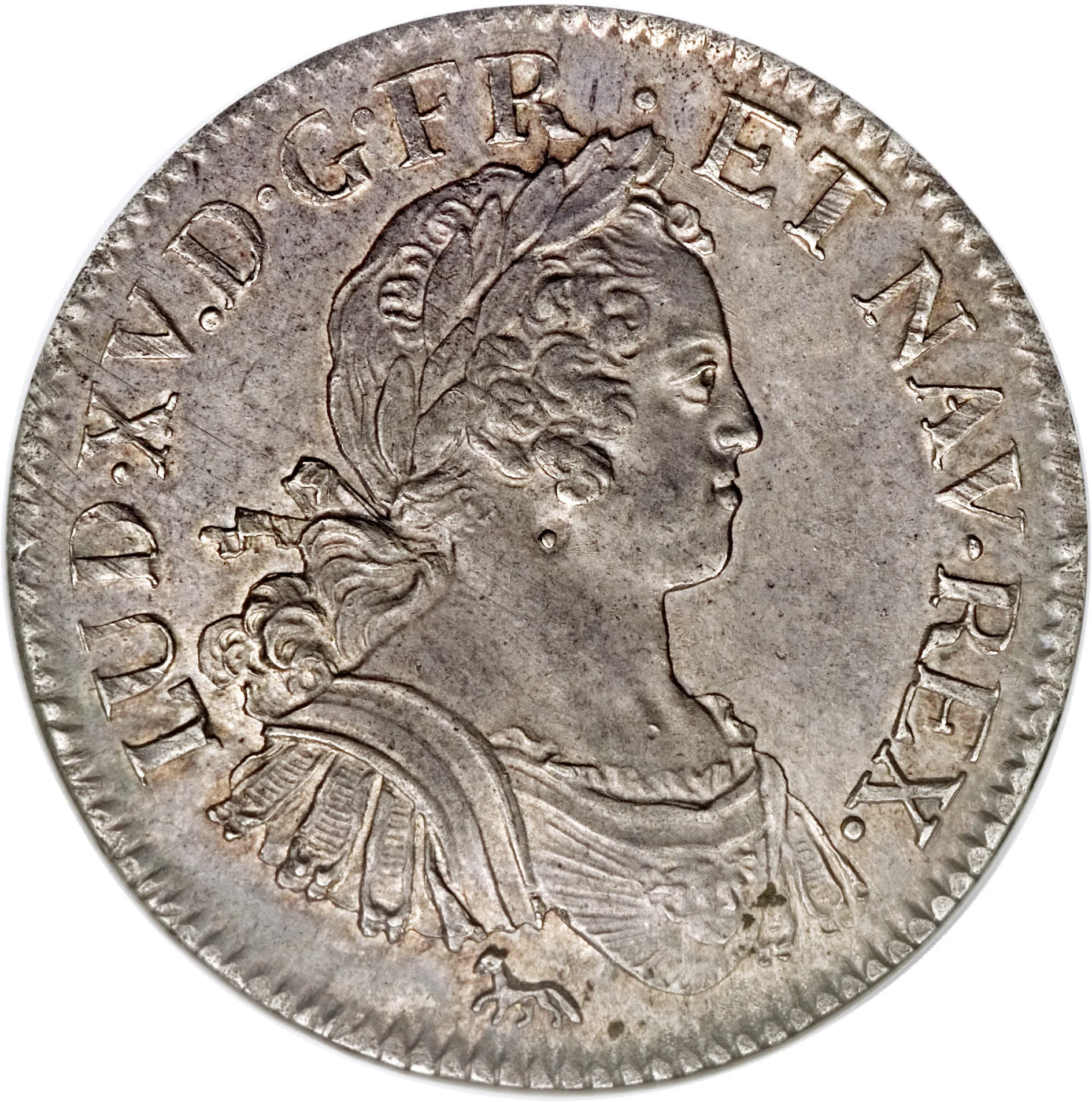
Obverse
Description:
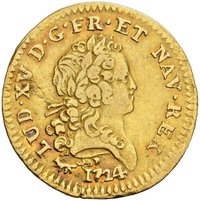
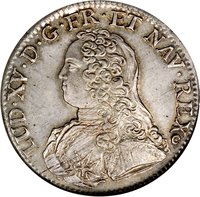
Laureate head right, inscription around.
Inscription:
* LUD . XV D . G . FR . ET . NAV . REX
Script: Latin
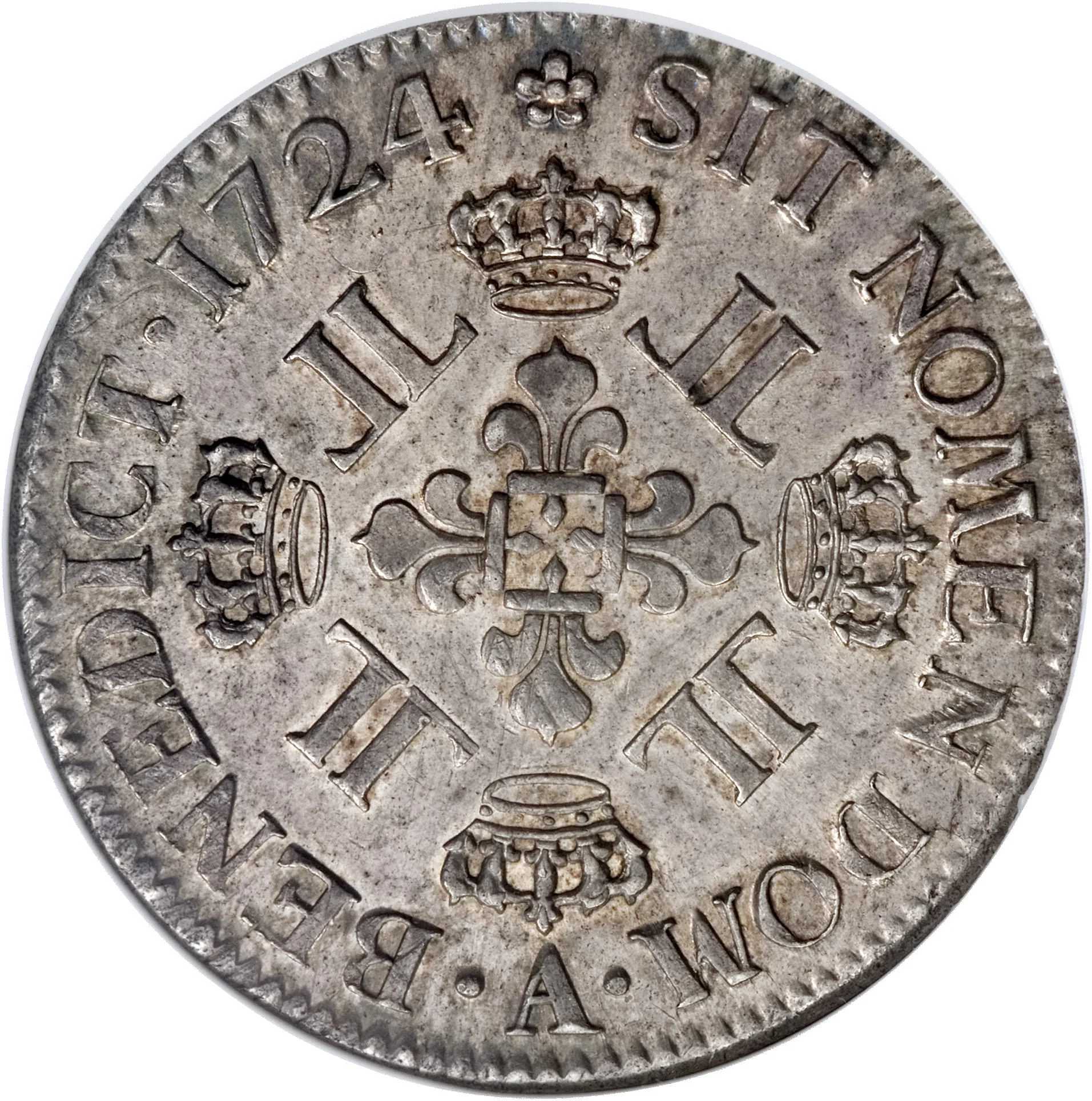
Reverse
Description:
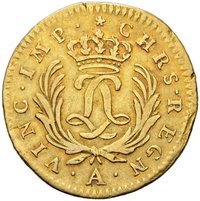
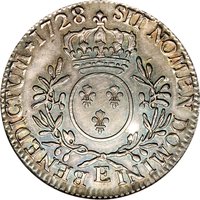
Four fleurs-de-lis center a square, encircled by four crowns separated by mirrored L's, with a dated inscription around the rim.
Inscription:
SIT . NOMEN DOM . BENEDICT . 1724
Script: Latin
Edge
Plain
Legend:
DOMINE SALVUM FAC REGEM
Categories
| Symbol> Fleur-de-lis |
Mints
| Name | Mark |
|---|---|
| Aix-en-Provence | & |
| Rennes | 9 |
| Monnaie de Paris | A |
| Metz | AA |
| Rouen | B |
| Caen | C |
| Lyon | D |
| Tours | E |
| Poitiers | G |
| La Rochelle | H |
| Limoges | I |
| Bordeaux | K |
| Bayonne | L |
| Montpellier | N |
| Riom | O |
| Dijon | P |
| Reims | S |
| Nantes | T |
| Lille | W |
| Amiens | X |
| Bourges | Y |
| Grenoble | Z |
| Besançon | ϽϹ |
Mintings
| Year | Mint Mark | Mintage | Quality | Collection |
|---|---|---|---|---|
| 1724 | & | — | ||
| 1724 | 9 | 311,000 | ||
| 1724 | A | — | ||
| 1724 | AA | 27,000 | ||
| 1724 | B | — | ||
| 1724 | C | 102,000 | ||
| 1724 | D | 313,000 | ||
| 1724 | E | — | ||
| 1724 | G | 18,000 | ||
| 1724 | H | — | ||
| 1724 | N | 304,000 | ||
| 1724 | O | 42,000 | ||
| 1724 | P | — | ||
| 1724 | R | — | ||
| 1724 | S | — | ||
| 1724 | T | — | ||
| 1724 | V | — | ||
| 1724 | W | — | ||
| 1724 | X | — | ||
| 1724 | Y | — | ||
| 1724 | Z | 51,000 | ||
| 1724 | ϽϹ | — | ||
| 1724 | I | — | ||
| 1724 | K | — | ||
| 1724 | M | — | ||
| 1725 | A | — | ||
| 1725 | N | 477,000 | ||
| 1725 | O | 415,000 | ||
| 1725 | P | — | ||
| 1725 | Q | — | ||
| 1725 | R | — | ||
| 1725 | S | — | ||
| 1725 | T | — | ||
| 1725 | V | — | ||
| 1725 | W | — | ||
| 1725 | & | — | ||
| 1725 | 9 | 2,430,523 | ||
| 1725 | AA | 181,000 | ||
| 1725 | B | — | ||
| 1725 | BB | 49,302 | ||
| 1725 | C | — | ||
| 1725 | D | 839,000 | ||
| 1725 | E | 882,000 | ||
| 1725 | G | 228,000 | ||
| 1725 | H | — | ||
| 1725 | I | — | ||
| 1725 | K | — | ||
| 1725 | L | — | ||
| 1725 | M | — | ||
| 1725 | X | — | ||
| 1725 | Y | — | ||
| 1725 | Z | 258,000 |
Historical background
In 1724, France was in the midst of a profound monetary crisis, a direct legacy of the disastrous financial experiments of the previous decade under the Scottish economist John Law. Law’s "System" (1716-1720) had replaced the metallic currency with paper banknotes and shares in the Mississippi Company, leading to rampant speculation, hyperinflation, and a catastrophic crash known as the Mississippi Bubble. By 1724, the nation was grappling with the aftermath: a complete loss of public confidence in paper money, a severely disrupted economy, and a chaotic circulation of both domestic and foreign coins of uncertain value.
Recognizing the urgent need for stability, the government of the young King Louis XV, guided by Finance Minister Charles Gaspard Dodun, embarked on a sweeping monetary reform. The edict of June 1724 aimed to restore a trustworthy metallic standard. It re-established the livre tournois as the unit of account and defined it in terms of both gold and silver, creating a bimetallic system. Crucially, the reform set a fixed legal ratio between gold and silver coins (1:14.5), and mandated that all coins be struck with precise weight and fineness, bearing the king’s effigy to guarantee their authenticity.
The 1724 reform was a pivotal, though only partially successful, effort to restore order. It succeeded in eliminating the discredited paper money and re-anchoring the currency to precious metals, which provided a foundation for economic recovery. However, the fixed bimetallic ratio failed to account for fluctuating market values of the two metals, a flaw that would lead to the persistent problem of one metal being undervalued and thus hoarded or exported. Nevertheless, the system established in 1724 provided a framework for French currency that would endure, with subsequent adjustments, until the Revolution.
Recognizing the urgent need for stability, the government of the young King Louis XV, guided by Finance Minister Charles Gaspard Dodun, embarked on a sweeping monetary reform. The edict of June 1724 aimed to restore a trustworthy metallic standard. It re-established the livre tournois as the unit of account and defined it in terms of both gold and silver, creating a bimetallic system. Crucially, the reform set a fixed legal ratio between gold and silver coins (1:14.5), and mandated that all coins be struck with precise weight and fineness, bearing the king’s effigy to guarantee their authenticity.
The 1724 reform was a pivotal, though only partially successful, effort to restore order. It succeeded in eliminating the discredited paper money and re-anchoring the currency to precious metals, which provided a foundation for economic recovery. However, the fixed bimetallic ratio failed to account for fluctuating market values of the two metals, a flaw that would lead to the persistent problem of one metal being undervalued and thus hoarded or exported. Nevertheless, the system established in 1724 provided a framework for French currency that would endure, with subsequent adjustments, until the Revolution.
💎 Extremely Rare