

1 Ducat (Treaty of Aix-la-Chapelle and Dutch Independence) – Aachen
Circulating commemorative coins
Commemoration: Treaty of Aix-la-Chapelle & 100th Anniversary of Dutch Independence
Germany

Obverse
Description:
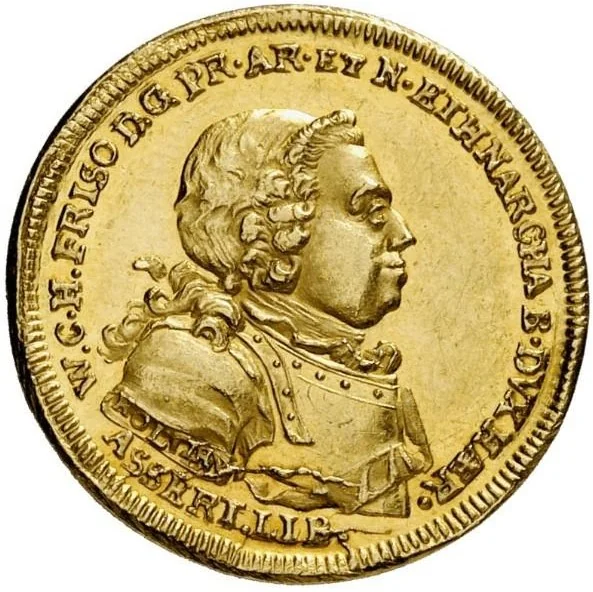
William IV bust
Inscription:
W C H FRISO D G PR AR ET N ETHNARCHA B DVX HÆR
ASSERT LIB
HOLTZHY
ASSERT LIB
HOLTZHY
Script: Latin
Engraver: Martin Holtzhey
Reverse
Description:
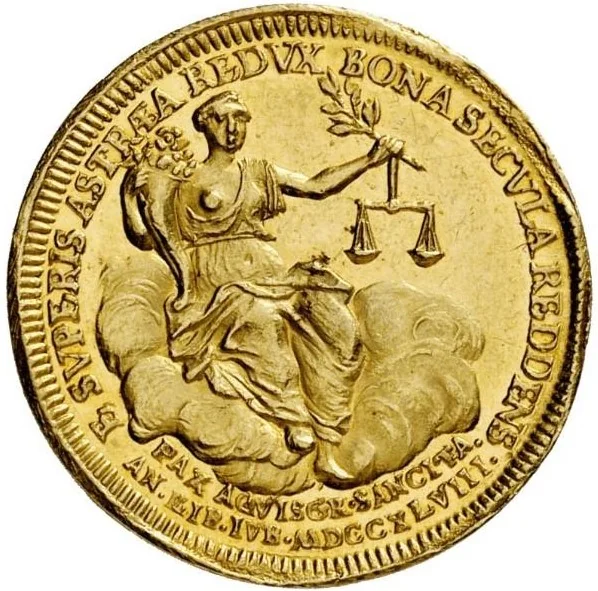
Astrea seated among clouds.
Inscription:
PAX AQVISGR SANCITA
AN LIP IVR MDCCXLVIII
E SVPERIS ASTRÆA REDVX BONAS SECVLA REDDENS
AN LIP IVR MDCCXLVIII
E SVPERIS ASTRÆA REDVX BONAS SECVLA REDDENS
Script: Latin
Edge
Mintings
| Year | Mint Mark | Mintage | Quality | Collection |
|---|---|---|---|---|
| 1748 | — | — |
Historical background
In 1748, the Free Imperial City of Aachen, a self-governing entity within the Holy Roman Empire, operated within a complex and fragmented monetary landscape. Like most of the Empire, it did not have the sovereign right to mint its own coins; instead, it primarily used currency issued by regional authorities. The most important of these was the Reichsthaler, the theoretical standard silver coin of the Empire, but in daily commerce, a plethora of circulating coins from neighboring states like the Electorate of Cologne, the Spanish Netherlands (later Austrian Netherlands), and the United Provinces (Dutch Republic) were in common use. This created a constant challenge of exchange rates and valuations, as the intrinsic silver content and face value of these coins varied widely.
The city's authorities attempted to manage this chaos through official Wechselordnungen (exchange ordinances), which periodically fixed the legal rates for the dozens of foreign coins circulating within its walls. These ordinances were essential for municipal finance, tax collection, and fair trade, aiming to protect citizens and merchants from debased coinage and fraudulent practices. However, the effectiveness of these decrees was limited by the sheer volume of cross-border trade, the physical wear on coins, and the frequent monetary manipulations by neighboring princes. The situation was further complicated by the use of Rechnungsgeld (account money), a stable notional unit used for bookkeeping and contracts, which was distinct from the ever-fluctuating physical coins actually handed over in transactions.
The year 1748 itself is significant as it followed the Treaty of Aix-la-Chapelle, which ended the War of the Austrian Succession. While the treaty reshaped European borders, it did not directly reform the Empire's monetary system. For Aachen, the post-war period likely meant a resurgence in its traditional cloth and needle trades, intensifying commercial interactions and thus the flow of even more foreign currency into the city. Therefore, the monetary background in 1748 was one of entrenched complexity, with the city council engaged in a continuous struggle to impose order on a circulatory system inherently prone to disorder, a microcosm of the Holy Roman Empire's decentralized political structure.
The city's authorities attempted to manage this chaos through official Wechselordnungen (exchange ordinances), which periodically fixed the legal rates for the dozens of foreign coins circulating within its walls. These ordinances were essential for municipal finance, tax collection, and fair trade, aiming to protect citizens and merchants from debased coinage and fraudulent practices. However, the effectiveness of these decrees was limited by the sheer volume of cross-border trade, the physical wear on coins, and the frequent monetary manipulations by neighboring princes. The situation was further complicated by the use of Rechnungsgeld (account money), a stable notional unit used for bookkeeping and contracts, which was distinct from the ever-fluctuating physical coins actually handed over in transactions.
The year 1748 itself is significant as it followed the Treaty of Aix-la-Chapelle, which ended the War of the Austrian Succession. While the treaty reshaped European borders, it did not directly reform the Empire's monetary system. For Aachen, the post-war period likely meant a resurgence in its traditional cloth and needle trades, intensifying commercial interactions and thus the flow of even more foreign currency into the city. Therefore, the monetary background in 1748 was one of entrenched complexity, with the city council engaged in a continuous struggle to impose order on a circulatory system inherently prone to disorder, a microcosm of the Holy Roman Empire's decentralized political structure.
✨ Legendary