

2 Kepings – Sumatra
Context
Year: 1798
Islamic (Hijri) Year: 1213
Country: British East Indies
Issuer: Sumatra
Currency:
(1783—1824)
Demonetized: Yes
Material
References
KM: #Click to copy to clipboard261
Numista: #267239
Obverse
Description:
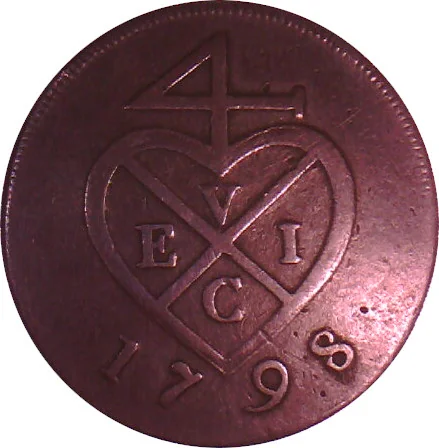
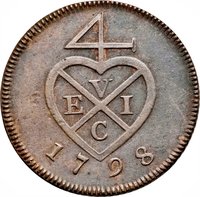
United East India Company 4-mark. Dated. Toothed border.
Inscription:
VEIC
1798
1798
Script: Latin
Reverse
Description:
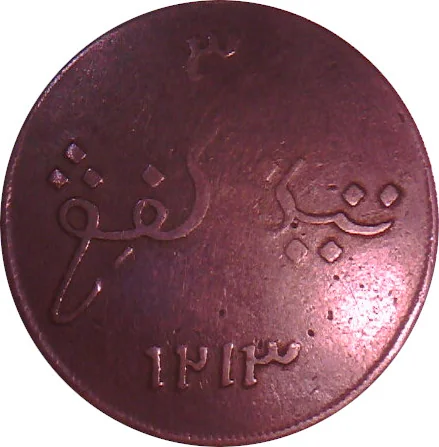
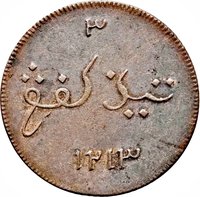
Arabic inscription, denomination above and date below in Eastern numerals, within a toothed border.
Inscription:
۳
تيݢ كفڠ
۱۲۱۳
تيݢ كفڠ
۱۲۱۳
Script: Arabic
Edge
Plain
Mints
| Name | Mark |
|---|---|
| Soho Mint | — |
Mintings
| Year | Mint Mark | Mintage | Quality | Collection |
|---|---|---|---|---|
| 1798 | — | — | ||
| 1798 | — | — | Proof |
Historical background
In 1798, the currency situation in Sumatra was a complex tapestry of indigenous, regional, and colonial monetary systems, reflecting the island's fragmented political landscape and its integration into global trade networks. The east coast, particularly the Sultanate of Siak and the Riau-Lingga Archipelago, operated within the sphere of the Dutch East India Company (VOC), which had formally collapsed the previous year. While Spanish silver dollars (pieces of eight) and Dutch rijksdaalders served as the primary high-value and international trade coins, their circulation was inconsistent. In the interior highlands of the Minangkabau and the northern Batak regions, a barter economy persisted alongside the use of commodity money, most notably pisis—small gold dust coins or un-minted gold measured by weight, which held both economic and ceremonial value.
The period was one of significant monetary instability. The bankruptcy and dissolution of the VOC in 1797 created a power vacuum and disrupted the already tenuous supply of standardized coinage. Furthermore, the French Revolutionary Wars had global repercussions, affecting the flow of Spanish silver from the Americas. This scarcity of reliable specie led to the proliferation of a wide variety of foreign coins—Portuguese, British Indian, and Arabic—all circulating at fluctuating values determined by local merchants and rulers. Counterfeiting and the clipping of silver coins were rampant, eroding trust in the monetary medium and complicating both local taxation and long-distance trade.
Concurrently, the British, who were briefly occupying Padang (1795-1819), began to exert their own monetary influence, introducing Sterling-based accounting and coins in their limited enclaves. However, their control did not extend inland. Therefore, the overall picture in 1798 was one of monetary pluralism and confusion. No single authority could impose a uniform currency, leaving Sumatran economies dependent on a volatile mix of inherited VOC systems, resilient local gold standards, and an influx of heterogeneous foreign silver, all set against a backdrop of regional political upheaval and shifting colonial fortunes.
The period was one of significant monetary instability. The bankruptcy and dissolution of the VOC in 1797 created a power vacuum and disrupted the already tenuous supply of standardized coinage. Furthermore, the French Revolutionary Wars had global repercussions, affecting the flow of Spanish silver from the Americas. This scarcity of reliable specie led to the proliferation of a wide variety of foreign coins—Portuguese, British Indian, and Arabic—all circulating at fluctuating values determined by local merchants and rulers. Counterfeiting and the clipping of silver coins were rampant, eroding trust in the monetary medium and complicating both local taxation and long-distance trade.
Concurrently, the British, who were briefly occupying Padang (1795-1819), began to exert their own monetary influence, introducing Sterling-based accounting and coins in their limited enclaves. However, their control did not extend inland. Therefore, the overall picture in 1798 was one of monetary pluralism and confusion. No single authority could impose a uniform currency, leaving Sumatran economies dependent on a volatile mix of inherited VOC systems, resilient local gold standards, and an influx of heterogeneous foreign silver, all set against a backdrop of regional political upheaval and shifting colonial fortunes.
✨ Legendary