



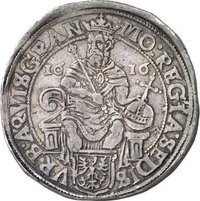
Obverse
Description:
Emperor on throne, shoulders split date.
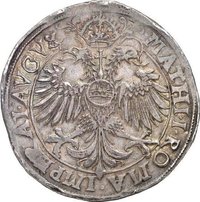
Reverse
Description:
Imperial eagle with orb, crowned, bearing Matthias's titles.
Edge
Mintings
| Year | Mint Mark | Mintage | Quality | Collection |
|---|---|---|---|---|
| 1616 | — | — |
Historical background
In 1616, the Free Imperial City of Aachen, a prosperous center of trade and pilgrimage, navigated a complex and often chaotic monetary landscape typical of the Holy Roman Empire. The city did not mint its own coins but operated within a web of circulating currencies. The most important for large-scale commerce and official accounts was the Reichsthaler, a large silver coin whose value was theoretically defined by Imperial ordinances. However, the daily reality for Aachen's merchants and citizens was dominated by a flood of smaller, regional coins from neighboring territories like Jülich, Cologne, and the Spanish Netherlands, whose values fluctuated based on their actual and often debased silver content.
This situation created significant challenges for the city council. Aachen's economy, reliant on its cloth trade, metalworking industries, and the flow of pilgrims to its cathedral, required stable transactions and trustworthy credit. The council regularly issued Münztaxen (currency valuation ordinances) that fixed the exchange rates between the myriad circulating coins and the stable Reichsthaler. These decrees aimed to combat the clipping and counterfeiting of coins and to prevent the influx of inferior foreign money, a practice known as "bad money driving out the good." Failure to manage this could lead to price inflation, trade disputes, and social unrest among craftsmen and consumers.
The year 1616 fell within a tense period of relative peace before the full outbreak of the Thirty Years' War (1618). However, monetary instability was already a chronic issue. Aachen's authorities had to constantly monitor not only the coins of nearby duchies but also the influential currency of the Spanish Netherlands, the Patagon, which played a major role in regional trade. Thus, the city's financial stability depended less on a sovereign currency and more on the vigilant regulatory efforts of its council to impose order on a fragmented and competitive imperial monetary system, a delicate balancing act essential for its economic survival.
This situation created significant challenges for the city council. Aachen's economy, reliant on its cloth trade, metalworking industries, and the flow of pilgrims to its cathedral, required stable transactions and trustworthy credit. The council regularly issued Münztaxen (currency valuation ordinances) that fixed the exchange rates between the myriad circulating coins and the stable Reichsthaler. These decrees aimed to combat the clipping and counterfeiting of coins and to prevent the influx of inferior foreign money, a practice known as "bad money driving out the good." Failure to manage this could lead to price inflation, trade disputes, and social unrest among craftsmen and consumers.
The year 1616 fell within a tense period of relative peace before the full outbreak of the Thirty Years' War (1618). However, monetary instability was already a chronic issue. Aachen's authorities had to constantly monitor not only the coins of nearby duchies but also the influential currency of the Spanish Netherlands, the Patagon, which played a major role in regional trade. Thus, the city's financial stability depended less on a sovereign currency and more on the vigilant regulatory efforts of its council to impose order on a fragmented and competitive imperial monetary system, a delicate balancing act essential for its economic survival.

✨ Legendary