

1 Thaler – Aachen
Germany
Context
Year: 1644
Country: Germany 
Issuer: Aachen
Period:
(1166—1798)
Ruler: Ferdinand III
Currency:
(1504—1798)
Demonetized: Yes
Material
References
KM: #Click to copy to clipboard40
Numista: #266844
Value
Bullion value: $81.28
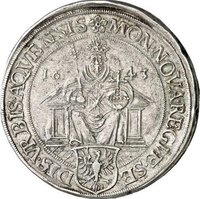
Obverse
Description:
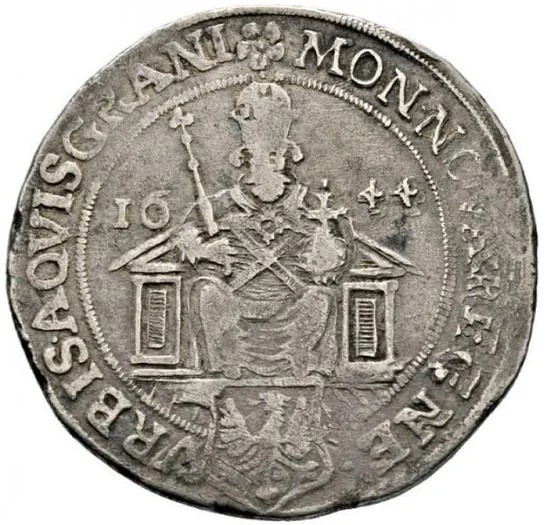
Charlemagne bust over arms, flanked by date.
Inscription:
MON NOVA REGNAE VRBIS AQVISGRANI
1644
1644
Script: Latin
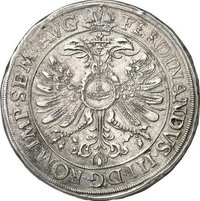
Reverse
Description:
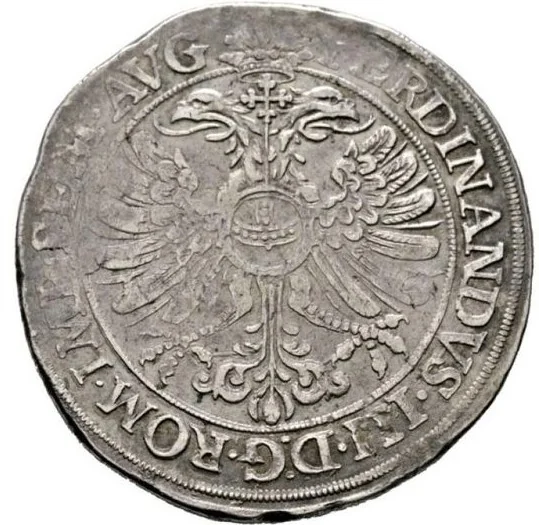
Imperial double eagle with Ferdinand III's titles.
Inscription:
FERDINANDVS III D G ROM IMP SEM AVG
Script: Latin
Edge
Mintings
| Year | Mint Mark | Mintage | Quality | Collection |
|---|---|---|---|---|
| 1644 | — | — |
Historical background
In 1644, the Free Imperial City of Aachen, like much of the Holy Roman Empire, was navigating a complex and debased currency landscape exacerbated by the Thirty Years' War (1618-1648). The city did not mint its own coins but operated within a fractured monetary system where numerous territorial states and cities issued currency of wildly varying silver content. The primary units of account were the Reichsthaler (Imperial Thaler) and the smaller Albus (or Weißpfennig), but the actual coins in circulation were a chaotic mix of domestic and foreign issues, including Dutch Rijksdaalders and Spanish Reales. The war had triggered a "race to the bottom," as states debased their coinage to fund military expenses, leading to severe inflation and a loss of public trust in small change.
Aachen's specific challenge was its position on the western border of the Empire, a major hub for trade and pilgrims. This made it a conduit for currencies from the Spanish Netherlands, the United Provinces, and the German principalities, all competing within its markets. The city council attempted to maintain stability by regularly publishing Münztabellen (currency tables) that fixed exchange rates between the myriad circulating coins and the stable accounting Thaler. However, these official rates often conflicted with market realities, leading to Gresham's Law in action: "bad" debased coins drove "good" full-weight coins out of circulation, as people hoarded the latter or exported them.
The situation created significant economic strain for Aachen's merchants and citizens. Prices for essential goods were volatile, and wage earners suffered as their small-denomination coins lost purchasing power. While the Peace of Westphalia was just four years away, in 1644 the monetary anarchy of the Kipper- und Wipperzeit (the period of currency manipulation) was still a fresh and painful memory. The city's authorities were thus engaged in a constant, defensive struggle to regulate exchange and punish counterfeiters, striving to protect local commerce from the worst effects of an imperial monetary system in crisis.
Aachen's specific challenge was its position on the western border of the Empire, a major hub for trade and pilgrims. This made it a conduit for currencies from the Spanish Netherlands, the United Provinces, and the German principalities, all competing within its markets. The city council attempted to maintain stability by regularly publishing Münztabellen (currency tables) that fixed exchange rates between the myriad circulating coins and the stable accounting Thaler. However, these official rates often conflicted with market realities, leading to Gresham's Law in action: "bad" debased coins drove "good" full-weight coins out of circulation, as people hoarded the latter or exported them.
The situation created significant economic strain for Aachen's merchants and citizens. Prices for essential goods were volatile, and wage earners suffered as their small-denomination coins lost purchasing power. While the Peace of Westphalia was just four years away, in 1644 the monetary anarchy of the Kipper- und Wipperzeit (the period of currency manipulation) was still a fresh and painful memory. The city's authorities were thus engaged in a constant, defensive struggle to regulate exchange and punish counterfeiters, striving to protect local commerce from the worst effects of an imperial monetary system in crisis.
✨ Legendary