

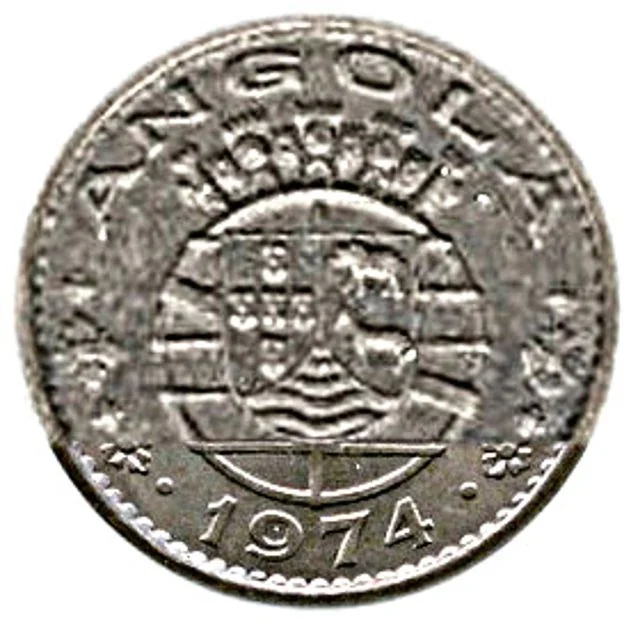
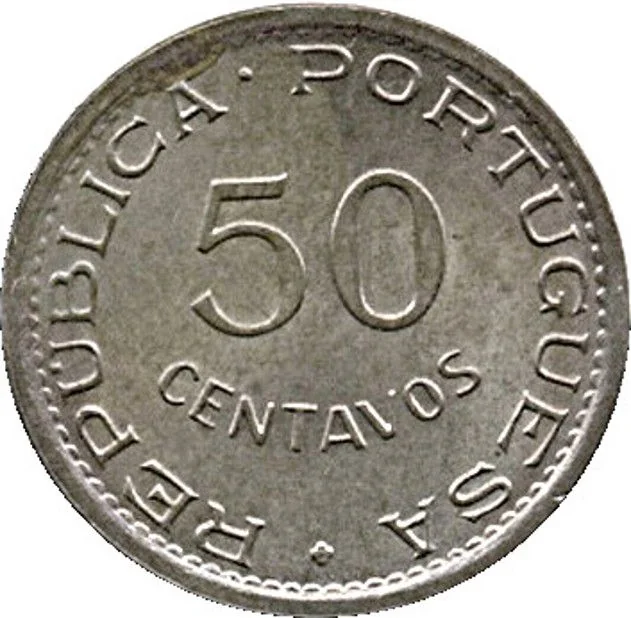
50 centavos – Angola
Add to wishlist
Angola
Obverse
Reverse
Description:
Valuable
Inscription:
REPÚBLICA·PORTUGUESA
50 CENTAVOS
50 CENTAVOS
Translation:
Portuguese Republic
50 Cents
50 Cents
Script: Latin
Language: Portuguese
Edge
Plain
Categories
| Animal> Elephant |
| Animal> Horse |
| Building> Castle or fortification |
| Symbols> Coat of Arms |
Mintings
| Year | Mint Mark | Mintage | Quality | Collection |
|---|---|---|---|---|
| 1974 | — | 150 |
Historical background
In 1974, Angola's currency situation was intrinsically tied to its status as a Portuguese colony. The official currency was the Angolan escudo, which was pegged at par with the Portuguese escudo and formed part of the escudo monetary zone. This system was managed by the Banco de Angola (Bank of Angola), which, despite its name, operated under the strict control of Lisbon, functioning essentially as a branch of the Portuguese central banking system. The currency's value and stability were therefore directly dependent on Portugal's own economic health and monetary policy.
The year 1974 was a period of profound political upheaval that directly threatened this monetary order. The Carnation Revolution in Lisbon in April overthrew the authoritarian Estado Novo regime, leading Portugal to announce its intention to grant independence to its African colonies. This sudden shift triggered immense uncertainty in Angola, sparking a violent power struggle between competing nationalist movements (MPLA, FNLA, UNITA). Economically, this political crisis caused capital flight, disrupted trade and production (especially in the key coffee and diamond sectors), and raised serious doubts about the future viability of the colonial currency.
Consequently, by late 1974, the Angolan escudo was under severe strain, operating on borrowed time. The looming independence, set for November 1975, guaranteed that the currency union with Portugal would be dissolved. The fundamental question for the future Angolan state was not if but how it would establish its own independent monetary system—whether by creating a new national currency from scratch or by reforming the existing colonial banknotes and institutions. The currency situation thus mirrored the country's overall condition: it was a colonial system awaiting imminent dismantlement amidst a climate of political chaos and economic uncertainty.
The year 1974 was a period of profound political upheaval that directly threatened this monetary order. The Carnation Revolution in Lisbon in April overthrew the authoritarian Estado Novo regime, leading Portugal to announce its intention to grant independence to its African colonies. This sudden shift triggered immense uncertainty in Angola, sparking a violent power struggle between competing nationalist movements (MPLA, FNLA, UNITA). Economically, this political crisis caused capital flight, disrupted trade and production (especially in the key coffee and diamond sectors), and raised serious doubts about the future viability of the colonial currency.
Consequently, by late 1974, the Angolan escudo was under severe strain, operating on borrowed time. The looming independence, set for November 1975, guaranteed that the currency union with Portugal would be dissolved. The fundamental question for the future Angolan state was not if but how it would establish its own independent monetary system—whether by creating a new national currency from scratch or by reforming the existing colonial banknotes and institutions. The currency situation thus mirrored the country's overall condition: it was a colonial system awaiting imminent dismantlement amidst a climate of political chaos and economic uncertainty.
💎 Extremely Rare