

4 mark – Norway
Add to wishlist
Norway
Context
Year: 1723
Issuer: Norway
Ruler: Frederick IV
Currency:
(1523—1746)
Subdivision: 4 mark = 1 Krone
Demonetized: Yes
Total mintage: 30,000
Material
References
KM: #
Numista: #101120
Value
Bullion value: $37.31
Obverse
Description:
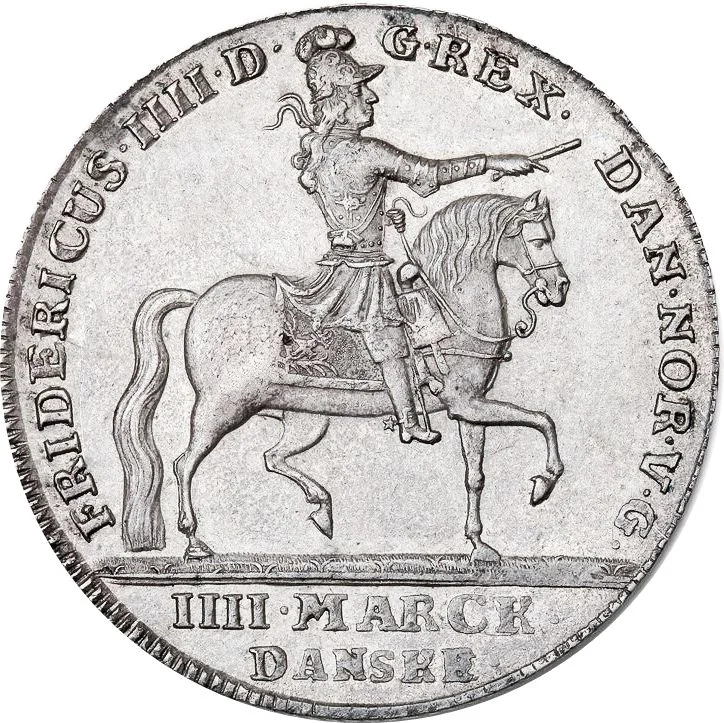
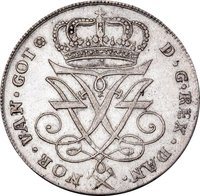
King on horse right, flat ground. Inscription around, value below. Beaded edge.
Inscription:
·FRIDERICUS·IIII·D· | G·REX· | DAN·NOR·V·G·
·IIII·MARCK·
·DANSKE·
·IIII·MARCK·
·DANSKE·
Script: Latin
Reverse
Description:
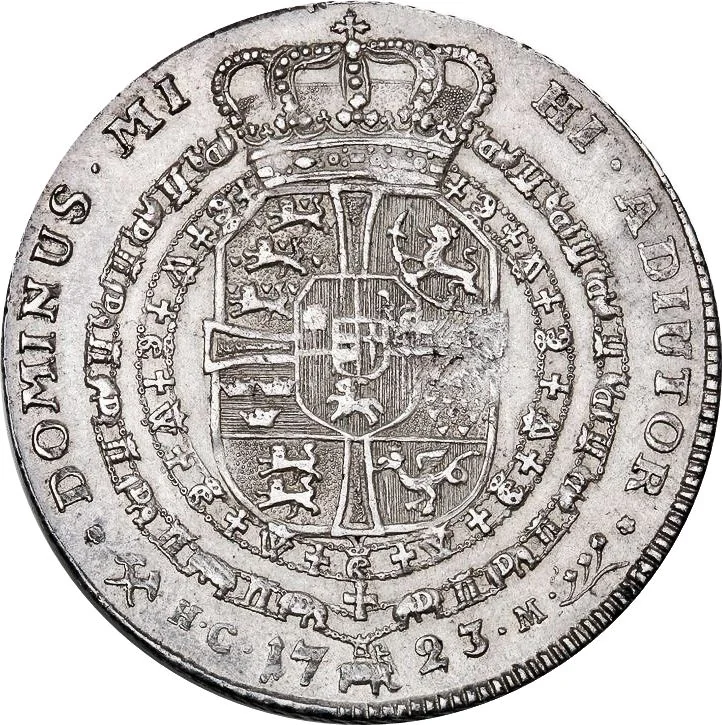
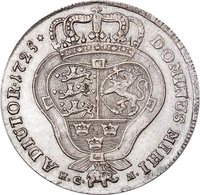
Shield with a central cross and crown. A small central shield displays the arms of Holstein, Stormarn, and Ditmarsken. The main shield features the arms of Denmark, Norway, the Kalmar Union, the Goths, and the Wends. It is encircled by the chains of the Order of the Elephant and Dannebrog. An inscription surrounds the design, with date and mintmarks below. Beaded edge.
Inscription:
✿ DOMINUS · MI | HI · ADIUTOR ✿
⚒ H·C· 17 | 23 ·M· 🙛
⚒ H·C· 17 | 23 ·M· 🙛
Script: Latin
Edge
Reeded
Mints
| Name | Mark |
|---|---|
| Norwegian Mint | — |
Mintings
| Year | Mint Mark | Mintage | Quality | Collection |
|---|---|---|---|---|
| 1723 | — | 30,000 |
Historical background
In 1723, Norway found itself in a precarious monetary situation, deeply entangled with its political union with Denmark. As part of the Danish-Norwegian state, Norway did not control its own currency. The primary circulating coin was the Danish riksdaler, but a severe shortage of official minted specie plagued the country. This scarcity was exacerbated by Norway's persistent trade deficit with Denmark, which caused silver coins to continually flow out of the kingdom to settle debts, leaving the domestic economy chronically under-monetized.
To facilitate everyday transactions in the absence of sufficient official coinage, a parallel system of "credit money" had become essential. Since 1695, the state had issued kreditivsedler (credit notes), which were essentially IOUs or treasury bonds that circulated as a form of paper currency. Furthermore, local merchants and officials issued their own veksler (promissory notes). While this private credit system kept commerce functioning, it was fragmented and inherently unstable, with the value of these notes fluctuating based on the trustworthiness of the issuer and the economic conditions of the region.
The year 1723 fell within a period of attempted reform under King Frederik IV. Just two years prior, in 1721, a state loan bank had been established in Christiania (Oslo) to regulate credit and provide more stability. However, the fundamental structural problems remained unresolved. The economy was still vulnerable, the outflow of silver continued, and the reliance on a patchwork of paper promises meant the monetary system was fragile. This situation would persist until more centralized reforms later in the century, leaving Norway in 1723 with a complex and strained dual system of scarce official coinage and necessary but risky credit instruments.
To facilitate everyday transactions in the absence of sufficient official coinage, a parallel system of "credit money" had become essential. Since 1695, the state had issued kreditivsedler (credit notes), which were essentially IOUs or treasury bonds that circulated as a form of paper currency. Furthermore, local merchants and officials issued their own veksler (promissory notes). While this private credit system kept commerce functioning, it was fragmented and inherently unstable, with the value of these notes fluctuating based on the trustworthiness of the issuer and the economic conditions of the region.
The year 1723 fell within a period of attempted reform under King Frederik IV. Just two years prior, in 1721, a state loan bank had been established in Christiania (Oslo) to regulate credit and provide more stability. However, the fundamental structural problems remained unresolved. The economy was still vulnerable, the outflow of silver continued, and the reliance on a patchwork of paper promises meant the monetary system was fragile. This situation would persist until more centralized reforms later in the century, leaving Norway in 1723 with a complex and strained dual system of scarce official coinage and necessary but risky credit instruments.
✨ Legendary