

½ Cent – Malaya
Malaysia
Context

Material
Weight: 2.91 g
Thickness: 1.45 mm
Shape: Square with rounded corners
Composition: Bronze
Magnetic: No
Technique: Milled
Alignment: Medal alignment
flip
References
KM: #Click to copy to clipboard1
Numista: #11599
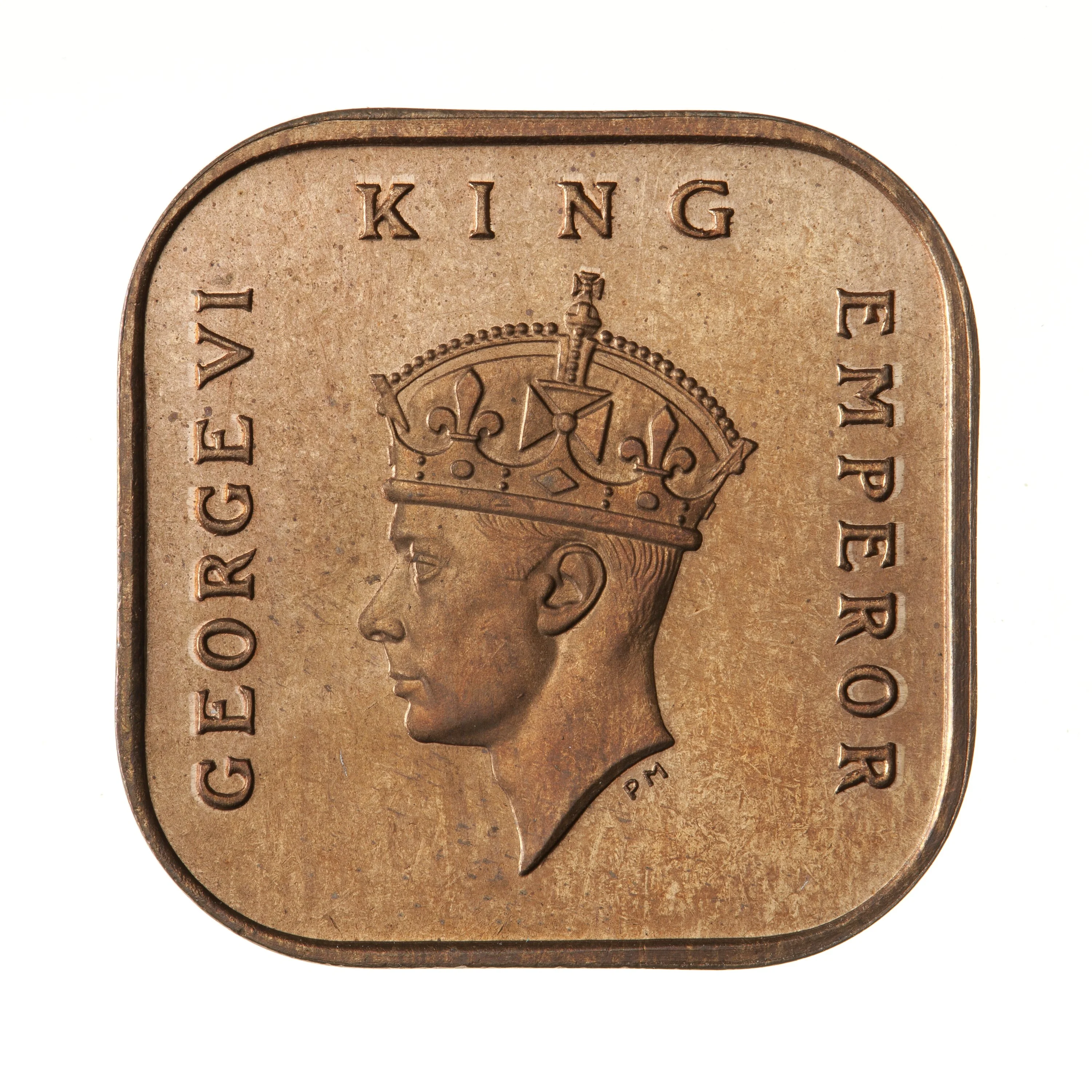
Obverse
Description:
Crowned left-facing bust.
Inscription:
GEORGE VI KING EMPEROR
Translation:
GEORGE VI KING EMPEROR
Script: Latin
Language: English
Engraver: Percy Metcalfe
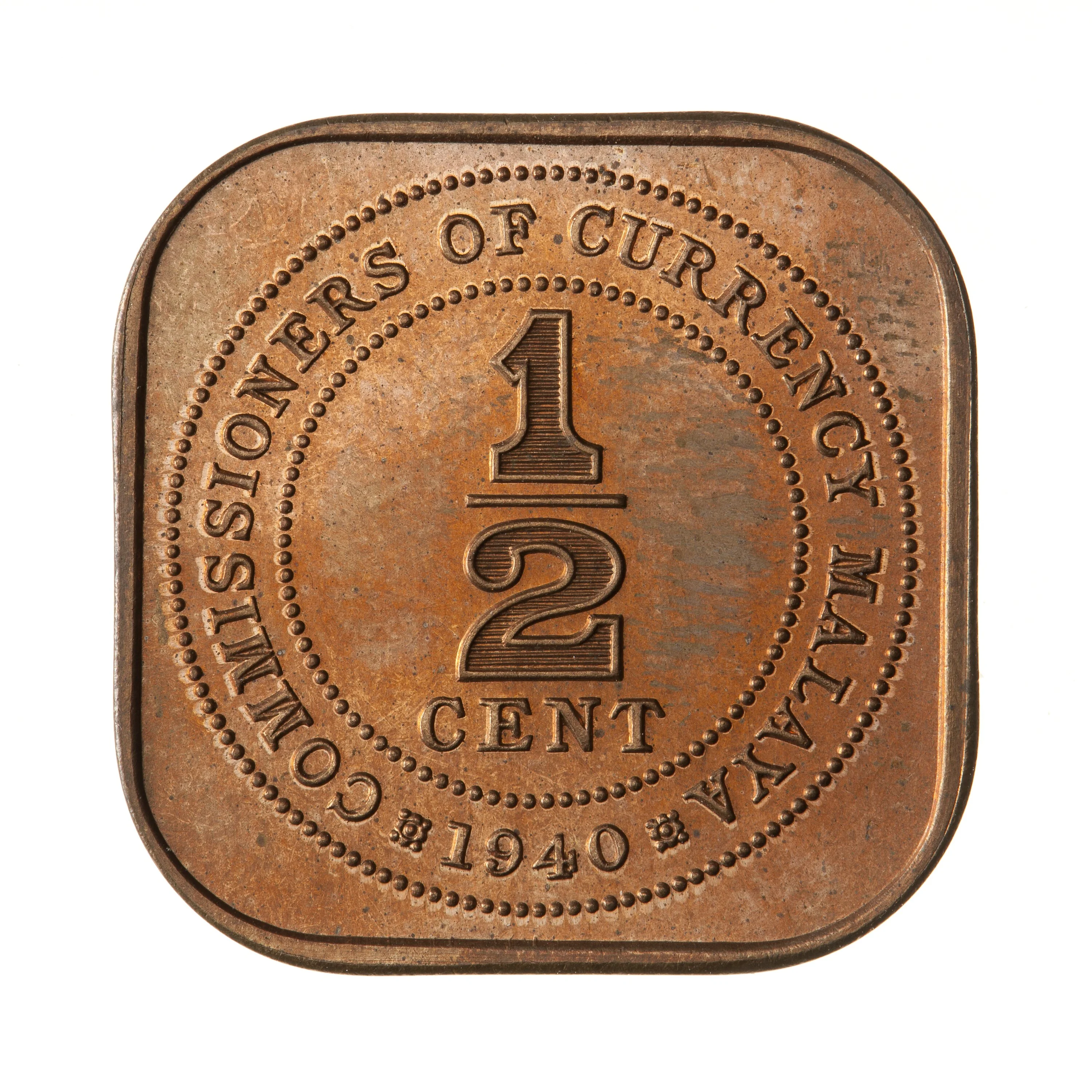
Reverse
Description:
Beaded circle value
Inscription:
COMMISSIONERS OF CURRENCY MALAYA
½
CENT
1940
½
CENT
1940
Script: Latin
Edge
Plain
Mints
| Name | Mark |
|---|---|
| Royal Mint (Tower Hill) | — |
Mintings
| Year | Mint Mark | Mintage | Quality | Collection |
|---|---|---|---|---|
| 1940 | — | 6,000,000 | ||
| 1940 | — | — | Proof |
Historical background
In 1940, Malaya's currency situation was firmly under the control of the British colonial administration, operating within the broader framework of the Straits Settlements currency system. The official currency was the Malayan dollar (or Straits dollar), issued by the Board of Commissioners of Currency, Malaya. This currency was pegged to sterling at a fixed rate of 1 shilling 4 pence (or 2 shillings to the dollar, depending on the convention), making it part of the Sterling Area. This peg ensured monetary stability and facilitated trade with the British Empire, which was crucial for Malaya's export-driven economy, heavily reliant on tin and rubber.
The currency was backed by a 100% sterling exchange reserve held in London, meaning that for every Malayan dollar issued, an equivalent value in British pounds was held as security. This "currency board system" ensured full convertibility and high confidence in the note issue, but it also meant that Malaya's money supply was directly dependent on its balance of payments with the sterling bloc. Economically, the year saw increased revenue due to high global demand for its strategic resources as World War II intensified in Europe, leading to a trade surplus and an inflow of sterling reserves.
However, this apparent stability was increasingly precarious. The escalating war in Europe and spreading conflict in Asia created underlying anxieties. While the currency system functioned normally, British authorities and local banks were quietly aware of the growing threat posed by Japanese expansionism. Contingency plans, including the secret removal of gold and sterling reserves from Singapore and the printing of emergency "invasion currency," were likely in preliminary stages, setting the scene for the severe monetary disruption that would follow the Japanese invasion in late 1941.
The currency was backed by a 100% sterling exchange reserve held in London, meaning that for every Malayan dollar issued, an equivalent value in British pounds was held as security. This "currency board system" ensured full convertibility and high confidence in the note issue, but it also meant that Malaya's money supply was directly dependent on its balance of payments with the sterling bloc. Economically, the year saw increased revenue due to high global demand for its strategic resources as World War II intensified in Europe, leading to a trade surplus and an inflow of sterling reserves.
However, this apparent stability was increasingly precarious. The escalating war in Europe and spreading conflict in Asia created underlying anxieties. While the currency system functioned normally, British authorities and local banks were quietly aware of the growing threat posed by Japanese expansionism. Contingency plans, including the secret removal of gold and sterling reserves from Singapore and the printing of emergency "invasion currency," were likely in preliminary stages, setting the scene for the severe monetary disruption that would follow the Japanese invasion in late 1941.
🌱 Fairly Common