

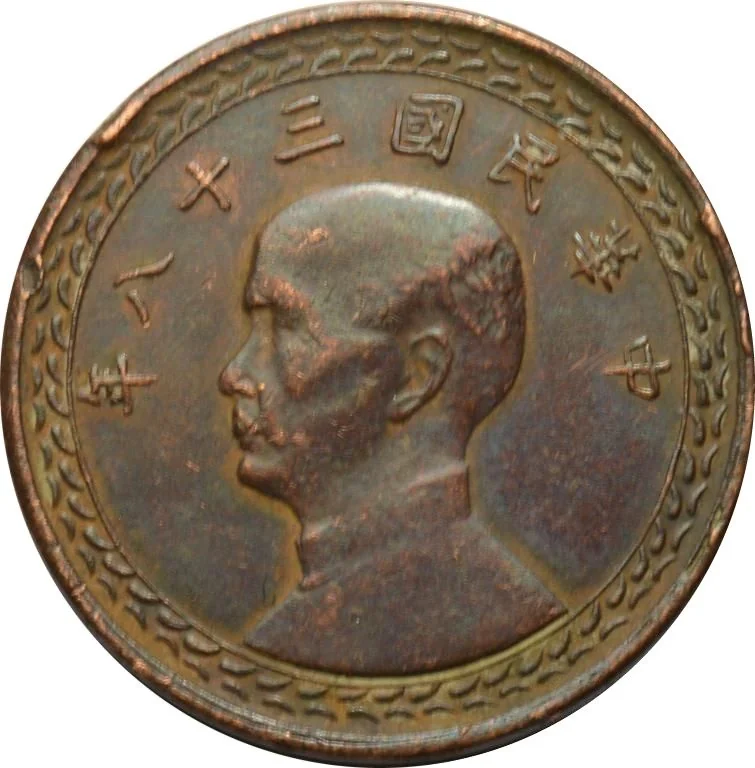
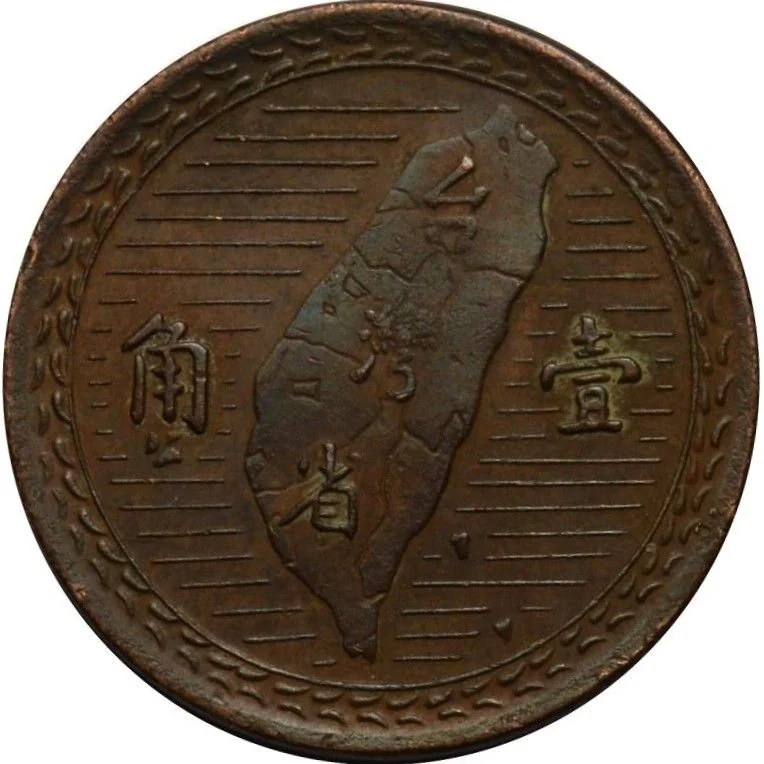
1 Jiao – Taiwan
China
Context
Year: 1949
Chinese republican Year: 38
Country: China 
Issuer: Taiwan 
Period:
(since 1949)
Currency:
(since 1949)
Subdivision: 1 Jiao = 10 Fen
Demonetized: Yes
Total mintage: 157,600,000
Material
References
Y: #Click to copy to clipboard531
Numista: #9277
Value
Exchange value: 0.1 TWD
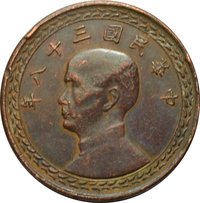
Obverse
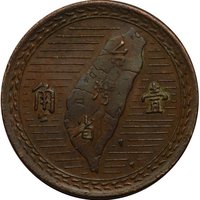
Reverse
Edge
Plain
Categories
| Person> Politician |
| Map |
Mintings
| Year | Mint Mark | Mintage | Quality | Collection |
|---|---|---|---|---|
| 1949 | — | 157,600,000 |
Historical background
In 1949, Taiwan's currency situation was one of extreme instability and hyperinflation, directly stemming from the final phase of the Chinese Civil War. As the Nationalist (Kuomintang, KMT) government under Chiang Kai-shek faced imminent defeat by the Chinese Communist Party, it retreated to Taiwan, bringing with it the remnants of its financial system and a massive influx of soldiers, officials, and refugees. This migration severely strained the island's resources. The KMT continued to issue the "Old Taiwan Dollar," which was a regional currency it had introduced in 1946 to replace the Taiwanese Yen used under Japanese rule. However, to finance its military efforts and the needs of the swollen population, the government printed money excessively, leading to a catastrophic loss of value and rampant hyperinflation that devastated the local economy and public trust.
To arrest the economic collapse, the Taiwanese government undertook a radical monetary reform on June 15, 1949, introducing the New Taiwan Dollar (NTD). This reform was engineered with crucial support from the United States and was anchored by substantial gold reserves brought from the mainland. The exchange rate was set at 40,000 Old Taiwan Dollars to 1 New Taiwan Dollar, starkly illustrating the scale of the devaluation. Critically, the issuance of the new currency was strictly limited, and it was partially backed by precious metals and foreign exchange to restore confidence. This reform was part of a broader package of economic stabilisation measures, including high-interest rates and strict control over prices and credit.
The successful launch of the New Taiwan Dollar in 1949 provided the essential monetary foundation for the island's subsequent recovery and transformation. It ended the period of hyperinflation, allowing for relative price stability. This stability was a prerequisite for the land reform and import-substitution industrial policies that the KMT regime would implement in the early 1950s, setting Taiwan on its path toward rapid economic development. Thus, the currency crisis and reform of 1949 mark a pivotal financial and political watershed, separating the chaotic postwar period from the era of Taiwan's modern economic growth, all while solidifying the island's separate financial system from mainland China.
To arrest the economic collapse, the Taiwanese government undertook a radical monetary reform on June 15, 1949, introducing the New Taiwan Dollar (NTD). This reform was engineered with crucial support from the United States and was anchored by substantial gold reserves brought from the mainland. The exchange rate was set at 40,000 Old Taiwan Dollars to 1 New Taiwan Dollar, starkly illustrating the scale of the devaluation. Critically, the issuance of the new currency was strictly limited, and it was partially backed by precious metals and foreign exchange to restore confidence. This reform was part of a broader package of economic stabilisation measures, including high-interest rates and strict control over prices and credit.
The successful launch of the New Taiwan Dollar in 1949 provided the essential monetary foundation for the island's subsequent recovery and transformation. It ended the period of hyperinflation, allowing for relative price stability. This stability was a prerequisite for the land reform and import-substitution industrial policies that the KMT regime would implement in the early 1950s, setting Taiwan on its path toward rapid economic development. Thus, the currency crisis and reform of 1949 mark a pivotal financial and political watershed, separating the chaotic postwar period from the era of Taiwan's modern economic growth, all while solidifying the island's separate financial system from mainland China.
🌱 Common