


1000 Yen – Japan
Non-circulating coins
Commemoration: 67th Annual Meeting of the International Monetary Fund in Tokyo
Japan
Context
Year: 2012
Japanese - Heisei era Year: 24
Issuer: Japan 
Ruler: Heisei
Currency:
(since 1871)
Total mintage: 50,000
Material

References
Y: #Click to copy to clipboard195
Numista: #85850
Value
Exchange value: 1000 JPY = $6.41
Bullion value: $83.58
Inflation-adjusted value: 1150.30 JPY
Obverse
Description:
Mt. Fuji with peasants and color reflector, encircled by legends.
Inscription:
第六十七回国際通貨基金 • 世界銀行グループ年次総会 • 東京開催
日 本 国 • 千 円
日 本 国 • 千 円
Translation:
Sixty-seventh International Monetary Fund • World Bank Group Annual Meetings • Hosted in Tokyo
Japan • One Thousand Yen
Japan • One Thousand Yen
Language: Japanese
Reverse
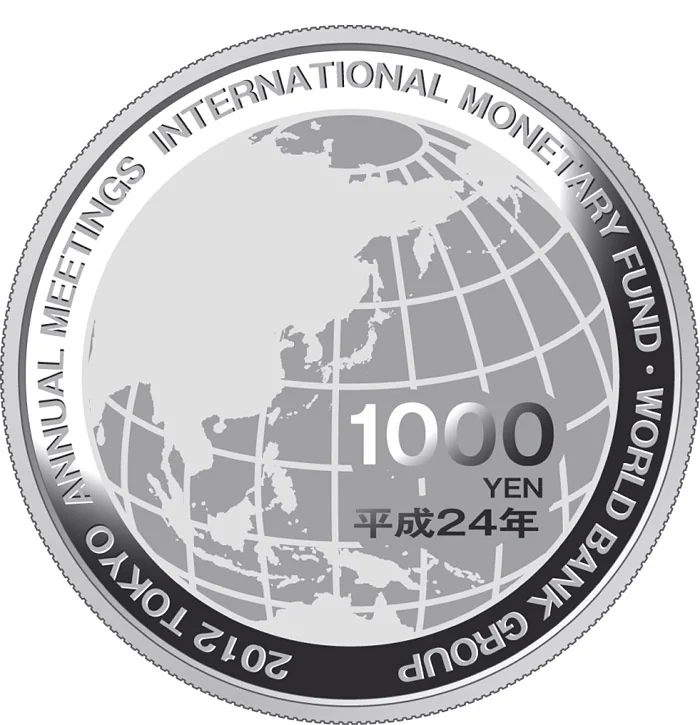
Description:
Globe highlighting the Pacific, with value, date, and legends.
Inscription:
2012 TOKYO ANNUAL MEETINGS INTERNATIONAL MONETARY FUND • WORLD BANK GROUP
1000
YEN
平成24年
1000
YEN
平成24年
Translation:
2012 TOKYO ANNUAL MEETINGS INTERNATIONAL MONETARY FUND • WORLD BANK GROUP
1000
YEN
Heisei 24
1000
YEN
Heisei 24
Edge
Slanted reeding
Mintings
| Year | Mint Mark | Mintage | Quality | Collection |
|---|---|---|---|---|
| 2012 | — | 50,000 | Proof |
Historical background
In 2012, Japan's currency situation was dominated by the persistent strength of the yen (JPY), a phenomenon known as "endaka." This high yen was a legacy of the 2008 global financial crisis, during which the yen became a safe-haven currency, appreciating sharply as global investors sought stability. While beneficial for importers and Japanese tourists abroad, the strong yen severely damaged the competitiveness of Japan's vital export sector, squeezing corporate profits for giants like Toyota and Sony and contributing to a prolonged period of deflation and economic stagnation. The situation was exacerbated by the 2011 Great East Japan Earthquake and Tsunami, which further disrupted production and supply chains.
Politically, 2012 was a pivotal year that set the stage for a dramatic shift in monetary policy. The Democratic Party of Japan (DPJ) government, led for much of the year by Prime Minister Yoshihiko Noda, intervened in the currency markets and pushed the Bank of Japan (BOJ) for further easing. However, these measures were seen as insufficient. Public frustration over the economy culminated in the landslide victory of the Liberal Democratic Party (LDP) in December's general election, bringing Shinzo Abe back to power with a clear mandate for radical change.
Abe's election victory immediately reframed the currency outlook around his proposed "Abenomics," a three-arrow strategy of aggressive monetary easing, flexible fiscal policy, and structural reforms. Even before taking office, Abe's rhetoric pressured the BOJ to adopt a 2% inflation target and pursue unlimited easing, directly targeting the yen's strength. Consequently, the yen began a sharp depreciation in late 2012, falling from around 78 to over 85 against the US dollar by year's end, as markets anticipated a historic break from the BOJ's previous cautious stance. Thus, 2012 ended as a transition year, closing a chapter of defensive struggle against a strong yen and opening a new era of proactive, reflationary policy designed to deliberately weaken the currency.
Politically, 2012 was a pivotal year that set the stage for a dramatic shift in monetary policy. The Democratic Party of Japan (DPJ) government, led for much of the year by Prime Minister Yoshihiko Noda, intervened in the currency markets and pushed the Bank of Japan (BOJ) for further easing. However, these measures were seen as insufficient. Public frustration over the economy culminated in the landslide victory of the Liberal Democratic Party (LDP) in December's general election, bringing Shinzo Abe back to power with a clear mandate for radical change.
Abe's election victory immediately reframed the currency outlook around his proposed "Abenomics," a three-arrow strategy of aggressive monetary easing, flexible fiscal policy, and structural reforms. Even before taking office, Abe's rhetoric pressured the BOJ to adopt a 2% inflation target and pursue unlimited easing, directly targeting the yen's strength. Consequently, the yen began a sharp depreciation in late 2012, falling from around 78 to over 85 against the US dollar by year's end, as markets anticipated a historic break from the BOJ's previous cautious stance. Thus, 2012 ended as a transition year, closing a chapter of defensive struggle against a strong yen and opening a new era of proactive, reflationary policy designed to deliberately weaken the currency.
💎 Extremely Rare