

500 Yen – Japan
Non-circulating coins
Commemoration: Opening of the Chubu International Airport
Japan
Context
Year: 2005
Japanese - Heisei era Year: 17
Issuer: Japan 
Ruler: Heisei
Currency:
(since 1871)
Total mintage: 50,000
Material
Diameter: 28 mm
Weight: 15.6 g
Silver weight: 15.58 g
Shape: Round
Composition: 99.9% Silver
Standard: Silver half ounce
Magnetic: No
Technique: Milled
Alignment: Medal alignment
flip
References
Y: #Click to copy to clipboard134
Numista: #85813
Value
Exchange value: 500 JPY = $3.20
Bullion value: $43.42
Inflation-adjusted value: 569.53 JPY
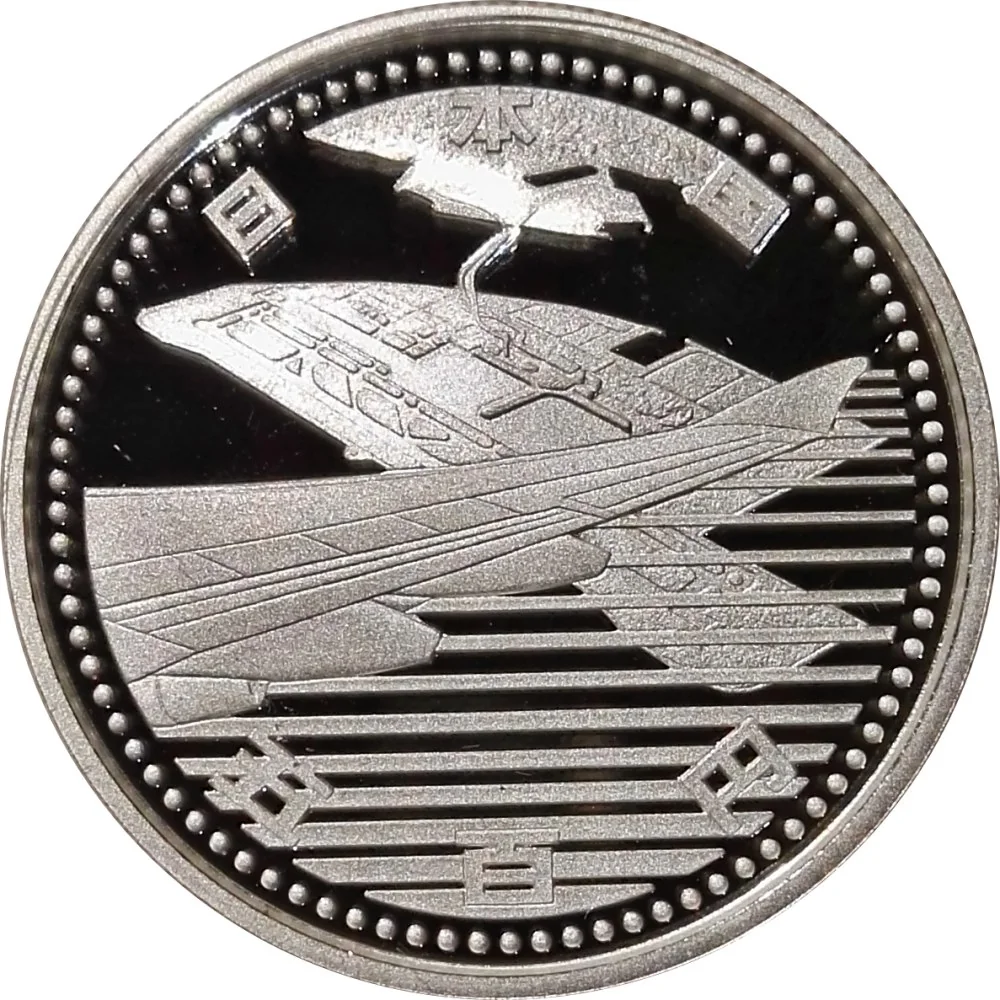
Obverse
Description:
View from above of Chubu Airport.
Inscription:
日 本 国
五 百 円
五 百 円
Translation:
Japan
500 Yen
500 Yen
Language: Japanese
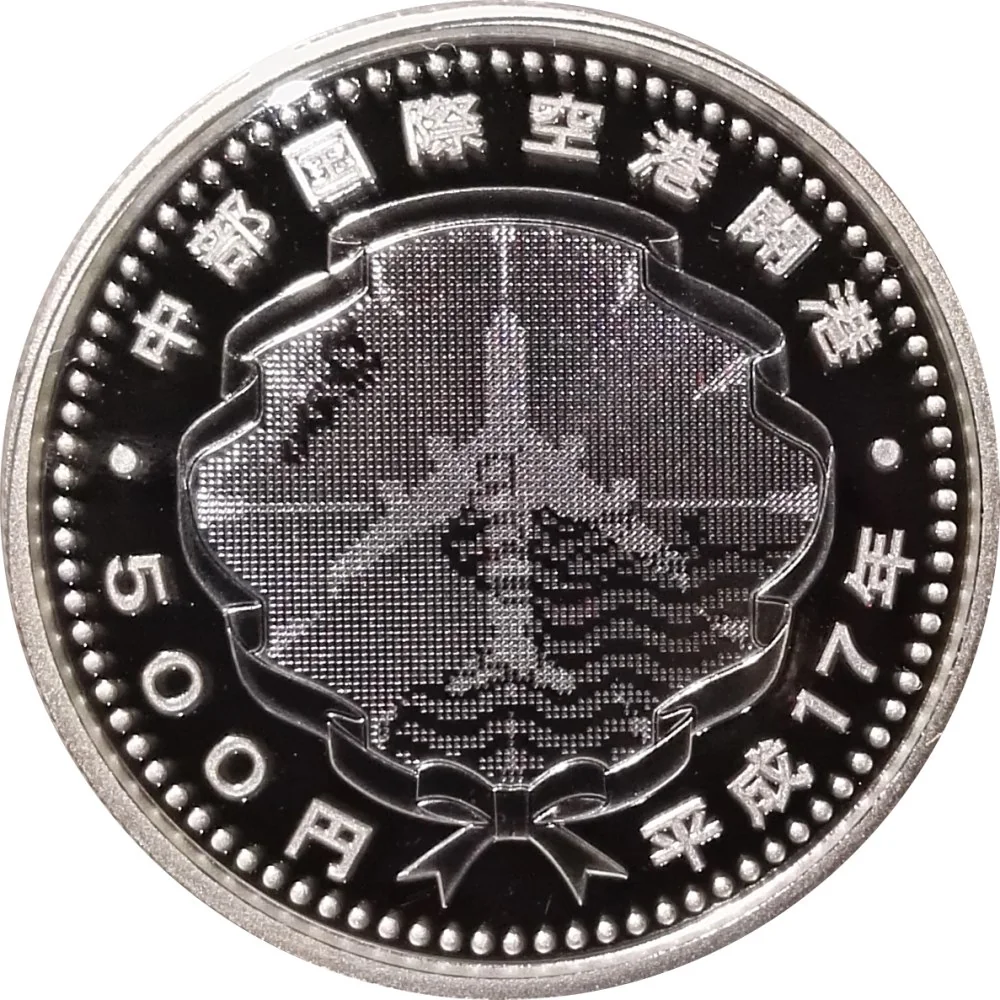
Reverse
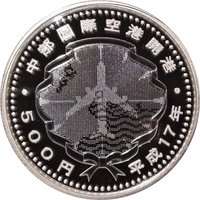
Description:
A map of Aichi with the airport marked by a looped ribbon and aircraft icon, using an optical pattern effect.
Inscription:
• 中部国際空港開港 •
500円 平成17年
500円 平成17年
Translation:
500 Yen, Heisei 17
Language: Japanese
Edge
Slanted reeding
Categories
| Map |
| Transportation> Aircraft |
Mintings
| Year | Mint Mark | Mintage | Quality | Collection |
|---|---|---|---|---|
| 2005 | — | 50,000 | Proof |
Historical background
In 2005, Japan’s currency situation was dominated by the aftermath of a prolonged period of deflation and the Bank of Japan's (BOJ) unprecedented quantitative easing (QE) policy. The yen was in a phase of relative weakness, trading around 110 to 120 against the US dollar, a level that supported the nation's vital export sector, including giants like Toyota and Sony. This environment was the result of the BOJ's aggressive monetary stimulus, initiated in 2001, which flooded the financial system with liquidity in a historic attempt to combat falling prices and stimulate the economy after the collapse of the asset bubble in the early 1990s.
Domestically, the economy was showing tentative signs of recovery, marking the beginning of what would later be called the "Izayoi" boom. However, deflationary pressures, though easing, persisted, keeping interest rates at effectively zero. This "zero-interest-rate policy" (ZIRP), combined with the large interest rate differential with the United States (where the Federal Reserve was raising rates), encouraged the "carry trade." Investors borrowed cheap yen to invest in higher-yielding assets abroad, a dynamic that further suppressed the yen's value and contributed to global financial liquidity.
By the end of 2005, the BOJ was signaling a pivotal shift, preparing to end its five-year QE policy, which it ultimately did in March 2006. This move was prompted by growing confidence that deflation was receding and that the financial system was stabilized, setting the stage for a future normalization of monetary policy. Thus, 2005 represented a transitional year—the tail end of an era of extreme monetary accommodation, with the yen’s weakness providing a tailwind for economic growth, while policymakers cautiously laid the groundwork for a less stimulative future.
Domestically, the economy was showing tentative signs of recovery, marking the beginning of what would later be called the "Izayoi" boom. However, deflationary pressures, though easing, persisted, keeping interest rates at effectively zero. This "zero-interest-rate policy" (ZIRP), combined with the large interest rate differential with the United States (where the Federal Reserve was raising rates), encouraged the "carry trade." Investors borrowed cheap yen to invest in higher-yielding assets abroad, a dynamic that further suppressed the yen's value and contributed to global financial liquidity.
By the end of 2005, the BOJ was signaling a pivotal shift, preparing to end its five-year QE policy, which it ultimately did in March 2006. This move was prompted by growing confidence that deflation was receding and that the financial system was stabilized, setting the stage for a future normalization of monetary policy. Thus, 2005 represented a transitional year—the tail end of an era of extreme monetary accommodation, with the yen’s weakness providing a tailwind for economic growth, while policymakers cautiously laid the groundwork for a less stimulative future.
💎 Very Rare