

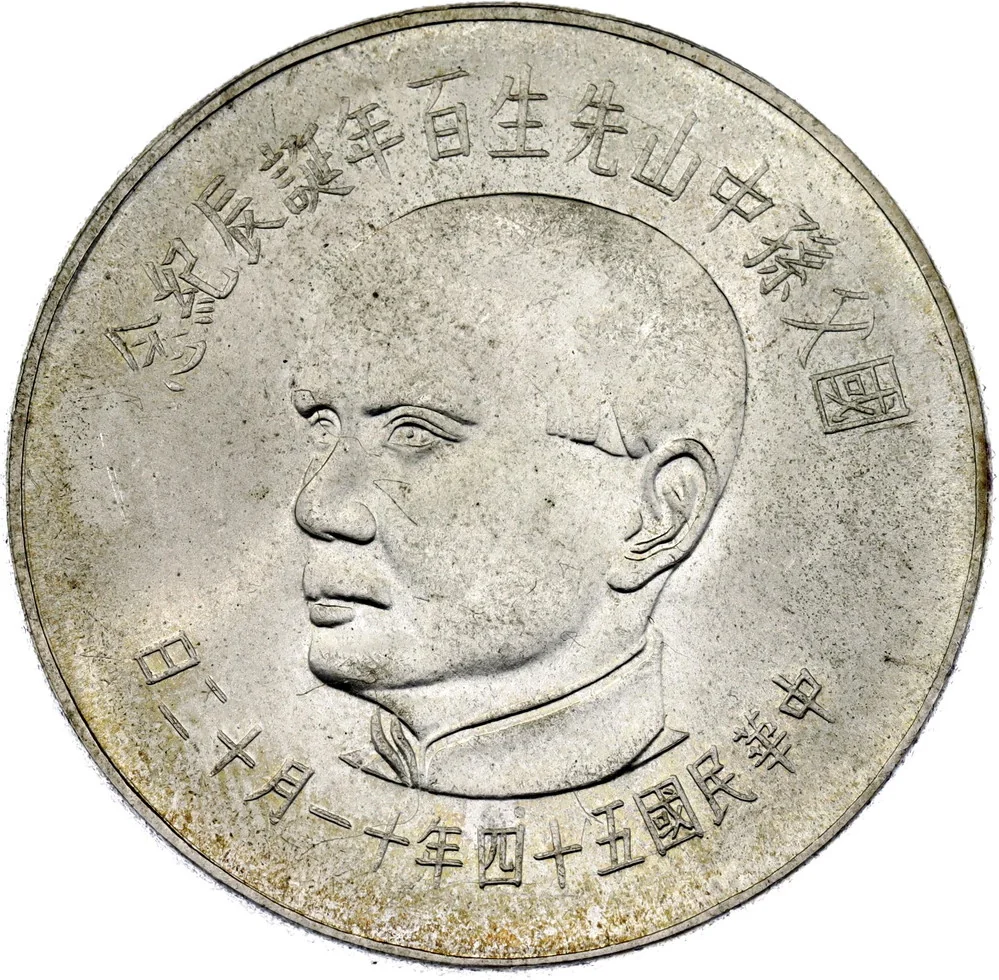
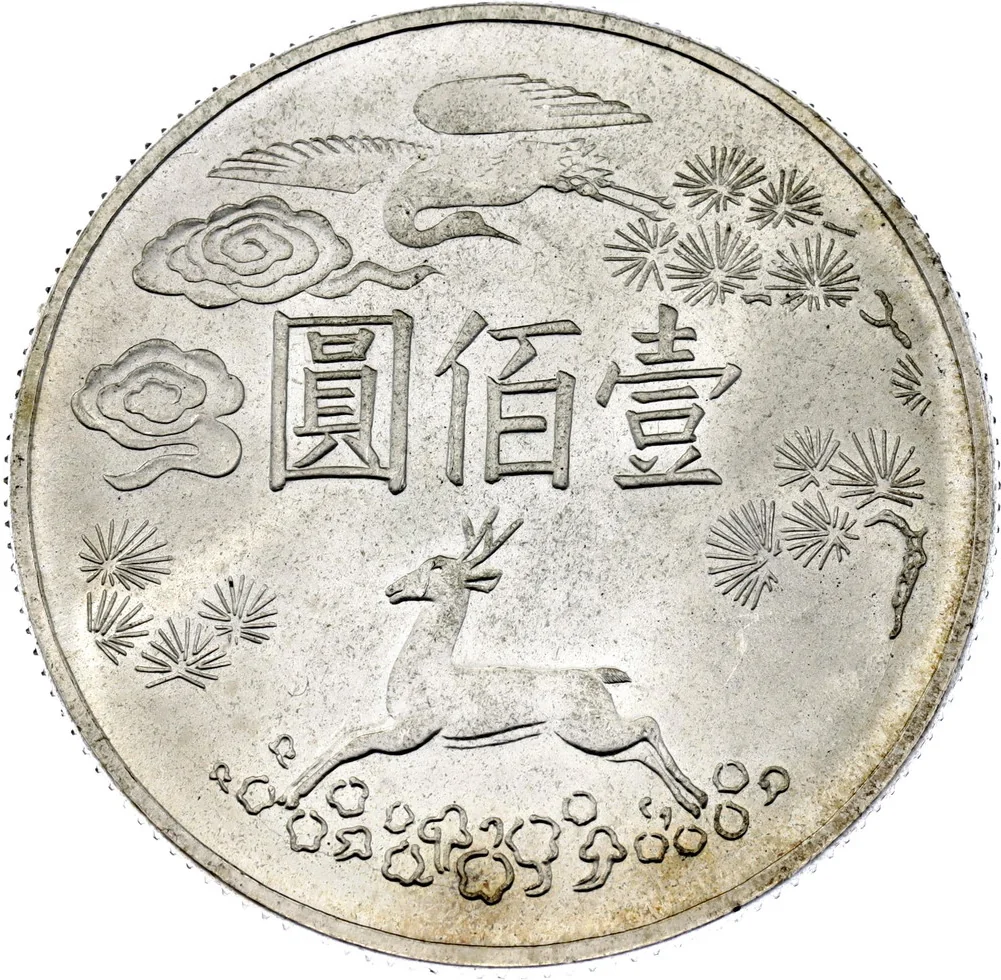
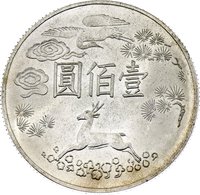
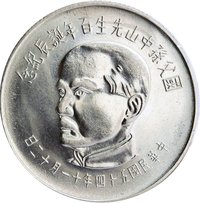
100 Yuan (Sūn Zhōngshān) – Taiwan
Non-circulating coins
Commemoration: 100th Anniversary of the Birth of Sūn Zhōngshān
China
Context
Year: 1965
Chinese republican Year: 54
Country: China 
Issuer: Taiwan 
Period:
(since 1949)
Currency:
(since 1949)
Material
References
Y: #Click to copy to clipboard540
Numista: #58720
Value
Exchange value: 100 TWD
Bullion value: $47.67
Obverse
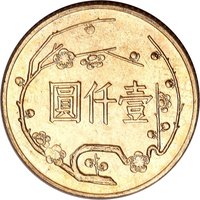
Reverse
Edge
Mintings
| Year | Mint Mark | Mintage | Quality | Collection |
|---|---|---|---|---|
| 1965 | — | — |
Historical background
In 1965, Taiwan's currency, the New Taiwan Dollar (NTD), was in a period of stabilization and controlled growth under the authoritarian developmental state of the Kuomintang (KMT) government. This followed a tumultuous period of hyperinflation in the late 1940s after the currency's introduction in 1949. By the mid-1960s, the government, with significant U.S. economic aid, had successfully implemented strict fiscal and monetary controls, including high interest rates and a balanced budget, which had tamed inflation and established a credible fixed exchange rate system pegged to the U.S. dollar.
The economic context was one of accelerating transition. The first Four-Year Economic Development Plan (1953-1956) had focused on import substitution, but by 1965, Taiwan was aggressively shifting toward export-oriented industrialization. This shift required a stable and competitive currency to attract foreign investment and make Taiwanese goods affordable on the global market. The fixed exchange rate, maintained by the Central Bank of China (which operated from Taipei), provided that predictability, crucially supporting the rapid growth of light industries like textiles and electronics.
Furthermore, 1965 marked a significant turning point as it was the year the United States formally ended its program of direct economic aid to Taiwan, which had totaled over $1.5 billion since 1951. This "graduation" from aid was a testament to the island's growing economic strength and currency stability. To sustain growth, the government now relied on attracting foreign direct investment and generating trade surpluses. The stable NTD was central to this new phase, underpinning the confidence that would fuel the "Taiwan Economic Miracle" of the subsequent decades.
The economic context was one of accelerating transition. The first Four-Year Economic Development Plan (1953-1956) had focused on import substitution, but by 1965, Taiwan was aggressively shifting toward export-oriented industrialization. This shift required a stable and competitive currency to attract foreign investment and make Taiwanese goods affordable on the global market. The fixed exchange rate, maintained by the Central Bank of China (which operated from Taipei), provided that predictability, crucially supporting the rapid growth of light industries like textiles and electronics.
Furthermore, 1965 marked a significant turning point as it was the year the United States formally ended its program of direct economic aid to Taiwan, which had totaled over $1.5 billion since 1951. This "graduation" from aid was a testament to the island's growing economic strength and currency stability. To sustain growth, the government now relied on attracting foreign direct investment and generating trade surpluses. The stable NTD was central to this new phase, underpinning the confidence that would fuel the "Taiwan Economic Miracle" of the subsequent decades.
⭐ Somewhat Rare