

2 jiao – Fukien Province
Add to wishlist
Circulating commemorative coins
Commemoration: Northern expedition
China
Context
Year: 1927
Chinese republican Year:: 16
Country: China
Issuer: Fukien Province
Period:
(1912—1949)
Currency:
(1896—1949)
Demonetized: Yes
Material
References
Y: #
Numista: #58286
Value
Bullion value: $12.78
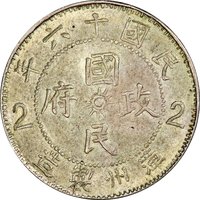
Obverse
Description:
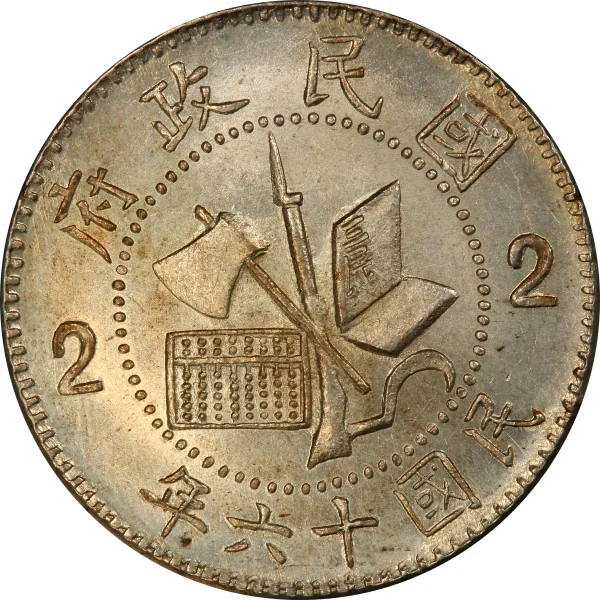
A rifle, axe, scythe, abacus, and laptop-like object, each flanked by Chinese characters and numerical values.
Inscription:
府政民國
2 民 2
年六十國民
2 民 2
年六十國民
Translation:
Republican Government of the People
Year 62 of the Republic
The People
Year 62 of the Republic
The People
Language: Chinese
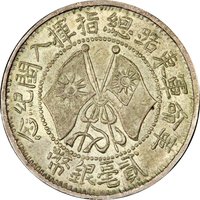
Reverse
Description:
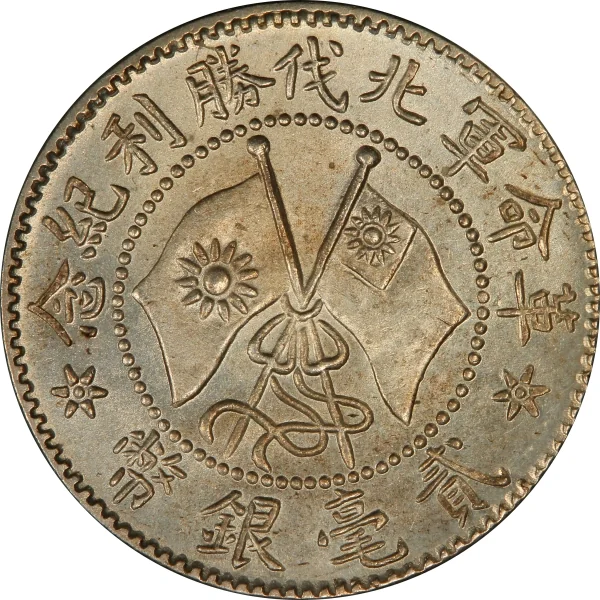
Crossed flags with Chinese characters.
Inscription:
念紀利勝伐北軍命華
幣銀毫貳
幣銀毫貳
Translation:
In commemoration of the victorious campaign against the northern army, by imperial decree.
Coin: Silver Mace, Two.
Coin: Silver Mace, Two.
Language: Classical Chinese
Edge
Reeded.
Mintings
| Year | Mint Mark | Mintage | Quality | Collection |
|---|---|---|---|---|
| 1927 | — | — |
Historical background
In 1927, Fukien (Fujian) Province was caught in the turbulent monetary fragmentation that defined China's Warlord Era. Following the collapse of the Qing dynasty, no single authority controlled the national currency system. In practice, Fukien's economy operated on a complex and unstable mixture of currencies. These included old imperial silver coins (yuan), various banknotes issued by local Fukienese banks and merchant guilds, and notes from the two major competing national banks: the Bank of China and the Bank of Communications. Crucially, the province was also under the influence of the Southern government in Canton, which issued its own "Guangdong dollars," adding another layer to the monetary chaos.
The political instability of the year directly exacerbated the currency crisis. 1927 marked the Northern Expedition's advance and the split between the Nationalists (KMT) and Communists. As military and political control in Fukien shifted between local warlords, remnants of the Northern Beiyang government, and advancing KMT forces, each entity sought to fund itself. This often led to the reckless printing of unbacked paper notes, causing severe inflation and a loss of public confidence. Merchants and the public heavily favored solid silver coinage over paper, leading to hoarding, sharp exchange rate disparities between different notes, and frequent merchant strikes or market closures in protest against depreciating currency.
This monetary disarray had profound consequences for daily life and commerce in Fukien. It disrupted intra-provincial trade, as exchange rates could vary wildly between cities like Foochow (Fuzhou) and Amoy (Xiamen). It also crippled inter-provincial trade, as Fukien's myriad notes were discounted or rejected elsewhere in China. The situation created a breeding ground for speculation and fraud, while eroding the tax base for any governing authority. Ultimately, the currency chaos of 1927 in Fukien was a microcosm of China's broader struggle for unification, demonstrating how financial disintegration both reflected and intensified political fragmentation.
The political instability of the year directly exacerbated the currency crisis. 1927 marked the Northern Expedition's advance and the split between the Nationalists (KMT) and Communists. As military and political control in Fukien shifted between local warlords, remnants of the Northern Beiyang government, and advancing KMT forces, each entity sought to fund itself. This often led to the reckless printing of unbacked paper notes, causing severe inflation and a loss of public confidence. Merchants and the public heavily favored solid silver coinage over paper, leading to hoarding, sharp exchange rate disparities between different notes, and frequent merchant strikes or market closures in protest against depreciating currency.
This monetary disarray had profound consequences for daily life and commerce in Fukien. It disrupted intra-provincial trade, as exchange rates could vary wildly between cities like Foochow (Fuzhou) and Amoy (Xiamen). It also crippled inter-provincial trade, as Fukien's myriad notes were discounted or rejected elsewhere in China. The situation created a breeding ground for speculation and fraud, while eroding the tax base for any governing authority. Ultimately, the currency chaos of 1927 in Fukien was a microcosm of China's broader struggle for unification, demonstrating how financial disintegration both reflected and intensified political fragmentation.
💎 Extremely Rare