

2 jiao – Fukien Province
Add to wishlist
China
Context
Year: 1911
Country: China
Issuer: Fukien Province
Period:
(1912—1949)
Currency:
(1896—1949)
Demonetized: Yes
Material
References
Y: #
Numista: #43117
Value
Bullion value: $12.78
Obverse
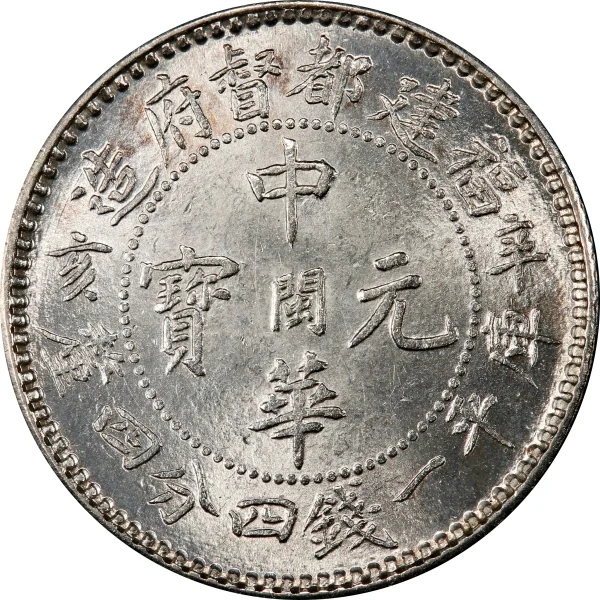
Description:
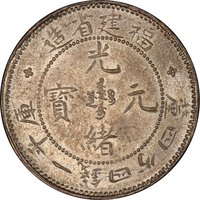
Four central ideograms read top-down, encircled by more characters.
Inscription:
造府督都建福
亥辛
中
寶閩元
華
釐四分四錢一平庫
亥辛
中
寶閩元
華
釐四分四錢一平庫
Translation:
Manufactured by the Viceroy's Mint of Fujian.
Xinhai (Year)
Central (Mint)
Treasure of Min, One Dollar
Hua (?)
One Dollar, Four Mace, Four Candareens, Standard Treasury Weight
Xinhai (Year)
Central (Mint)
Treasure of Min, One Dollar
Hua (?)
One Dollar, Four Mace, Four Candareens, Standard Treasury Weight
Script: Chinese
Language: Chinese
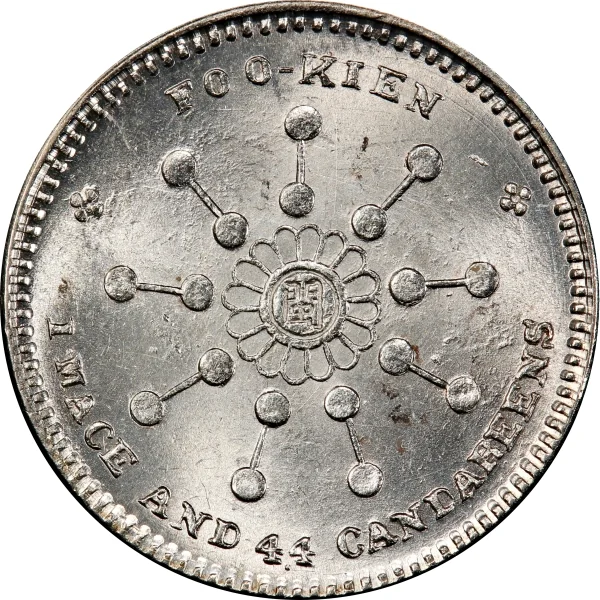
Reverse
Edge
Reeded.
Mintings
| Year | Mint Mark | Mintage | Quality | Collection |
|---|---|---|---|---|
| 1911 | — | — |
Historical background
In 1911, Fukien (modern Fujian) Province, like much of China, operated within a complex and fragmented monetary system on the eve of the Xinhai Revolution. The official currency was the silver tael, a unit of weight rather than a minted coin, leading to local variations and inefficiency. Alongside this, foreign silver dollars, particularly the Mexican "Eagle" dollar and the British trade dollar, circulated widely in coastal treaty ports like Fuzhou and Xiamen due to extensive overseas trade. These foreign coins were often preferred for their standardized weight and reliability, undermining the Qing dynasty's monetary sovereignty.
Provincial mints also produced their own silver and copper coinage, adding to the complexity. The Fujian provincial authorities minted silver dollars and subsidiary copper coins (tongyuan) to facilitate local trade and revenue collection. However, the value and acceptance of these coins were often regional, and their quality could be inconsistent. Furthermore, a vast quantity of copper cash coins from earlier dynasties remained in everyday use for small transactions among the general populace, creating a multi-tiered system where exchange rates between silver, copper, and foreign dollars fluctuated constantly.
This monetary disarray reflected and exacerbated the wider political and economic instability of the late Qing period. The proliferation of different currencies, combined with a persistent drain of silver abroad, created uncertainty for merchants and peasants alike. When the revolution broke out in October 1911, leading to Fujian declaring independence from the Qing in November, this chaotic currency situation presented an immediate challenge for the new provincial administration, which sought to assert control over finances and establish a more unified monetary system to fund its operations and stabilize the local economy.
Provincial mints also produced their own silver and copper coinage, adding to the complexity. The Fujian provincial authorities minted silver dollars and subsidiary copper coins (tongyuan) to facilitate local trade and revenue collection. However, the value and acceptance of these coins were often regional, and their quality could be inconsistent. Furthermore, a vast quantity of copper cash coins from earlier dynasties remained in everyday use for small transactions among the general populace, creating a multi-tiered system where exchange rates between silver, copper, and foreign dollars fluctuated constantly.
This monetary disarray reflected and exacerbated the wider political and economic instability of the late Qing period. The proliferation of different currencies, combined with a persistent drain of silver abroad, created uncertainty for merchants and peasants alike. When the revolution broke out in October 1911, leading to Fujian declaring independence from the Qing in November, this chaotic currency situation presented an immediate challenge for the new provincial administration, which sought to assert control over finances and establish a more unified monetary system to fund its operations and stabilize the local economy.
💎 Extremely Rare