

1 jiao – Fukien Province
Add to wishlist
Circulating commemorative coins
Commemoration: Canton martyrs
China
Context
Years: 1928–1931
Country: China
Issuer: Fukien Province
Period:
(1912—1949)
Currency:
(1896—1949)
Demonetized: Yes
Material
References
Y: #
Numista: #42436
Value
Bullion value: $6.49
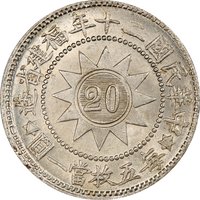
Obverse
Description:
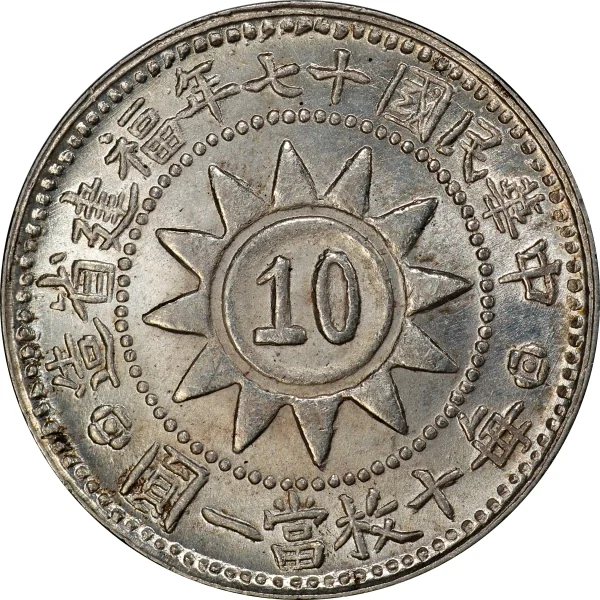
Sun with twelve rays encircled by Chinese characters.
Inscription:
造省建福年七十國民華中
10
圓一當枚十每
10
圓一當枚十每
Translation:
Made in the 70th year of the Republic of China, each ten pieces equal one ten-dollar coin.
Scripts: Chinese (traditional, regular script)
Language: Chinese
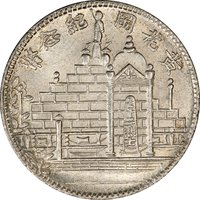
Reverse
Description:
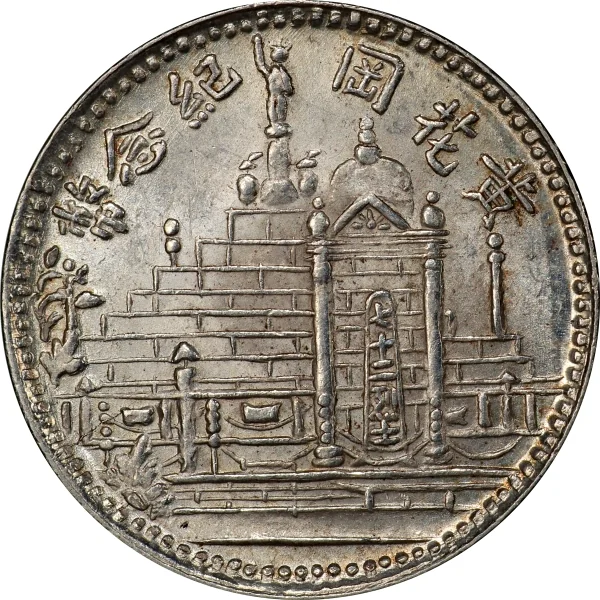
Huanghuagang Mausoleum, topped with a statue and inscribed with Chinese characters on its shrine.
Inscription:
幣念紀岡花黄
七
十
二
烈
士
七
十
二
烈
士
Translation:
In Commemoration of the Huanghuagang Seventy-Two Martyrs
Scripts: Chinese (traditional, regular script)
Language: Chinese
Edge
Reeded.
Mintings
| Year | Mint Mark | Mintage | Quality | Collection |
|---|---|---|---|---|
| 1928 | — | — | ||
| 1931 | — | — |
Historical background
In 1928, Fukien (Fujian) Province was caught in a complex and unstable currency situation, typical of China's "warlord era" before national unification. The province did not have a single, authoritative currency. Instead, circulation was a chaotic mix of various monies: national currencies like the Shanghai-based "Fabì" notes from the Bank of China and Bank of Communications, local banknotes issued by provincial and private banks within Fujian, and even a significant volume of silver dollars (most notably the Mexican "Eagle" dollar and the later "Sun Yat-sen" dollar). This multiplicity created confusion, hindered trade, and made the provincial economy vulnerable to sudden shifts in exchange rates between these competing mediums.
The root of this disorder lay in fragmented political control. While nominally under the Nanjing-based Nationalist Government after the Northern Expedition, Fujian in 1928 still experienced considerable de facto autonomy and lingering warlord influence. Local military and political authorities, needing to finance their administrations and armies, often compelled provincial banks to issue unbacked paper currency. This led to frequent depreciation and loss of public trust, causing people to prefer hard silver coinage or notes from more stable foreign banks in treaty ports like Xiamen (Amoy) and Fuzhou. The province was effectively a multi-currency zone where the value of money depended heavily on who issued it and the military fortunes of its backers.
Consequently, the year 1928 represented a point of attempted transition rather than stability. The new Nationalist government in Nanjing was beginning its efforts to enforce monetary unification and displace warlord currencies with its central bank notes, but this process was slow and faced deep resistance in provinces like Fujian. The coexistence of old and new currencies, along with the persistent inflow of silver, meant that economic activity operated in an environment of significant uncertainty. This chaotic background would persist until the Nationalist government's more forceful currency reforms in the mid-1930s.
The root of this disorder lay in fragmented political control. While nominally under the Nanjing-based Nationalist Government after the Northern Expedition, Fujian in 1928 still experienced considerable de facto autonomy and lingering warlord influence. Local military and political authorities, needing to finance their administrations and armies, often compelled provincial banks to issue unbacked paper currency. This led to frequent depreciation and loss of public trust, causing people to prefer hard silver coinage or notes from more stable foreign banks in treaty ports like Xiamen (Amoy) and Fuzhou. The province was effectively a multi-currency zone where the value of money depended heavily on who issued it and the military fortunes of its backers.
Consequently, the year 1928 represented a point of attempted transition rather than stability. The new Nationalist government in Nanjing was beginning its efforts to enforce monetary unification and displace warlord currencies with its central bank notes, but this process was slow and faced deep resistance in provinces like Fujian. The coexistence of old and new currencies, along with the persistent inflow of silver, meant that economic activity operated in an environment of significant uncertainty. This chaotic background would persist until the Nationalist government's more forceful currency reforms in the mid-1930s.
✨ Legendary