

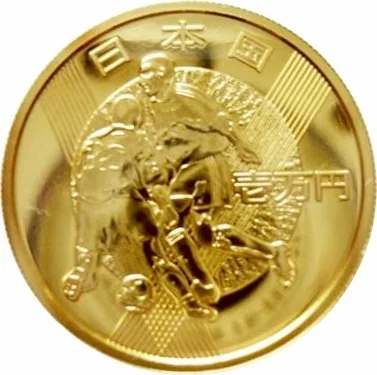
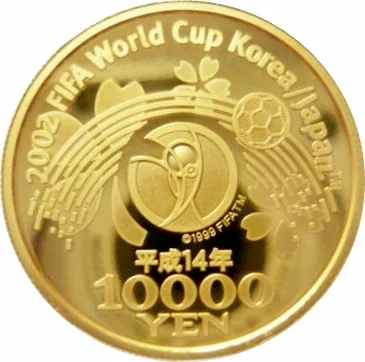
10000 Yen – Japan
Non-circulating coins
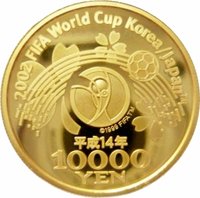
Commemoration: 2002 FIFA World Cup Korea/Japan
Japan
Context
Year: 2002
Japanese - Heisei era Year: 14
Issuer: Japan 
Ruler: Heisei
Currency:
(since 1871)
Total mintage: 100,000
Material
Diameter: 26 mm
Weight: 15.6 g
Gold weight: 15.58 g
Shape: Round
Composition: 99.9% Gold
Standard: Silver half ounce
Magnetic: No
Technique: Milled
Alignment: Medal alignment
flip
References
Y: #Click to copy to clipboard130
Numista: #40380
Value
Exchange value: 10000 JPY = $64.08
Bullion value: $2604.86
Inflation-adjusted value: 11257.60 JPY
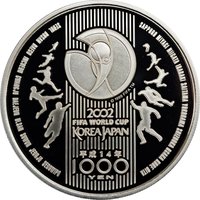
Obverse
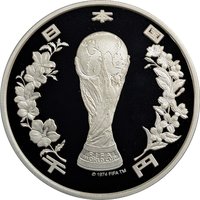
Reverse
Edge
Slanted reeding and latent images
Categories
| Sport> Football> FIFA World Cup |
Mintings
| Year | Mint Mark | Mintage | Quality | Collection |
|---|---|---|---|---|
| 2002 | — | 100,000 | Proof |
Historical background
In 2002, Japan remained mired in a complex and protracted period of economic stagnation and deflation, often referred to as the "Lost Decade." The currency situation was defined by a deliberate policy of maintaining a weak yen, orchestrated by the Bank of Japan (BOJ) under Governor Masaru Hayami. Throughout the year, the BOJ engaged in aggressive, unsterilized currency intervention, selling yen and buying U.S. dollars to depress the yen's value. This was done in close coordination with the Ministry of Finance, which held operational authority over foreign exchange policy. The primary goal was to combat deflation by boosting export competitiveness, as a cheaper yen made Japanese goods like automobiles and electronics more affordable overseas, providing crucial support to major corporate exporters.
This weak-yen policy existed within a broader context of extreme monetary easing. The BOJ had already pioneered its "zero interest rate policy" (ZIRP) in 1999 and, in March 2001, had shifted to a more radical framework called "quantitative easing" (QE). Under QE, the BOJ flooded the banking system with excess liquidity by targeting the current account balances held by financial institutions, rather than the overnight interest rate. Despite these unprecedented measures, domestic demand remained persistently weak, consumer prices continued to fall, and the economy faced a looming banking crisis due to massive non-performing loans. Thus, currency intervention was a key external tool to stimulate growth when conventional domestic policy levers seemed ineffective.
The situation drew significant international attention and criticism, particularly from the United States and European nations, who argued that Japan was artificially manipulating its currency to gain an unfair trade advantage. Nonetheless, Japanese authorities were resolute, viewing the weak yen as a necessary defense against a deflationary spiral that threatened the entire financial system. The yen's average value in 2002 was approximately 125 to 130 against the U.S. dollar, a level policymakers actively sought to maintain. This period underscored Japan's struggle with post-bubble economic ailments and its reliance on a combination of experimental monetary policy and direct forex intervention as a response, setting a precedent for central bank actions in later global crises.
This weak-yen policy existed within a broader context of extreme monetary easing. The BOJ had already pioneered its "zero interest rate policy" (ZIRP) in 1999 and, in March 2001, had shifted to a more radical framework called "quantitative easing" (QE). Under QE, the BOJ flooded the banking system with excess liquidity by targeting the current account balances held by financial institutions, rather than the overnight interest rate. Despite these unprecedented measures, domestic demand remained persistently weak, consumer prices continued to fall, and the economy faced a looming banking crisis due to massive non-performing loans. Thus, currency intervention was a key external tool to stimulate growth when conventional domestic policy levers seemed ineffective.
The situation drew significant international attention and criticism, particularly from the United States and European nations, who argued that Japan was artificially manipulating its currency to gain an unfair trade advantage. Nonetheless, Japanese authorities were resolute, viewing the weak yen as a necessary defense against a deflationary spiral that threatened the entire financial system. The yen's average value in 2002 was approximately 125 to 130 against the U.S. dollar, a level policymakers actively sought to maintain. This period underscored Japan's struggle with post-bubble economic ailments and its reliance on a combination of experimental monetary policy and direct forex intervention as a response, setting a precedent for central bank actions in later global crises.


✨ Legendary