

5000 Yen (Judicial System) – Japan
Non-circulating coins
Commemoration: 100th Anniversary of the Judicial System
Japan
Context
Year: 1990
Japanese - Heisei era Year: 2
Issuer: Japan 
Ruler: Heisei
Currency:
(since 1871)
Total mintage: 5,000,000
Material
References
Y: #Click to copy to clipboard104
Numista: #35951
Value
Exchange value: 5000 JPY = $32.04
Bullion value: $40.21
Inflation-adjusted value: 6254.75 JPY
Obverse
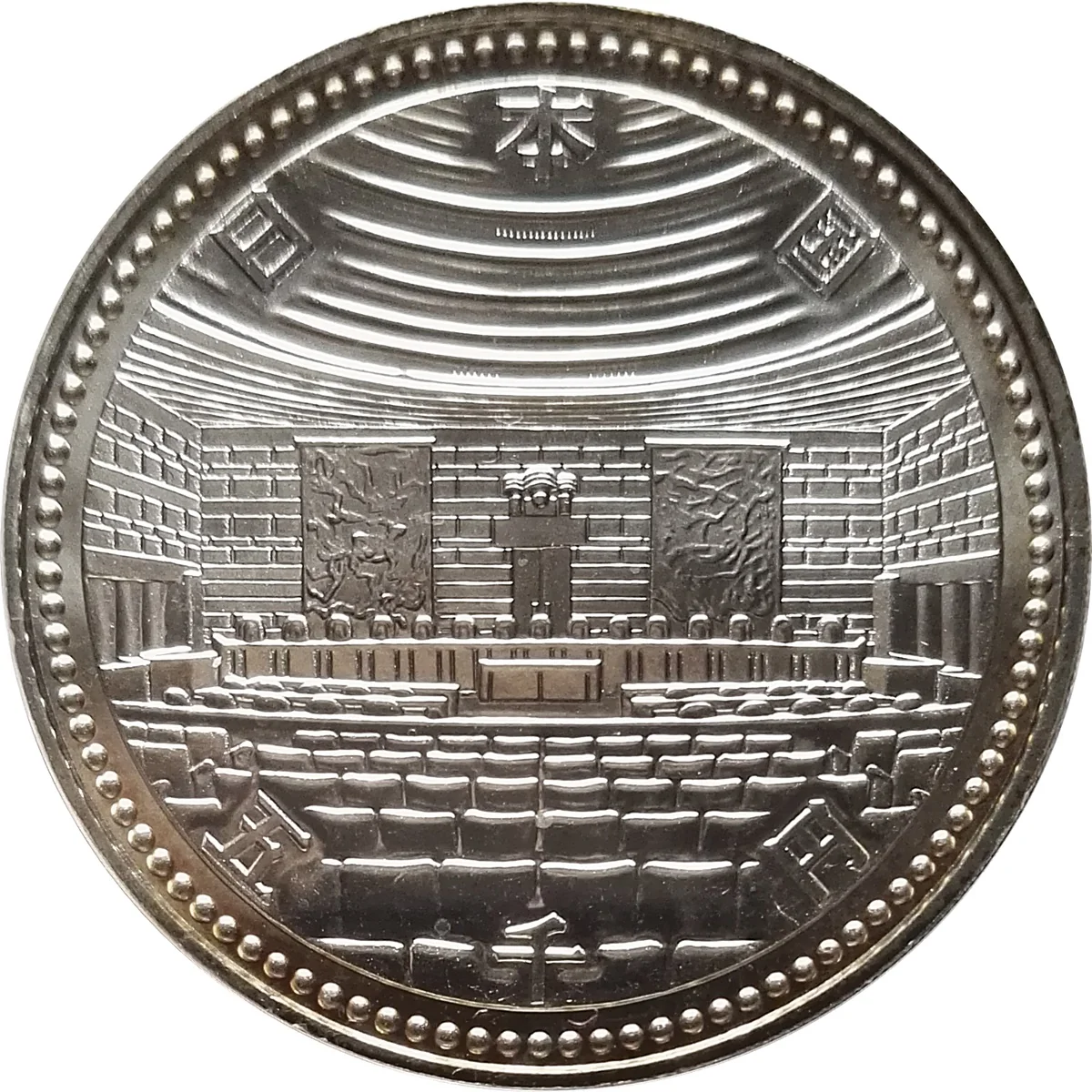
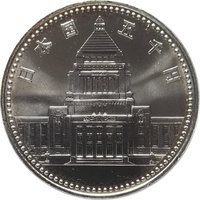
Description:
Supreme Court of Japan courtroom
Inscription:
日 本 国
五 千 円
五 千 円
Translation:
JAPAN
5000 YEN
5000 YEN
Language: Japanese
Reverse
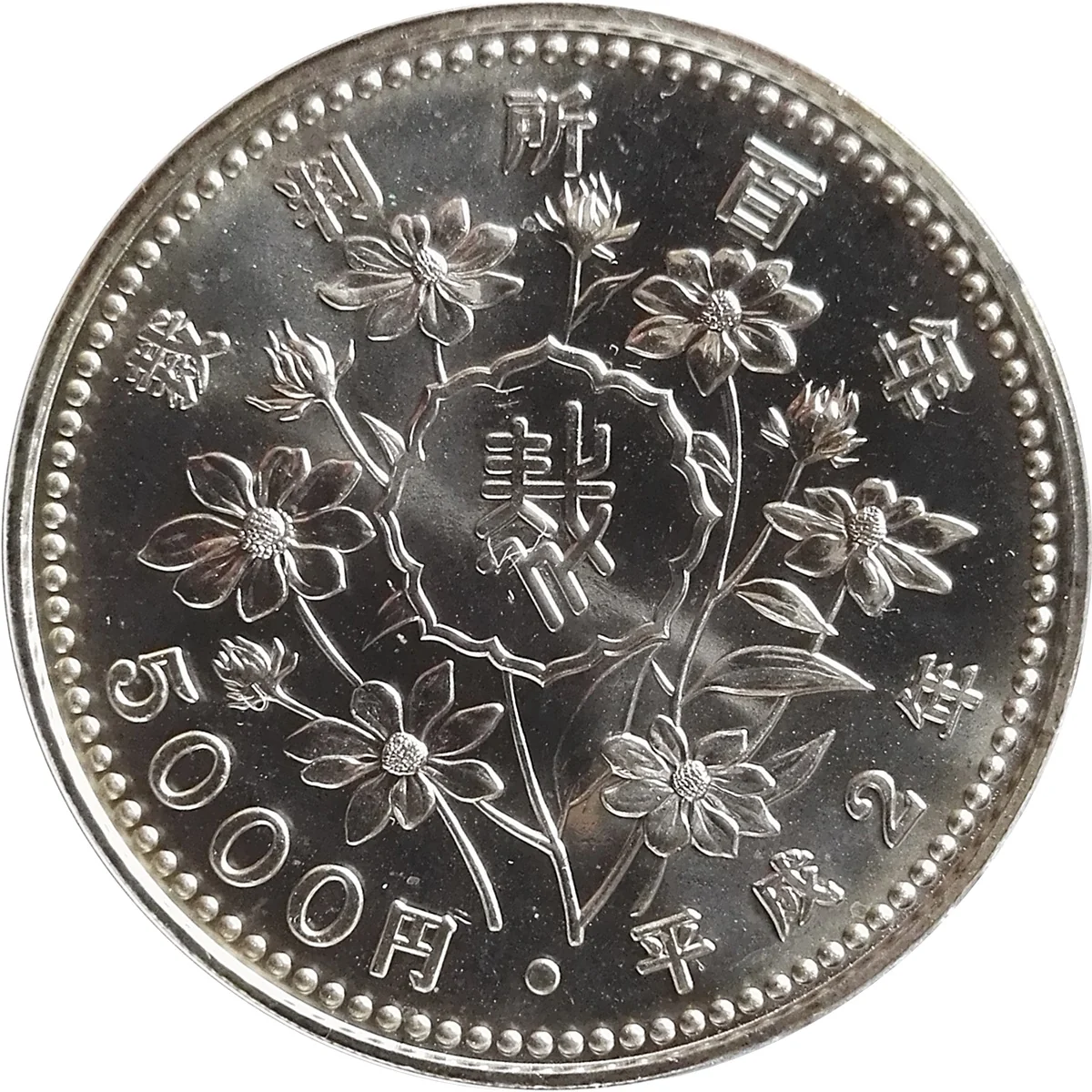
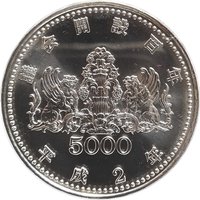
Description:
Court staff badge within 'yata no kagami,' encircled by rudbeckia and laciniata.
Inscription:
裁 判 所 百 年
裁
5000 円 • 平 成 2 年
裁
5000 円 • 平 成 2 年
Translation:
Courts Centennial
5000 Yen • Heisei 2
5000 Yen • Heisei 2
Language: Japanese
Mints
| Name | Mark |
|---|---|
| Japan Mint | — |
Mintings
| Year | Mint Mark | Mintage | Quality | Collection |
|---|---|---|---|---|
| 1990 | — | 5,000,000 |
Historical background
In 1990, Japan stood at the precipice of a dramatic economic reversal, with its currency, the yen, reflecting the nation's extraordinary rise and looming crisis. The preceding decade had seen Japan's economy and financial markets soar to unprecedented heights, fueled by asset price bubbles in real estate and stocks. A strong yen was both a symbol and a consequence of this success, having appreciated sharply following the 1985 Plaza Accord, where international agreements aimed to devalue the U.S. dollar. This "endaka" (high yen) initially caused a recession but was soon mitigated by the Bank of Japan's extremely loose monetary policy, which inadvertently poured fuel on the speculative bubble.
The currency situation in 1990 was therefore one of paradoxical strength masking profound vulnerability. The yen traded at a historically high level, around 140-150 yen to the U.S. dollar, projecting an image of a financial superpower. This external strength, however, was underpinned by a domestic economy intoxicated by cheap credit and wildly inflated asset values. The Bank of Japan, recognizing the danger, had begun tightening monetary policy in 1989, raising interest rates. This deliberate move aimed to cool the speculation but would soon trigger the collapse of the bubble economy.
Consequently, 1990 marked the inflection point where financial reality detached from perception. As the stock market began its precipitous fall and land prices started their long decline, the yen's value became increasingly disconnected from the deteriorating health of the Japanese financial system. The currency remained strong for a time, supported by Japan's massive trade surpluses and foreign asset holdings, but the stage was set for the "Lost Decade." The bursting bubble would lead to banking crises, deflation, and stagnant growth, creating a long-term economic environment where yen policy would shift towards combating weakness rather than managing strength.
The currency situation in 1990 was therefore one of paradoxical strength masking profound vulnerability. The yen traded at a historically high level, around 140-150 yen to the U.S. dollar, projecting an image of a financial superpower. This external strength, however, was underpinned by a domestic economy intoxicated by cheap credit and wildly inflated asset values. The Bank of Japan, recognizing the danger, had begun tightening monetary policy in 1989, raising interest rates. This deliberate move aimed to cool the speculation but would soon trigger the collapse of the bubble economy.
Consequently, 1990 marked the inflection point where financial reality detached from perception. As the stock market began its precipitous fall and land prices started their long decline, the yen's value became increasingly disconnected from the deteriorating health of the Japanese financial system. The currency remained strong for a time, supported by Japan's massive trade surpluses and foreign asset holdings, but the stage was set for the "Lost Decade." The bursting bubble would lead to banking crises, deflation, and stagnant growth, creating a long-term economic environment where yen policy would shift towards combating weakness rather than managing strength.
💎 Very Rare