

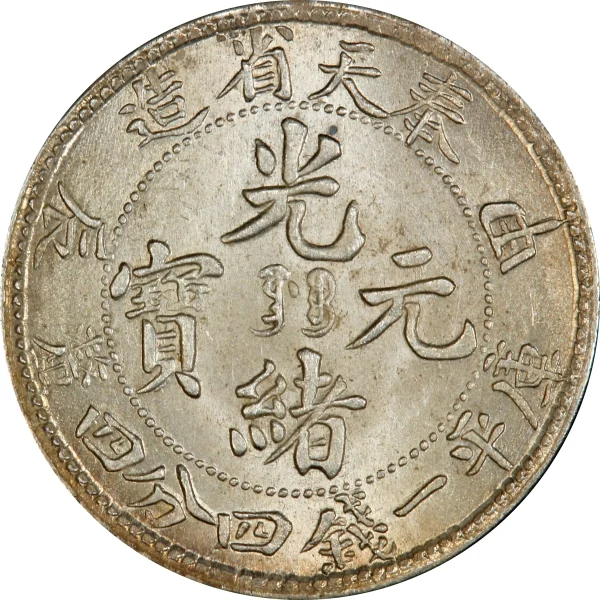
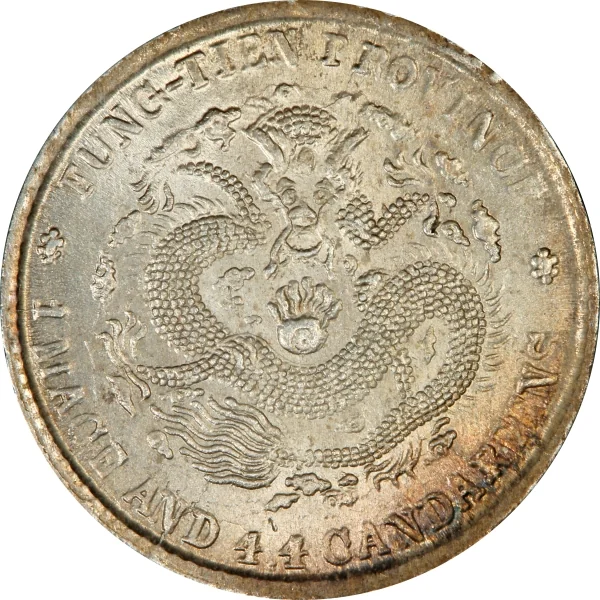
20 fen – Fengtien Province
Add to wishlist
China
Context
Year: 1904
Country: China
Issuer: Fengtien Province
Ruler: Guangxu
Currency:
(1897—1931)
Demonetized: Yes
Material
References
Y: #
Numista: #34895
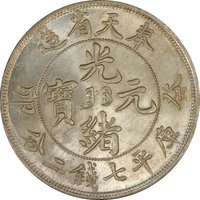
Obverse
Description:
Chinese ideograms top to bottom, right to left, with central Manchu text, all encircled by more Chinese characters.
Inscription:
造省天奉
辰甲
光
寶 ᡶᡠᠩ ᠪᠣᠣ 元
緒
釐四分四錢一平庫
辰甲
光
寶 ᡶᡠᠩ ᠪᠣᠣ 元
緒
釐四分四錢一平庫
Translation:
Made in the Chen-Year under the Guangxu Reign
Tael 1.44 Mace
Fengboo Silver Ingot
Standard Treasury
Tael 1.44 Mace
Fengboo Silver Ingot
Standard Treasury
Scripts: Chinese, Mongolian / Manchu
Languages: Manchu, Classical Chinese
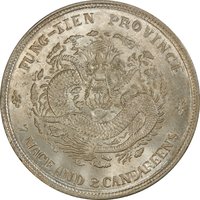
Reverse
Description:
Dragon encircling a pearl, surrounded by English text.
Inscription:
FUNG-TIEN
1 MACE AND 4.4 CANDAREENS
1 MACE AND 4.4 CANDAREENS
Script: Latin
Edge
Reeded.
Categories
| Mythology> Fantastic animal |
Mintings
| Year | Mint Mark | Mintage | Quality | Collection |
|---|---|---|---|---|
| 1904 | — | — |
Historical background
In 1904, Fengtien Province (modern Liaoning) was the epicenter of a severe and chaotic currency crisis, a direct consequence of the Russo-Japanese War being fought on its soil. The province, particularly its major city of Mukden (Shenyang), was a critical battleground, and both warring empires flooded the region with their own military scrip to fund operations. Russian rubles, Japanese yen, and specially issued military notes circulated alongside, and competed with, the existing Qing dynasty currency, which included silver taels, copper cash, and various local banknotes. This created a wildly unstable multi-currency environment where exchange rates fluctuated violently based on the fortunes of war, leading to rampant speculation and commercial paralysis.
The crisis was profoundly exacerbated by the decay of the traditional Qing monetary system. The central government's authority was weak, and Fengtien's economy relied heavily on heterogeneous paper notes issued by local "official banks," merchant guilds, and even private shops, with no standard reserve backing. As war pressures mounted, many of these note-issuing entities failed, rendering their paper worthless. Furthermore, the province suffered from a chronic shortage of standard copper cash coins, which were hoarded or melted down, leading to a crippling small-change shortage that strangled daily market transactions for the common populace.
The result was economic devastation and social hardship. Merchants and peasants faced ruin as the value of their holdings evaporated overnight; prices became unpredictable, and trade was severely disrupted. The currency chaos vividly demonstrated the Qing state's inability to maintain monetary sovereignty or provide economic stability in a time of crisis. This situation not only intensified the suffering of Fengtien's population during the war but also served as a potent precursor to the wider financial disintegration that would contribute to the dynasty's collapse less than a decade later.
The crisis was profoundly exacerbated by the decay of the traditional Qing monetary system. The central government's authority was weak, and Fengtien's economy relied heavily on heterogeneous paper notes issued by local "official banks," merchant guilds, and even private shops, with no standard reserve backing. As war pressures mounted, many of these note-issuing entities failed, rendering their paper worthless. Furthermore, the province suffered from a chronic shortage of standard copper cash coins, which were hoarded or melted down, leading to a crippling small-change shortage that strangled daily market transactions for the common populace.
The result was economic devastation and social hardship. Merchants and peasants faced ruin as the value of their holdings evaporated overnight; prices became unpredictable, and trade was severely disrupted. The currency chaos vividly demonstrated the Qing state's inability to maintain monetary sovereignty or provide economic stability in a time of crisis. This situation not only intensified the suffering of Fengtien's population during the war but also served as a potent precursor to the wider financial disintegration that would contribute to the dynasty's collapse less than a decade later.
💎 Extremely Rare