

5 Jiao – Fengtien Province
China
Context
Years: 1897–1899
Country: China 
Issuer: Fengtien Province
Ruler: Guangxu
Currency:
(1897—1931)
Subdivision: 5 Jiao = 50 Fen
Demonetized: Yes
Material
References
Y: #Click to copy to clipboard86
Numista: #32214
Value
Bullion value: $37.49
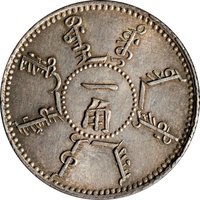
Obverse
Description:
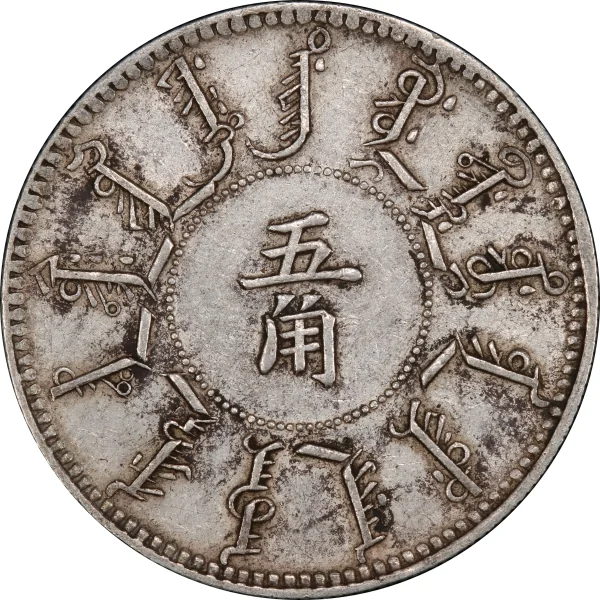
Manchu text encircling two Chinese characters.
Inscription:
ᡩᠠᡳᠴᡳᠩ ᡤᡠᡵᡠᠨ ᡳ᠋ ᠪᠠᡩᠠᡵᠠᠩᡤᠠ ᡩᠣᡵᠣ ᡳ᠋ ᠣᡵᡳᠨ ᡩᡠᡳᠴᡳ ᠠᠨᡳᠶᠠ ᠠᠪᡴᠠᡳ ᡳᠮᡳᠶᠠᠩᡤᠠ ᡨᡝᡨᡠᠨ ᡧᡠᡵᡩᡝᡵᡝ ᡴᡡᠸᠠᡵᠠᠨ ᠸᡝᡳᡵᡝᡥᡝ
五
角
五
角
Translation:
DAICING GURUN-I BADARANGGA DORO-I ORIN DUICI ANIYA ABKAI IMIYANGGGA TETUN ŠURDERE KŪWARAN WEIREHE
五
角
五
角
Language: Manchu
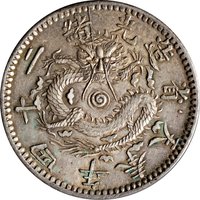
Reverse
Description:
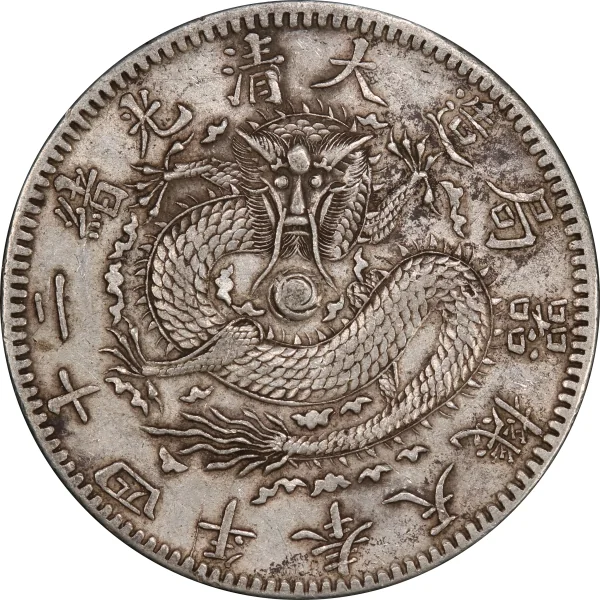
Dragon encircling a pearl, surrounded by English text.
Inscription:
清大
造局器械天奉年四十二緒光
造局器械天奉年四十二緒光
Translation:
Manufactured by the Clear and Great
Ordnance Bureau, Instrument and Armament.
In the 42nd Year of the Tianfeng Era,
Guangxu.
Ordnance Bureau, Instrument and Armament.
In the 42nd Year of the Tianfeng Era,
Guangxu.
Language: Chinese
Edge
Reeded.
Categories
| Mythology> Fantastic animal |
Mintings
| Year | Mint Mark | Mintage | Quality | Collection |
|---|---|---|---|---|
| 1897 | — | — | ||
| 1898 | — | — | ||
| 1899 | — | — |
Historical background
In 1897, Fengtien Province (modern Liaoning) was at the epicenter of a complex and chaotic monetary situation, characteristic of late Qing China's struggle with imperialist encroachment and financial modernization. The province, and its key city of Mukden (Shenyang), operated within a "multi-currency system" where various forms of money circulated simultaneously without fixed exchange rates. This included imperial Qing silver sycee (measured in taels), copper-alloy cash coins (strung in guan), and a growing volume of foreign silver dollars, particularly Mexican Eagle Dollars and later Japanese Yen, which entered via thriving trade and foreign concessions.
This monetary fragmentation was exacerbated by the region's strategic importance. Following the First Sino-Japanese War (1894-95), Japanese influence expanded rapidly, and the Russian Empire was deepening its economic penetration, having secured railway and concession rights in Manchuria. Both powers sought to advance their currencies as dominant mediums of exchange to solidify economic control. Concurrently, local Chinese financial institutions, such as piaohao (draft banks) and qianzhuang (native banks), issued their own private banknotes (zhuangpiao), convertible to silver or copper. These notes were essential for commerce but their value depended entirely on the issuing house's reputation, leading to frequent instability and localized inflation.
The Qing government's attempts to impose a unified currency system were largely ineffective in Fengtien at this time. Provincial authorities and military units sometimes issued their own scrip to meet local needs, adding another layer of complexity. Thus, by 1897, the monetary landscape was one of competitive vulnerability, where everyday transactions required constant negotiation between metal content, coin origin, and paper creditworthiness. This instability reflected the weakening sovereignty of the Qing state and set the stage for the more radical currency interventions that would follow, especially after the Russo-Japanese War (1904-05).
This monetary fragmentation was exacerbated by the region's strategic importance. Following the First Sino-Japanese War (1894-95), Japanese influence expanded rapidly, and the Russian Empire was deepening its economic penetration, having secured railway and concession rights in Manchuria. Both powers sought to advance their currencies as dominant mediums of exchange to solidify economic control. Concurrently, local Chinese financial institutions, such as piaohao (draft banks) and qianzhuang (native banks), issued their own private banknotes (zhuangpiao), convertible to silver or copper. These notes were essential for commerce but their value depended entirely on the issuing house's reputation, leading to frequent instability and localized inflation.
The Qing government's attempts to impose a unified currency system were largely ineffective in Fengtien at this time. Provincial authorities and military units sometimes issued their own scrip to meet local needs, adding another layer of complexity. Thus, by 1897, the monetary landscape was one of competitive vulnerability, where everyday transactions required constant negotiation between metal content, coin origin, and paper creditworthiness. This instability reflected the weakening sovereignty of the Qing state and set the stage for the more radical currency interventions that would follow, especially after the Russo-Japanese War (1904-05).
✨ Legendary