

10 cash – Hunan Province
Add to wishlist
Circulating commemorative coins
Commemoration: Founding of the Empire
China
Context
Year: 1916
Chinese - Hongxian era Year:: 1
Country: China
Issuer: Hunan Province
Ruler: Hongxian
Currency:
(1897—1949)
Demonetized: Yes
Material
References
Y: #
Numista: #31884
Obverse
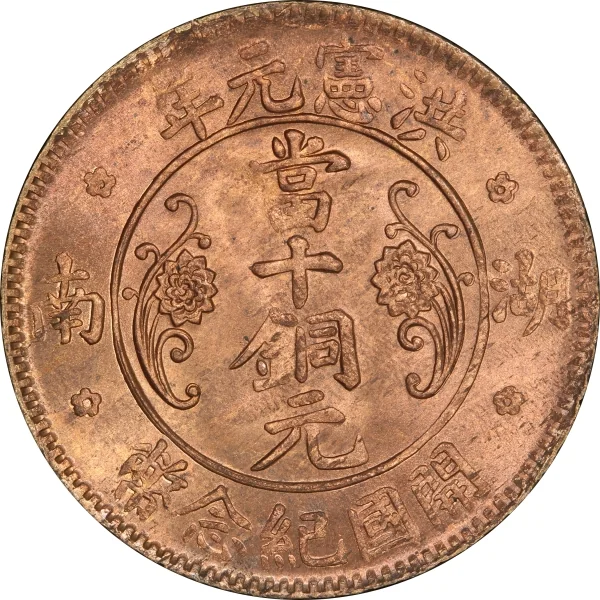
Description:
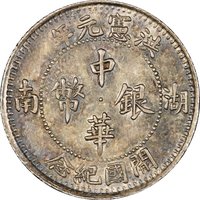
Four floral-flanked Chinese ideograms encircled by more characters.
Inscription:
年元憲洪
南湖
當
十
銅
元
幣念紀國開
南湖
當
十
銅
元
幣念紀國開
Translation:
Commemorative Coin of the Founding of the Republic
South Lake
Dang
Ten
Copper
Yuan
South Lake
Dang
Ten
Copper
Yuan
Language: Chinese
Reverse
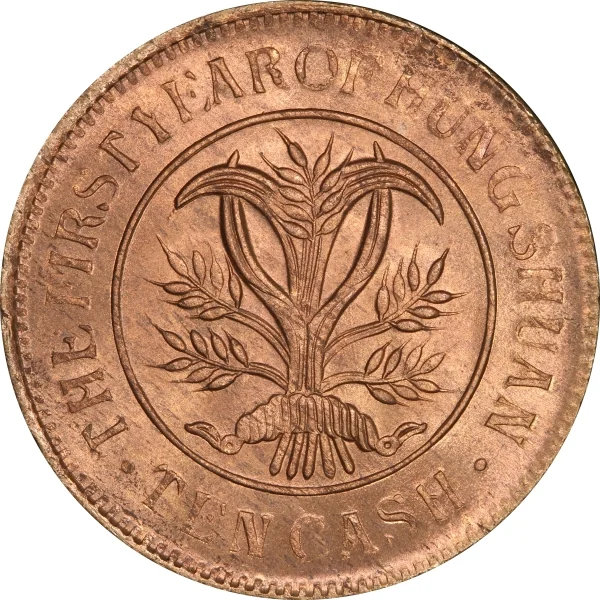
Description:
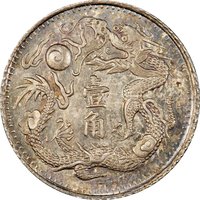
Rice plant with five ears and a ribbon, encircled by English text.
Inscription:
THE FIRST YEAR OF HUNG SHUAN
TEN CASH
TEN CASH
Edge
Plain
Mintings
| Year | Mint Mark | Mintage | Quality | Collection |
|---|---|---|---|---|
| 1916 | — | — |
Historical background
In 1916, Hunan Province found itself in a state of profound monetary disorder, a direct consequence of China's fragmented political landscape during the Warlord Era. Following the death of Yuan Shikai in June of that year, central authority from Beijing effectively collapsed, and Hunan became a contested prize among rival militarists like Tang Xiangming and later, Tan Yankai. This political instability severed the province from a unified national monetary system, leading to a chaotic coexistence of multiple, depreciating currencies. The primary circulating medium was the Hunan Provincial Bank's banknotes, but their value was entirely dependent on the solvency and credibility of whichever warlord faction controlled the provincial government at any given moment.
The currency environment was characterized by severe inflation and a lack of public trust. Provincial banknotes were over-issued to fund military campaigns and administrative costs, leading to rapid devaluation. Alongside these local notes, older imperial-era copper coins ("cash") and silver sycee still circulated, particularly in rural areas, creating a complex and inefficient multi-currency system. Furthermore, foreign silver dollars (notably Mexican and British trade dollars) and banknotes from neighboring provinces and foreign banks in treaty ports like Shanghai flowed in, often holding more value than the local paper. This created a hierarchy of money where people hoarded silver and spent paper, accelerating the depreciation of Hunan's own currency.
This monetary chaos severely disrupted Hunan's economy, hampering inter-regional trade and imposing a heavy burden on peasants and merchants who suffered from unpredictable price fluctuations. The situation was a microcosm of the broader Chinese economic crisis of the time, where the lack of a strong central state prevented the enforcement of a uniform currency. The currency instability in Hunan in 1916 was therefore not merely a financial issue, but a direct symptom and amplifier of the province's political strife and the disintegration of national coherence in the early Republic.
The currency environment was characterized by severe inflation and a lack of public trust. Provincial banknotes were over-issued to fund military campaigns and administrative costs, leading to rapid devaluation. Alongside these local notes, older imperial-era copper coins ("cash") and silver sycee still circulated, particularly in rural areas, creating a complex and inefficient multi-currency system. Furthermore, foreign silver dollars (notably Mexican and British trade dollars) and banknotes from neighboring provinces and foreign banks in treaty ports like Shanghai flowed in, often holding more value than the local paper. This created a hierarchy of money where people hoarded silver and spent paper, accelerating the depreciation of Hunan's own currency.
This monetary chaos severely disrupted Hunan's economy, hampering inter-regional trade and imposing a heavy burden on peasants and merchants who suffered from unpredictable price fluctuations. The situation was a microcosm of the broader Chinese economic crisis of the time, where the lack of a strong central state prevented the enforcement of a uniform currency. The currency instability in Hunan in 1916 was therefore not merely a financial issue, but a direct symptom and amplifier of the province's political strife and the disintegration of national coherence in the early Republic.
💎 Very Rare