

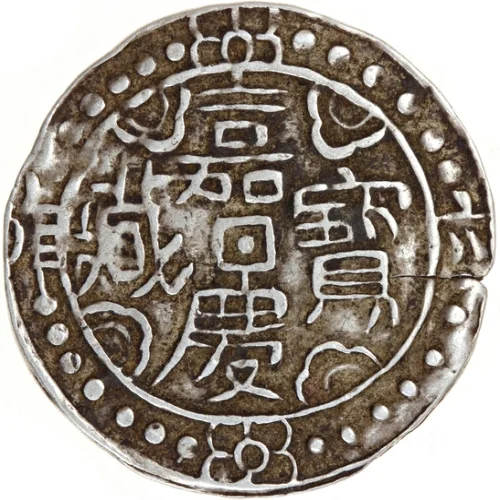

Obverse
Description:
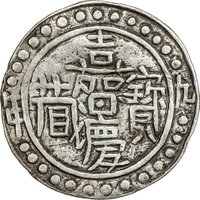
Four Chinese characters read vertically, flanked by clouds and flowers, with additional characters noting the year.
Inscription:
嘉
年藏 通六
慶
年藏 通六
慶
Translation:
Jiaqing. Tongbao.
Scripts: Chinese (traditional, regular script)
Language: Classical Chinese
Reverse
Description:
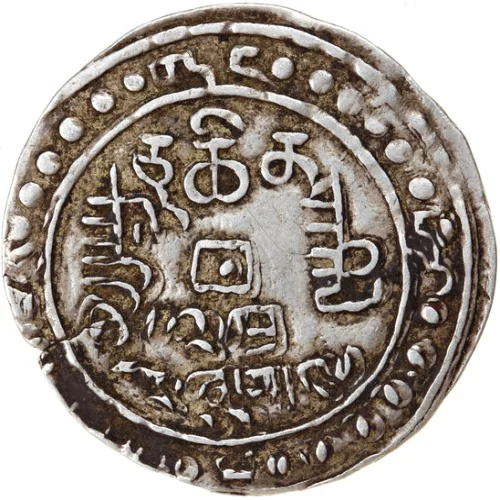
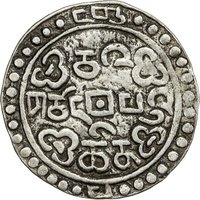
Tibetan script above and below, Manchu script vertically on the sides, with additional characters denoting the year.
Inscription:
གུང་ ལོ་དྲུག་པ་
ᠮᡝᠩᡤᡠᠨ - ᠨᡳᠨᡤᡠᠨ
ཅའ་ ཆིན་
འཁྲི་
བཞུགས་
ᠮᡝᠩᡤᡠᠨ - ᠨᡳᠨᡤᡠᠨ
ཅའ་ ཆིན་
འཁྲི་
བཞུགས་
Translation:
Gung, year six.
Menggun - ninggun.
Cha chin.
Thri.
Zhu.
Menggun - ninggun.
Cha chin.
Thri.
Zhu.
Script: Tibetan
Edge
Plain
Mintings
| Year | Mint Mark | Mintage | Quality | Collection |
|---|---|---|---|---|
| 1801 | — | — |
Historical background
In 1801, the currency situation in Tibet was characterized by a complex and largely self-contained monetary system under the firm administrative control of the Qing Dynasty's Amban (imperial resident) in Lhasa. The primary circulating currency was the Tibetan silver coin, the Tangka (also spelled Tam or Srang), which was minted locally in Lhasa. These coins bore religious and imperial symbols, but crucially, they were minted from silver bullion provided by the Qing central government, reflecting Beijing's ultimate authority over Tibet's fiscal sovereignty. The system was deliberately isolated; foreign coins and even standard Qing silver sycees were not meant to circulate freely, creating a closed monetary zone.
However, this system faced significant practical challenges. A chronic shortage of official Tangkas led to the widespread circulation of older, worn coins and privately minted issues, often of inferior silver content, which caused confusion and devaluation. Furthermore, the region's vital trade with Nepal was underpinned by a separate currency flow. Since the 1792 war and the subsequent Qing intervention, a treaty mandated that Tibet mint its coins using Nepalese silver, but strictly to a Chinese standard, ending the previous practice of accepting debased Nepalese coins that had caused economic conflict. This arrangement remained delicate in 1801.
Ultimately, the currency background in 1801 reveals a landscape of asserted Qing control juxtaposed with local scarcity and cross-border economic realities. The monetary policy was designed to project political sovereignty and stability, yet everyday transactions were hampered by insufficient coinage and reliance on complex trade mechanisms. This situation underscored Tibet's unique position within the Qing Empire: administratively integrated yet economically distinct, with its currency serving as a tangible instrument of imperial policy and a point of local economic friction.
However, this system faced significant practical challenges. A chronic shortage of official Tangkas led to the widespread circulation of older, worn coins and privately minted issues, often of inferior silver content, which caused confusion and devaluation. Furthermore, the region's vital trade with Nepal was underpinned by a separate currency flow. Since the 1792 war and the subsequent Qing intervention, a treaty mandated that Tibet mint its coins using Nepalese silver, but strictly to a Chinese standard, ending the previous practice of accepting debased Nepalese coins that had caused economic conflict. This arrangement remained delicate in 1801.
Ultimately, the currency background in 1801 reveals a landscape of asserted Qing control juxtaposed with local scarcity and cross-border economic realities. The monetary policy was designed to project political sovereignty and stability, yet everyday transactions were hampered by insufficient coinage and reliance on complex trade mechanisms. This situation underscored Tibet's unique position within the Qing Empire: administratively integrated yet economically distinct, with its currency serving as a tangible instrument of imperial policy and a point of local economic friction.

✨ Legendary