

10 Cash – Hunan Province
Circulating commemorative coins
Commemoration: Provincial Constituation
China
Context
Year: 1922
Chinese republican Year: 11
Country: China 
Issuer: Hunan Province
Period:
(1912—1949)
Currency:
(1897—1949)
Demonetized: Yes
Material
References
Y: #Click to copy to clipboard402.1
Numista: #296833
Obverse
Description:
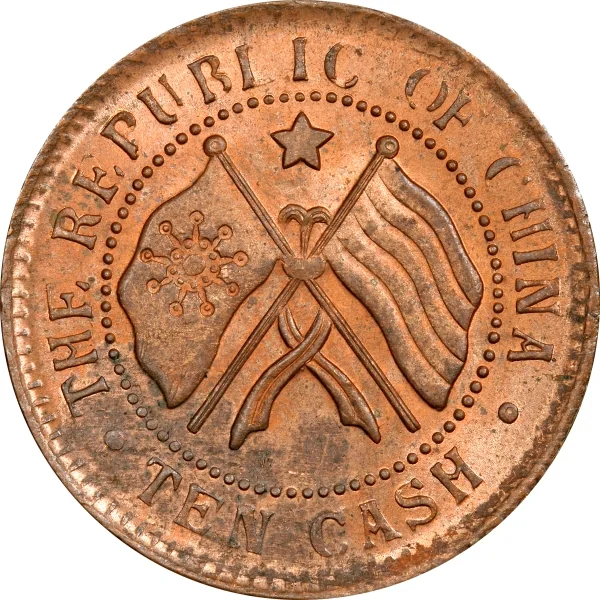
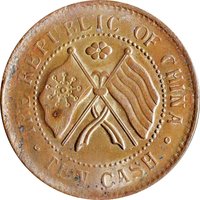
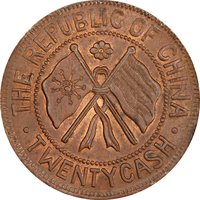
Crossed flags with a flower above, encircled by English text.
Inscription:
THE REPUBLIC OF CHINA
TEN CASH
TEN CASH
Reverse
Description:
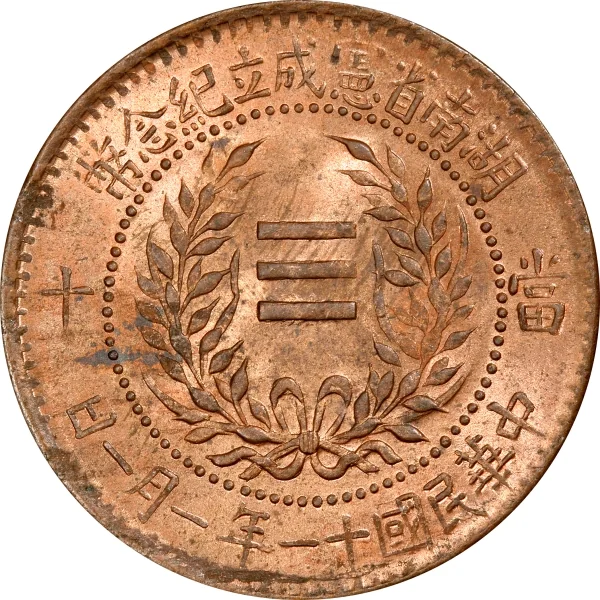
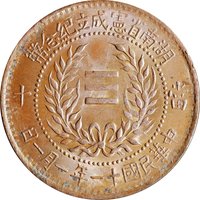
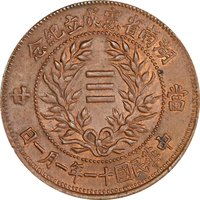
Trigram ☰ within wreath, encircled by Chinese characters.
Inscription:
幣念紀立成憲省南湖
十 當
日一月一年一十國民華中
十 當
日一月一年一十國民華中
Translation:
In Commemoration of the Establishment of the Constitution by the National Government of the Republic of China.
Ten Cents.
11th Year, 1st Month, 1st Day.
Ten Cents.
11th Year, 1st Month, 1st Day.
Language: Chinese
Edge
Plain
Mintings
| Year | Mint Mark | Mintage | Quality | Collection |
|---|---|---|---|---|
| 1922 | — | — |
Historical background
In 1922, Hunan Province existed within the fractured monetary landscape of Warlord Era China, where provincial authorities and military commanders issued currency to fund their regimes. The Hunan provincial government, under the militarist Zhao Hengti, heavily relied on printing unbacked paper notes to cover administrative and military expenses. This led to a proliferation of local banknotes from various provincial banks, notably the Hunan Provincial Bank, which circulated alongside older imperial coins, foreign silver dollars, and notes from other regions, creating a chaotic and unreliable monetary environment.
The primary consequence was severe inflation and rapid currency depreciation. As the provincial treasury printed more notes without sufficient silver reserves, public trust evaporated. Merchants and peasants began to hoard silver coinage, leading to a wide and fluctuating gap between the face value of paper notes and their actual purchasing power. This devaluation effectively functioned as a heavy tax on the population, eroding livelihoods and disrupting commercial activity, as trade often required cumbersome exchanges and negotiations over which currency would be accepted.
This financial instability was both a symptom and a cause of broader social unrest. The depreciating currency exacerbated economic hardships for peasants and urban workers, contributing to the fertile ground for labor organizing and the growing Communist movement, which Mao Zedong was actively involved with in Hunan during this period. The currency crisis underscored the inability of the local warlord government to provide basic economic governance, highlighting the centrifugal forces pulling China apart and the urgent need for national reunification and monetary centralization.
The primary consequence was severe inflation and rapid currency depreciation. As the provincial treasury printed more notes without sufficient silver reserves, public trust evaporated. Merchants and peasants began to hoard silver coinage, leading to a wide and fluctuating gap between the face value of paper notes and their actual purchasing power. This devaluation effectively functioned as a heavy tax on the population, eroding livelihoods and disrupting commercial activity, as trade often required cumbersome exchanges and negotiations over which currency would be accepted.
This financial instability was both a symptom and a cause of broader social unrest. The depreciating currency exacerbated economic hardships for peasants and urban workers, contributing to the fertile ground for labor organizing and the growing Communist movement, which Mao Zedong was actively involved with in Hunan during this period. The currency crisis underscored the inability of the local warlord government to provide basic economic governance, highlighting the centrifugal forces pulling China apart and the urgent need for national reunification and monetary centralization.
💎 Extremely Rare