

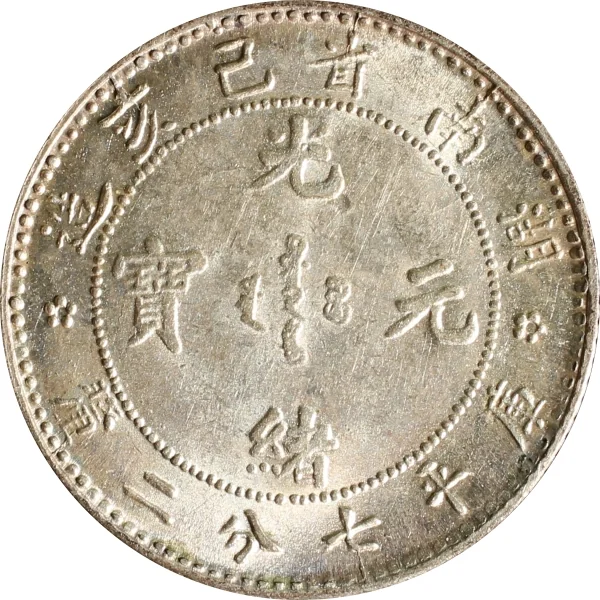
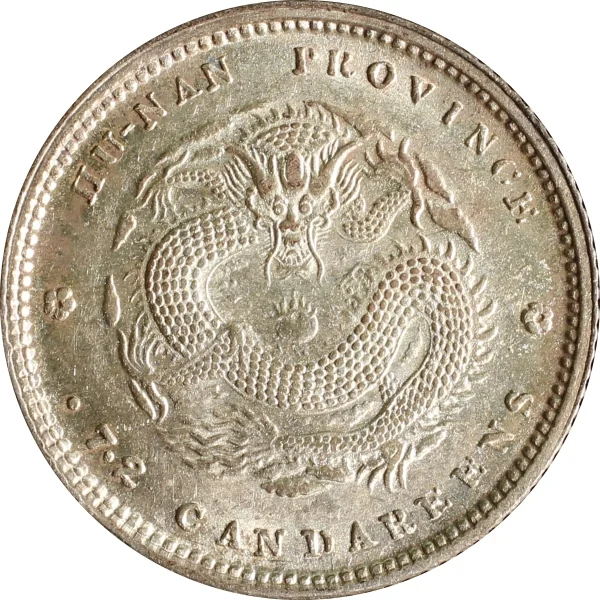
10 Fen – Hunan Province
China
Context
Years: 1898–1899
Country: China 
Issuer: Hunan Province
Ruler: Guangxu
Currency:
(1897—1949)
Demonetized: Yes
Material
References
Y: #Click to copy to clipboard115.1
Numista: #296766
Value
Bullion value: $5.91
Obverse
Description:
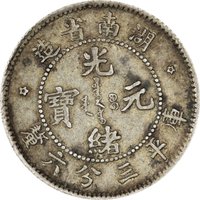
Chinese ideograms read vertically, right to left, with Manchu text in the center, all encircled by more Chinese characters.
Inscription:
造亥己省南湖
光
ᠪᠠᡩᠠᡵᠠᠩᡤᠠ
寶 ᠶᡠᠸᠠᠨ ᠪᠣᠣ 元
ᡩᠣᡵᠣ
緒
釐二分七平庫
光
ᠪᠠᡩᠠᡵᠠᠩᡤᠠ
寶 ᠶᡠᠸᠠᠨ ᠪᠣᠣ 元
ᡩᠣᡵᠣ
緒
釐二分七平庫
Translation:
Made in the Southern Lake of Jihai Province
Guangxu
Badarangga
Yuan Bao
Doro
7 Fen 2 Li, Pingku Standard
Guangxu
Badarangga
Yuan Bao
Doro
7 Fen 2 Li, Pingku Standard
Scripts: Chinese, Mongolian / Manchu
Reverse
Description:
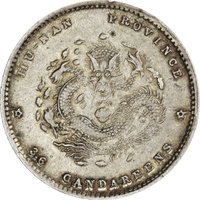
Dragon encircling a pearl, surrounded by English text.
Inscription:
HU-NAN PROVINCE
7.2 CANDAREENS
7.2 CANDAREENS
Script: Latin
Edge
Reeded.
Categories
| Mythology> Fantastic animal |
Mintings
| Year | Mint Mark | Mintage | Quality | Collection |
|---|---|---|---|---|
| 1898 | — | — | ||
| 1899 | — | — |
Historical background
In 1898, the currency situation in Hunan Province was one of profound complexity and instability, reflecting the broader monetary disintegration of the late Qing Dynasty. The province operated within a chaotic multi-currency system, where official silver taels (yuanbao), foreign-minted silver dollars (notably Mexican Eagle Dollars), and a vast array of privately issued cash coins (tongbao) circulated simultaneously. The lack of a standardized provincial mint meant exchange rates between these mediums—silver by weight, silver by coin, and copper-alloy cash—fluctuated wildly based on purity, locale, and merchant agreement, crippling commerce and tax collection.
This monetary disorder was exacerbated by severe copper cash inflation. To finance local needs, Hunan's authorities and private merchants excessively cast low-quality, debased copper coins, leading to a dramatic devaluation. Meanwhile, the scarcity of silver, due to both foreign trade imbalances and hoarding, created a widening gap between the silver tael and copper cash. This "silver famine" (yinhuang) placed an immense burden on the peasantry, who earned income in depreciating copper but often had to pay taxes and debts reckoned in more valuable silver, deepening social discontent.
The crisis in 1898 was not merely economic but also political, occurring within the tumultuous context of the Hundred Days' Reform. Reformers at the national level, recognizing that monetary chaos like Hunan's weakened the state, advocated for a unified national silver currency. While these radical reforms would soon be crushed by conservative forces, the situation in Hunan highlighted the urgent need for modernization. The province's currency turmoil thus stood as a microcosm of the Qing Empire's failing fiscal governance, contributing to the revolutionary ferment that would eventually culminate in the dynasty's collapse.
This monetary disorder was exacerbated by severe copper cash inflation. To finance local needs, Hunan's authorities and private merchants excessively cast low-quality, debased copper coins, leading to a dramatic devaluation. Meanwhile, the scarcity of silver, due to both foreign trade imbalances and hoarding, created a widening gap between the silver tael and copper cash. This "silver famine" (yinhuang) placed an immense burden on the peasantry, who earned income in depreciating copper but often had to pay taxes and debts reckoned in more valuable silver, deepening social discontent.
The crisis in 1898 was not merely economic but also political, occurring within the tumultuous context of the Hundred Days' Reform. Reformers at the national level, recognizing that monetary chaos like Hunan's weakened the state, advocated for a unified national silver currency. While these radical reforms would soon be crushed by conservative forces, the situation in Hunan highlighted the urgent need for modernization. The province's currency turmoil thus stood as a microcosm of the Qing Empire's failing fiscal governance, contributing to the revolutionary ferment that would eventually culminate in the dynasty's collapse.
💎 Extremely Rare