

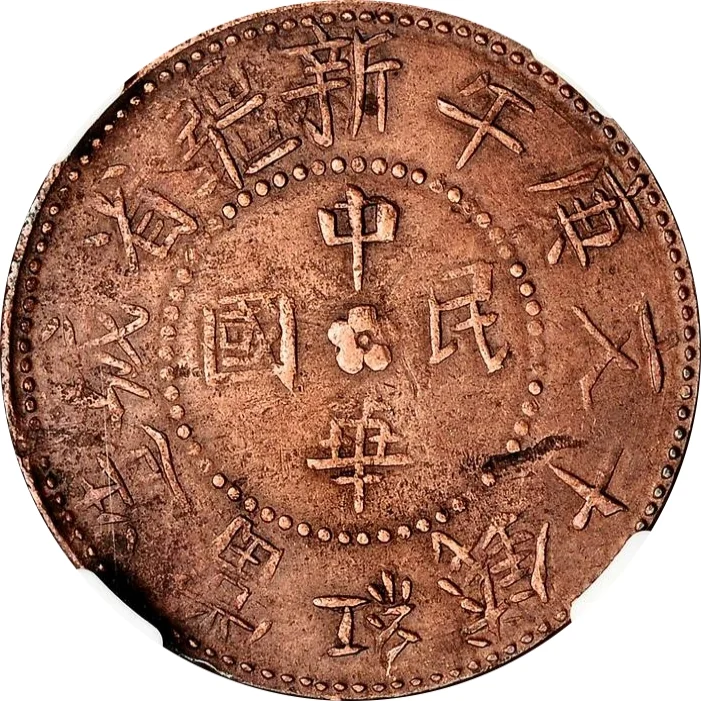
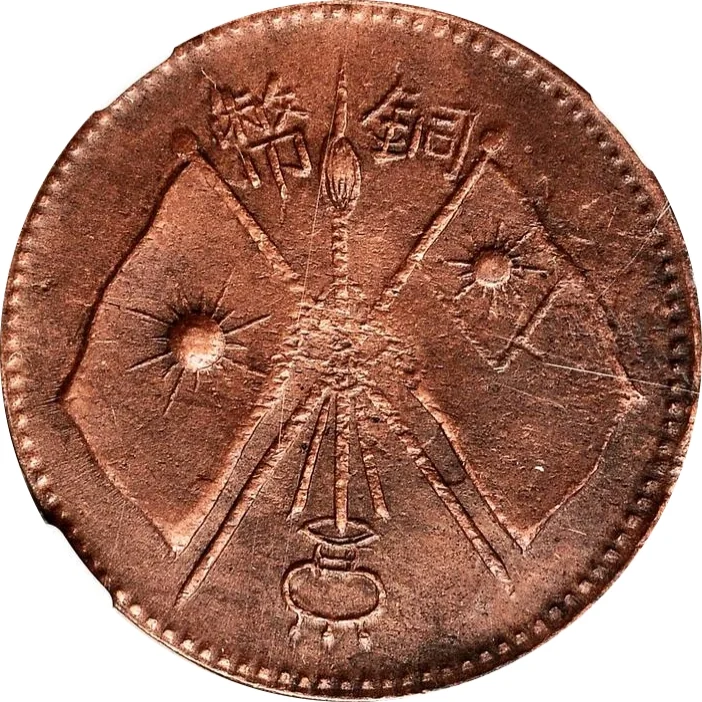
10 cash – Sinkiang Province
Add to wishlist
China
Context
Year: 1930
Country: China
Issuer: Sinkiang Province
Period:
(1912—1949)
Currency:
(1939—1949)
Demonetized: Yes
Material
References
Y: #
Numista: #296540
Obverse
Description:
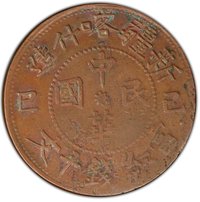
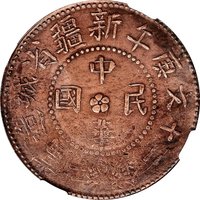
Four Chinese ideograms arranged vertically around a central flower, surrounded by additional characters.
Inscription:
造城省疆新午庚文十錢紅當
中
國民
華
中
國民
華
Translation:
Board of Works mint coin, Xinwu year, Kangxi tenth issue, red cash, value ten.
Script: Chinese
Language: Classical Chinese
Reverse
Edge
Mintings
| Year | Mint Mark | Mintage | Quality | Collection |
|---|---|---|---|---|
| 1930 | — | — |
Historical background
During the early 1930s, the currency situation in Sinkiang (Xinjiang) Province was characterized by extreme fragmentation and instability, mirroring the region's political turmoil. The province was under the nominal but tenuous control of Governor Jin Shuren, who succeeded the warlord Yang Zengxin in 1928. Jin's administration, facing severe financial strain from military expenditures and corruption, resorted to issuing vast quantities of unbacked paper currency. This provincial currency, printed on cheap paper and known as Xinjiang piao, rapidly depreciated, leading to severe inflation that crippled the local economy and eroded public trust.
The monetary landscape was further complicated by the circulation of multiple competing currencies. Alongside the devalued provincial notes, traditional silver sycees (ingots) and Mexican silver dollars remained in use, particularly for significant transactions and in border trade. In southern oases like Kashgar, local Muslim authorities and merchants issued their own tangas (silver coins) and paper notes, creating isolated monetary zones. Furthermore, Soviet rubles and gold tsarist-era coins circulated prominently, especially in the Ili region, reflecting Sinkiang's growing economic dependence on the Soviet Union for trade and aid.
This chaotic currency environment exacerbated the province's social crises, contributing to the widespread discontent that fueled major rebellions in 1931, including the Kumul Uprising. The inability to establish a unified, trustworthy medium of exchange stifled commerce, facilitated exploitation, and underscored the Jin administration's failure to provide basic economic governance. The situation would only begin to stabilize later in the decade under Jin's successor, Sheng Shicai, who further integrated Sinkiang's economy with the Soviet Union, introducing a new, Soviet-supported provincial currency in 1939.
The monetary landscape was further complicated by the circulation of multiple competing currencies. Alongside the devalued provincial notes, traditional silver sycees (ingots) and Mexican silver dollars remained in use, particularly for significant transactions and in border trade. In southern oases like Kashgar, local Muslim authorities and merchants issued their own tangas (silver coins) and paper notes, creating isolated monetary zones. Furthermore, Soviet rubles and gold tsarist-era coins circulated prominently, especially in the Ili region, reflecting Sinkiang's growing economic dependence on the Soviet Union for trade and aid.
This chaotic currency environment exacerbated the province's social crises, contributing to the widespread discontent that fueled major rebellions in 1931, including the Kumul Uprising. The inability to establish a unified, trustworthy medium of exchange stifled commerce, facilitated exploitation, and underscored the Jin administration's failure to provide basic economic governance. The situation would only begin to stabilize later in the decade under Jin's successor, Sheng Shicai, who further integrated Sinkiang's economy with the Soviet Union, introducing a new, Soviet-supported provincial currency in 1939.
✨ Legendary