

5 Yuan – Taiwan
China
Context
Material
References
Y: #Click to copy to clipboard548
Numista: #2962
Value
Exchange value: 5 TWD
Obverse
Description:
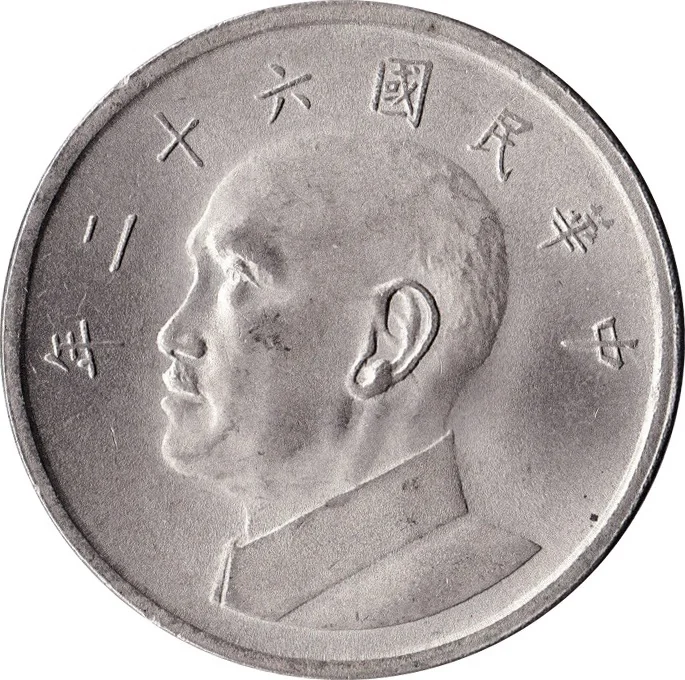
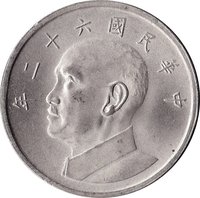
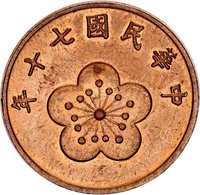
Chiang Kai-shek bust, left profile.
Inscription:
年二十六國民华中
Translation:
Twenty-sixth Year of the Republic of China
Scripts: Chinese (traditional, regular script)
Language: Chinese
Reverse
Description:
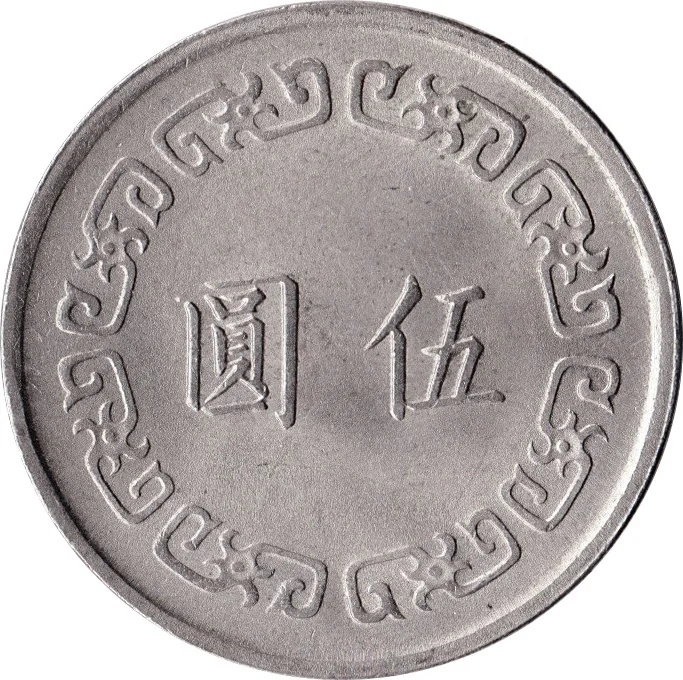
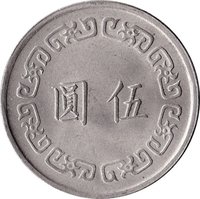
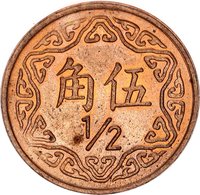
Centered denomination
Inscription:
圓 伍
Translation:
Yuan Five
Scripts: Chinese (traditional, regular script)
Language: Chinese
Edge
Reeded
Categories
| Person> Politician |
Mints
| Name | Mark |
|---|---|
| Central Mint of Taiwan | — |
| United States Mint of Philadelphia | — |
Mintings
| Year | Mint Mark | Mintage | Quality | Collection |
|---|---|---|---|---|
| 1970 | — | 12,360,000 | ||
| 1971 | — | 20,575,000 | ||
| 1972 | — | 27,998,000 | ||
| 1973 | — | 50,122,000 | ||
| 1974 | — | 418,068,000 | ||
| 1975 | — | 39,520,000 | ||
| 1976 | — | 140,000,000 | ||
| 1977 | — | 50,260,000 | ||
| 1978 | — | 78,082,000 | ||
| 1979 | — | — |
Historical background
In 1970, Taiwan's currency situation was characterized by stability and controlled growth under the authoritarian governance of the Kuomintang (KMT). The New Taiwan Dollar (NTD), issued by the Central Bank of China (which had re-established operations in Taipei in 1961), was firmly pegged to the US Dollar at a fixed rate of NT$40 to US$1. This peg provided a crucial anchor for confidence, both domestically and for foreign investors, supporting Taiwan's export-oriented industrialization strategy known as the "Taiwan Miracle."
Economically, this period followed a successful fiscal stabilization program in the late 1950s that had curbed hyperinflation. By 1970, Taiwan was experiencing rapid economic expansion, fueled by light industry and manufacturing exports. The fixed exchange rate facilitated predictable trade and investment flows, helping Taiwan accumulate foreign exchange reserves. Price stability was maintained, with inflation kept at a modest level, allowing for planned economic development under a series of multi-year plans directed by the government.
Politically, the currency system reflected the KMT's claim to be the legitimate government of all China, with banknotes still bearing the name "Central Bank of China." The stability of the NTD stood in stark contrast to the economic turmoil of the mainland's Cultural Revolution, a point of propaganda and pride for the Taipei authorities. This financial solidity, managed by technocrats within a single-party state, underpinned both economic success and the regime's political legitimacy during a period of intense diplomatic isolation, as international recognition began to shift toward the People's Republic of China.
Economically, this period followed a successful fiscal stabilization program in the late 1950s that had curbed hyperinflation. By 1970, Taiwan was experiencing rapid economic expansion, fueled by light industry and manufacturing exports. The fixed exchange rate facilitated predictable trade and investment flows, helping Taiwan accumulate foreign exchange reserves. Price stability was maintained, with inflation kept at a modest level, allowing for planned economic development under a series of multi-year plans directed by the government.
Politically, the currency system reflected the KMT's claim to be the legitimate government of all China, with banknotes still bearing the name "Central Bank of China." The stability of the NTD stood in stark contrast to the economic turmoil of the mainland's Cultural Revolution, a point of propaganda and pride for the Taipei authorities. This financial solidity, managed by technocrats within a single-party state, underpinned both economic success and the regime's political legitimacy during a period of intense diplomatic isolation, as international recognition began to shift toward the People's Republic of China.
🌱 Very Common