

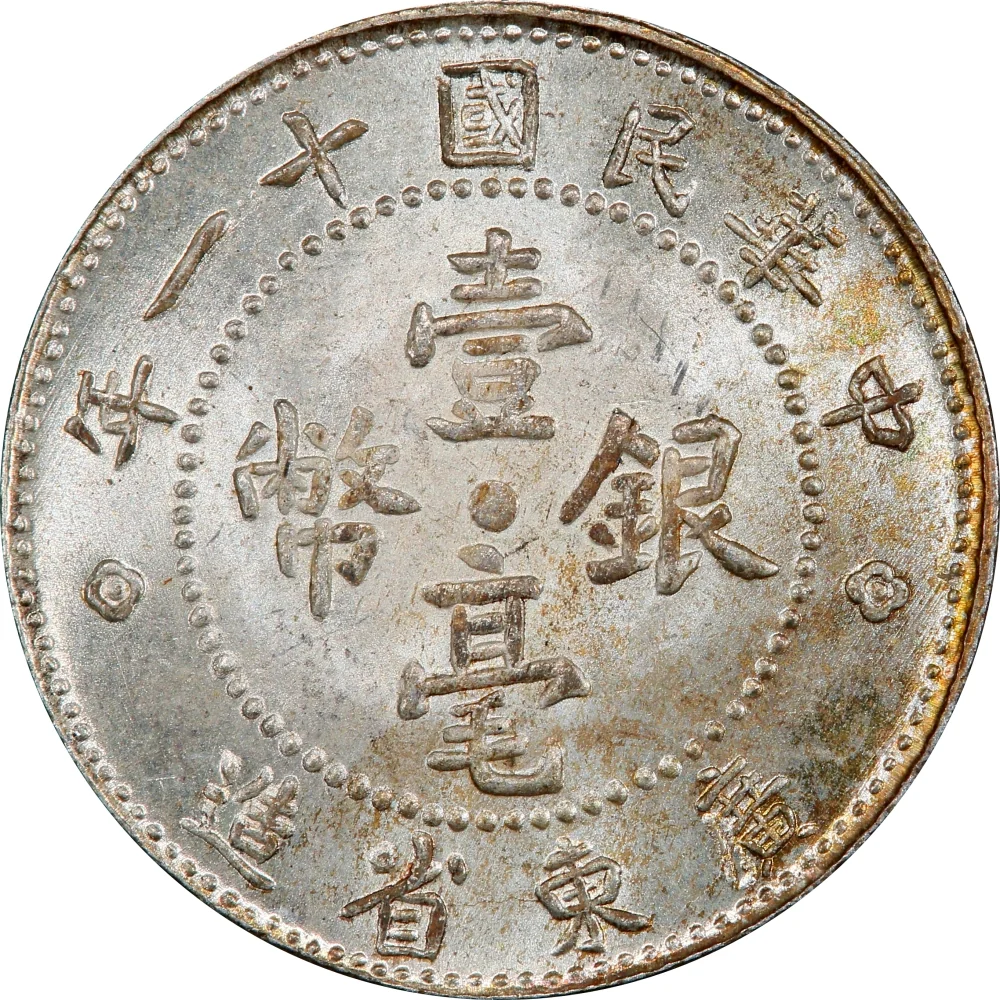
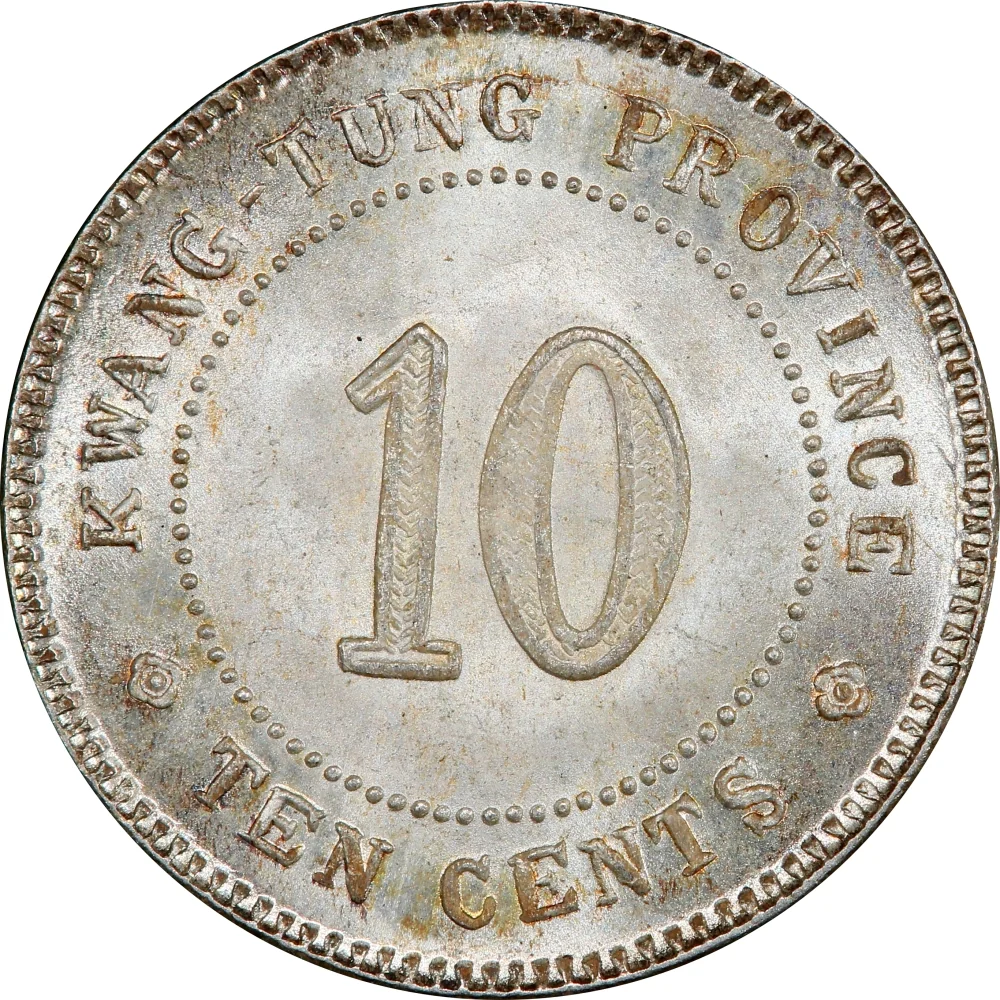
1 Jiao – Kwangtung Province
China
Context
Years: 1913–1922
Country: China 
Issuer: Kwangtung Province
Period:
(1912—1949)
Currency:
(1900—1949)
Subdivision: 1 Jiao = 10 Cents
Demonetized: Yes
Total mintage: 8,798,000
Material
References
Y: #Click to copy to clipboard422
Numista: #28945
Value
Bullion value: $7.57
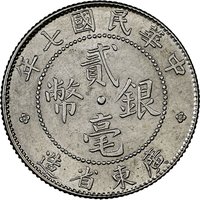
Obverse
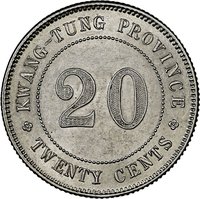
Reverse
Edge
Reeded.
Mintings
| Year | Mint Mark | Mintage | Quality | Collection |
|---|---|---|---|---|
| 1913 | — | 8,798,000 | ||
| 1914 | — | — | ||
| 1922 | — | — |
Historical background
In 1913, Kwangtung (Guangdong) Province existed in a state of monetary complexity and instability, characteristic of the early Republican period following the 1911 Revolution. The province was nominally under the authority of the new Beiyang government in Beijing, but in practice, it was a power base for Sun Yat-sen's Kuomintang (Nationalist Party), creating a tense political duality. This fragmentation was mirrored in its currency system, where no single authority had full control. The primary unit was the silver dollar, notably the Mexican "eagle" dollar and the Chinese "dragon" dollar, but their value fluctuated with the global silver market. Crucially, a vast array of local banknotes, issued by native banks (qianzhuang), military governors, and commercial enterprises, circulated at variable and often depreciated exchange rates, leading to widespread confusion and frequent merchant disputes.
The situation was further complicated by the pervasive use of the Guangdong tael, a unit of account for silver bullion, which differed in value from the Shanghai tael and other regional standards. While coinage and notes were used for daily transactions, larger commercial and tax dealings were often calculated in this imaginary tael, requiring conversion and facilitating profiteering. This period also saw the continued circulation of old imperial copper cash coins, alongside a flood of debased and privately minted copper "small cash," which eroded the purchasing power of the common populace. The provincial authority attempted to impose order, but its efforts were undermined by fiscal weakness, the need to finance military forces, and a lack of centralized minting and regulatory power.
Consequently, the monetary landscape of Kwangtung in 1913 was one of layered chaos, serving as a tangible reflection of the province's political disunity. The coexistence of foreign and domestic silver coins, multiple units of account, and a unreliable patchwork of paper credit created significant obstacles to trade and economic development. This instability would persist and even intensify in the following years, as Kwangtung became a center of revolutionary activity against Yuan Shikai's regime, leading to further emissions of military scrip and a deepening of the monetary crisis well into the Warlord Era.
The situation was further complicated by the pervasive use of the Guangdong tael, a unit of account for silver bullion, which differed in value from the Shanghai tael and other regional standards. While coinage and notes were used for daily transactions, larger commercial and tax dealings were often calculated in this imaginary tael, requiring conversion and facilitating profiteering. This period also saw the continued circulation of old imperial copper cash coins, alongside a flood of debased and privately minted copper "small cash," which eroded the purchasing power of the common populace. The provincial authority attempted to impose order, but its efforts were undermined by fiscal weakness, the need to finance military forces, and a lack of centralized minting and regulatory power.
Consequently, the monetary landscape of Kwangtung in 1913 was one of layered chaos, serving as a tangible reflection of the province's political disunity. The coexistence of foreign and domestic silver coins, multiple units of account, and a unreliable patchwork of paper credit created significant obstacles to trade and economic development. This instability would persist and even intensify in the following years, as Kwangtung became a center of revolutionary activity against Yuan Shikai's regime, leading to further emissions of military scrip and a deepening of the monetary crisis well into the Warlord Era.
⭐ Rare