

10 Cash – Kiangsi Province
China
Context
Year: 1911
Country: China 
Issuer: Kiangsi Province
Period:
(1911—1912)
Currency:
(1902—1949)
Demonetized: Yes
References
Y: #Click to copy to clipboard411
Numista: #287783
Obverse
Description:
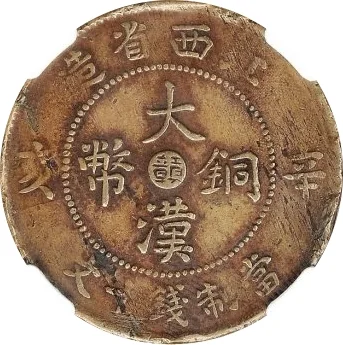
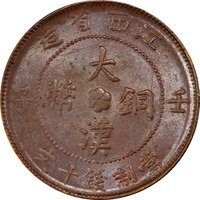
Four Chinese characters read vertically, right to left, with a central mintmark, encircled by more characters.
Inscription:
造省西江
亥辛
大
幣贛銅
漢
文十錢制當
亥辛
大
幣贛銅
漢
文十錢制當
Translation:
Made in Jiangxi Province
Xinhai Year
Great
Copper Coin of Jiangxi
Han
Ten-Cash, Equal to Standard Coin
Xinhai Year
Great
Copper Coin of Jiangxi
Han
Ten-Cash, Equal to Standard Coin
Language: Classical Chinese
Reverse
Description:
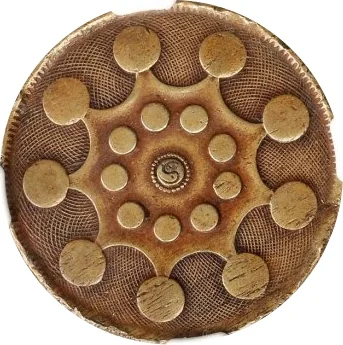
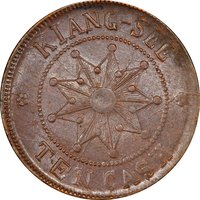
Yin-yang inside an eight-pointed star with dots, over a wavy background.
Edge
Mintings
| Year | Mint Mark | Mintage | Quality | Collection |
|---|---|---|---|---|
| 1911 | — | — |
Historical background
In 1911, Kiangsi (Jiangxi) Province, like much of China, operated within a complex and fragmented monetary system on the eve of the Xinhai Revolution. The official currency was the silver tael, a unit of weight rather than a coin, leading to countless local variants and exchange rates. Alongside this, foreign silver dollars, particularly Mexican "Eagle" dollars and later British trade dollars, circulated widely in treaty ports like Jiujiang, valued for their standardized weight and reliability. The provincial economy also relied heavily on copper cash coins (tongyuan) for everyday small transactions, creating a bimetallic system prone to fluctuation and manipulation.
This monetary landscape was further complicated by the proliferation of paper notes. Official "Dragon Notes" were issued by the Imperial Bank of China and the Bank of Communications, but their acceptance was limited. More impactful locally were the vast quantities of private banknotes (zhuangpiao) issued by native banks (qianzhuang) and merchant guilds. While facilitating commerce, these notes were only as trustworthy as the issuing entity, leading to frequent defaults and losses for holders, especially peasants. The Qing state’s inability to impose a unified currency created a precarious environment of financial uncertainty.
The outbreak of the revolution in October 1911 exacerbated this instability. As the Qing authority collapsed in Kiangsi, the new revolutionary government faced immediate fiscal crisis. To fund military and administrative costs, it resorted to issuing its own provincial currency, a practice mirrored across China. This sudden injection of unbacked paper money, combined with the lingering distrust of older notes and the hoarding of silver, accelerated inflationary pressures. Thus, by the end of 1911, Kiangsi’s currency situation had transitioned from fragmented imperial complexity to revolutionary-era disorder, setting the stage for the severe monetary challenges of the early Republic.
This monetary landscape was further complicated by the proliferation of paper notes. Official "Dragon Notes" were issued by the Imperial Bank of China and the Bank of Communications, but their acceptance was limited. More impactful locally were the vast quantities of private banknotes (zhuangpiao) issued by native banks (qianzhuang) and merchant guilds. While facilitating commerce, these notes were only as trustworthy as the issuing entity, leading to frequent defaults and losses for holders, especially peasants. The Qing state’s inability to impose a unified currency created a precarious environment of financial uncertainty.
The outbreak of the revolution in October 1911 exacerbated this instability. As the Qing authority collapsed in Kiangsi, the new revolutionary government faced immediate fiscal crisis. To fund military and administrative costs, it resorted to issuing its own provincial currency, a practice mirrored across China. This sudden injection of unbacked paper money, combined with the lingering distrust of older notes and the hoarding of silver, accelerated inflationary pressures. Thus, by the end of 1911, Kiangsi’s currency situation had transitioned from fragmented imperial complexity to revolutionary-era disorder, setting the stage for the severe monetary challenges of the early Republic.
✨ Legendary